#LLM model comparison
1426 related articles
·3 min
Serving Markdown Content Directly to AI Agents via Accept Headers
How HTTP Accept header content negotiation can serve Markdown to AI Agents and LLM crawlers, reducing token costs and improving information extraction efficiency.
Read more →
·3 min
Qwen VLM Takes on Where's Waldo: Exposing the Achilles' Heel of Fine-Grained Visual Localization
Qwen 3.6 VLM takes on Where's Waldo, revealing vision-language models' weaknesses in fine-grained target localization in dense scenes. Analysis of resolution limits, visual grounding gaps, and future directions.
Read more →
·2 min
Ollama Cloud Pro Unusual Usage Depletion: In-Depth Analysis of DeepSeek's Sudden Usage Spike
Ollama Cloud Pro users report DeepSeek model usage spiking suddenly, hitting limits within an hour. We analyze token billing, model versioning, and billing weight changes, plus offer optimization tips.
Read more →

·3 min
Run Multiple Open-Source OCR Models via a Unified API: 100K Pages for Just $60
VLM.run wraps open-source OCR models like DeepSeek-OCR-2, GLM-OCR, and dots.mocr into a unified OpenAI-compatible API. Parse 100K pages for just $60 with JSON output and MCP server support.
Read more →
·3 min
The Alignment Tax: AI Safety Guardrails Are Consuming 35% of Your Compute Budget
Analysis of the hidden "alignment tax" in commercial AI: safety guardrails consume 25-35% of compute budgets through token overhead, false refusals, and model drift. Self-hosted open models offer an alternative.
Read more →

·3 min
Ornith 1.5 35B Hands-On: Q4 vs Q8 Quantization Comparison — Which One Is Worth Running?
In-depth comparison of Ornith 1.5 35B-A3B Q4KM vs Q8 quantization across browser OS, FPS games, 3D modeling and more, helping consumer hardware users choose the right version.
Read more →

·3 min
Hands-On with AGY + Gemini Flash: Impressive Speed, But Trust Remains the Biggest Weakness
A developer switched to AGY with Gemini Flash after exhausting Codex and Claude Code quotas. The iteration speed impressed, but trust in Gemini remains critically low. Analysis of speed vs. trust in AI tools.
Read more →

·3 min
Creating McKinsey-Level PPTs with AI: 8 Golden Rules for Consulting Slides
Master 8 core McKinsey-style PPT rules including Pyramid Principle, action titles, and MECE, combined with AI tools to efficiently create professional consulting-grade presentations.
Read more →

·2 min
DeepSeek API Pricing Adjustments Explained: A New Option for Developer Cost Optimization
In-depth analysis of DeepSeek's latest API pricing strategy, covering context caching, price comparisons with GPT-4 and Claude, the LLM API price war, and developer recommendations.
Read more →

·2 min
ProgramBench: An AI Evaluation Benchmark for Reverse-Engineering Program Logic from Runnable Binaries
ProgramBench is a novel AI coding benchmark that requires models to reverse-engineer source code logic from runnable binaries, testing deep reasoning beyond standard code generation.
Read more →

·2 min
Gemini 3.7 Flash Deep Dive: Major Upgrades in Coding, Debugging, and Agent Capabilities
Deep dive into Google Gemini 3.7 Flash: enhanced coding and debugging, more stable multi-step agent execution, and high-fidelity design-to-code generation for developers.
Read more →

·4 min
How Generative AI Can Meet Innovation Requirements for R&D Tax Credits
Exploring how generative AI applications can build certifiable technical innovation at the algorithm and interface levels to meet R&D tax credit eligibility requirements.
Read more →

·3 min
Same Prompt Fed to 11 AI Models — Why Did They Produce 11 Different Answers?
Testing the same prompt across GPT, Claude, Gemini, and 11 LLMs reveals vastly different results. Learn why models differ and how to build multi-model evaluation and routing strategies.
Read more →

·3 min
The Small Model RAG Trap: Why Retrieval Quality Becomes a Make-or-Break Factor
After migrating from GPT-4 to open-source small models, RAG retrieval quality issues are dramatically amplified. Learn production-grade strategies including hybrid retrieval, reranking, and corrective retrieval.
Read more →

·3 min
Can the RTX 3050 Handle Machine Learning? Is 6GB VRAM Enough?
Detailed analysis of whether the RTX 3050 6GB GPU with Intel Core Ultra 5 210H can meet machine learning beginner needs, evaluating VRAM limits and cloud alternatives.
Read more →

·4 min
Memory Storage for AI Agents: Vector Database vs. Plain Files — How to Choose
Analyzing vector databases vs. plain text files for AI agent memory systems, with decision signals and a hybrid architecture where files are authoritative and indexes are rebuildable.
Read more →
·3 min
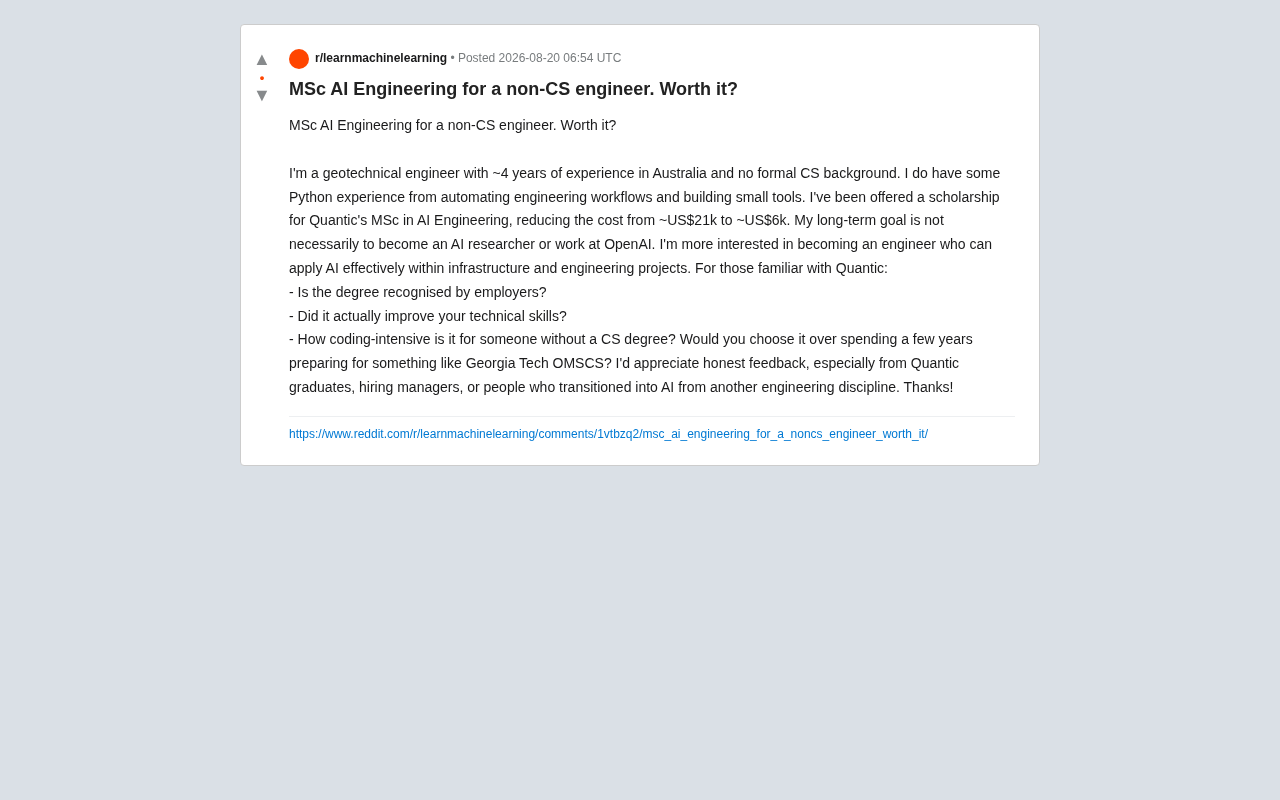
Is an AI Master's Worth It for Non-CS Engineers? Quantic vs OMSCS Deep Comparison
Should non-CS engineers pursue an AI master's? Deep comparison of Quantic AI Engineering vs Georgia Tech OMSCS, analyzing degree recognition, programming barriers, and ROI for traditional engineers transitioning to AI.
Read more →

·2 min
Cursor Models Getting Slower? Developer Community Performance Concerns and Optimization Guide
Cursor users report slower AI assistant responses and declining output quality. Analysis of model upgrade latency, server load impacts, and practical optimization tips.
Read more →

·4 min
DiffusionGemma Explained: How Diffusion Models Make LLMs 5x Faster
Deep dive into Google DeepMind's DiffusionGemma diffusion language model: how parallel denoising achieves 1,500 tokens/sec—5x faster than autoregressive models—while maintaining quality. Covers training pipeline, adaptive stopping, and open-source applications.
Read more →

·2 min
Screen Memory Without Screenshots: A Lightweight Text-to-Markdown Approach
Explore a new screen memory approach that skips screenshots: extracting screen text directly to Markdown for better storage efficiency, privacy, and AI retrieval.
Read more →