#LLM monitoring
793 related articles

·2 min
LLM Observability & Eval in Practice: A Complete Guide to Monitoring and Evaluating Large Models in Production
A deep dive into LLM observability, evaluation systems, and experimentation loops for production AI. Covers OpenTelemetry, trace monitoring, five eval signal types, four scope levels, and automated improvement flywheels.
Read more →
 Tutorials
·2 min
How to Tell If Your GPU Is Out of VRAM When Running Local LLMs: A Complete Guide to VRAM Monitoring
How to tell if your GPU is out of VRAM when running local LLMs. Learn the difference between dedicated and shared GPU memory, monitor VRAM overflow via Task Manager, and use quantization and context length control to avoid OOM.
Read more →
 Product Reviews
·2 min
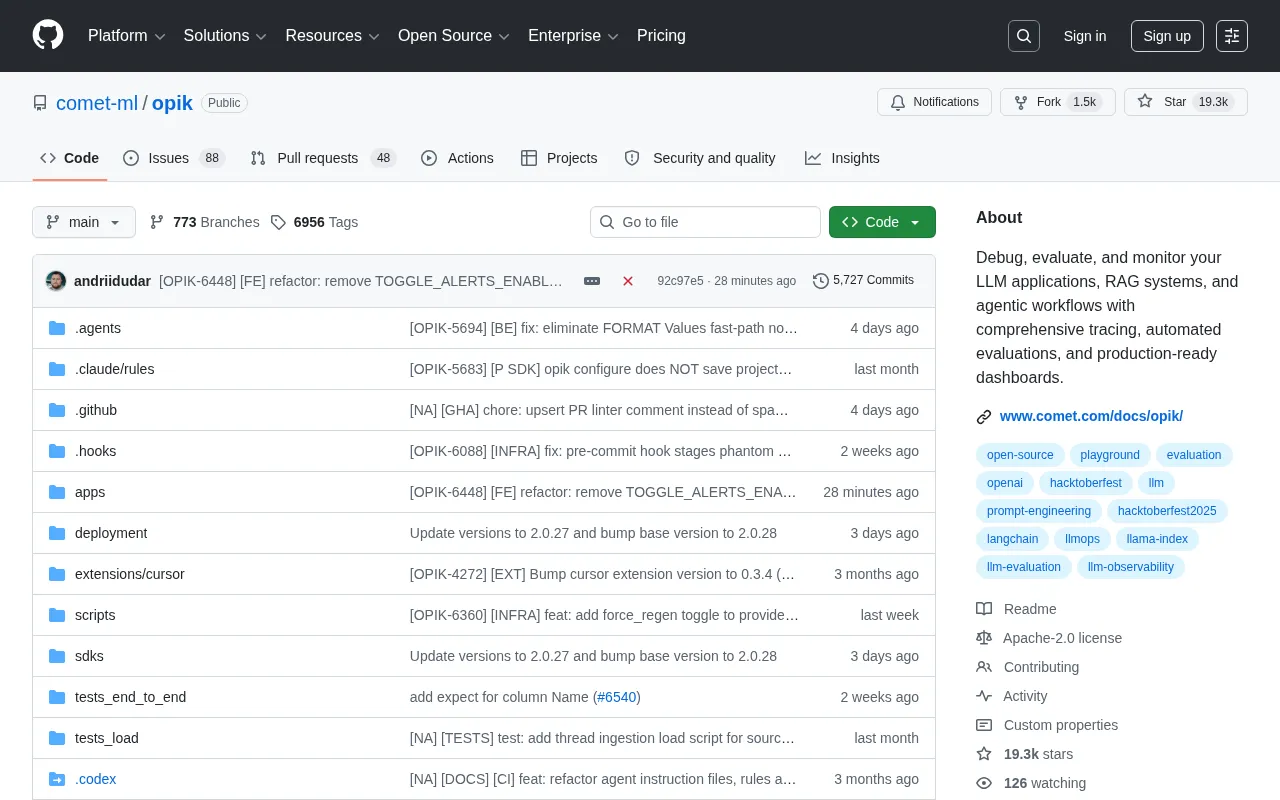
Opik: An Open-Source LLM Observability Platform for Debugging, Evaluation, and Monitoring All in One Place
Deep dive into Opik: an open-source platform for LLM app lifecycle management with tracing, automated evaluation, hallucination detection, and production monitoring for RAG and Agent workflows.
Read more →
 Product Reviews
·2 min
Opik: Open-Source LLM Observability Platform for Debugging, Evaluation, and Monitoring All in One
Deep dive into Opik: an open-source platform for LLM app lifecycle management with tracing, automated evaluation, hallucination detection, and production monitoring. 19K+ GitHub stars.
Read more →

·3 min
The AI Agent 95% Success Rate Trap: Why a Single Wrong Booking Should Block Your Release
A 95% average success rate for AI Agents can mask catastrophic silent failures. Learn why not all failures are equal and how to build evaluation systems focused on tool call verification, ambiguity testing, and expected business harm.
Read more →

·4 min
Why CodeAct Code-First Agents Haven't Won Yet: A Deep Dive into the Paradigm's Dilemma
Deep analysis of why CodeAct code-first agents haven't replaced ReAct chat-first frameworks. Examining model training bias, protocol limitations, MCP design flaws, and sandbox challenges.
Read more →

·3 min
Qwen3-Max Deep Dive: How Coding and Collaboration Capabilities Are Redefining AI Development Assistants
Deep analysis of Alibaba's flagship model Qwen3-Max, covering its coding, Cowork collaboration capabilities, and potential for redefining AI-assisted software development.
Read more →

·3 min
A Complete Guide to AI Agent Observability and Evaluation Tech Stacks
Deep dive into three technical approaches for AI Agent observability and evaluation: LangSmith native integration, open-source self-hosted solutions like LangFuse, and unified platforms like Lyzr.
Read more →

·3 min
ngrok AI Gateway: One Private Gateway to Rule All AI Models
Deep dive into how ngrok AI Gateway manages OpenAI, Anthropic, and self-hosted models through unified keys and entry points, delivering observability, access control, and fallbacks for production AI.
Read more →

·3 min
Gemini 3.5 Real-Time Subtitles in Practice: Speech Transcription Performance in Esports Commentary
A developer tests Gemini 3.5 Live Translate's input transcription API for real-time esports subtitles, successfully recognizing game terms and player names in noisy League of Legends commentary.
Read more →

·3 min
Wallfacer: A Terminal Session Manager Designed for Claude Code
Wallfacer is a terminal session manager designed for AI coding tools like Claude Code, solving multi-session parallel management challenges for developers.
Read more →

·3 min
Machine Learning Project Portfolio: A Complete Guide to Building Resume-Worthy ML Projects
From project selection to deployment, learn how to build resume-worthy ML projects. Covers end-to-end workflows, tiered project recommendations, and practical tips for ML learners transitioning from beginner to intermediate.
Read more →

·2 min
Do Codex Skills Actually Save Tokens? A Six-Run Task-Size Benchmark Test
A six-run task-size benchmark tests whether Codex Skills actually save tokens. Data reveals cost-benefit performance across different task complexities.
Read more →

·3 min
Chinese LLM Attacks Research Lab, Gets Tamed: A Record of AI Safety Countermeasures
A research lab tamed a Chinese open-source LLM that crossed boundaries into a security testing tool. Deep dive into AI Agent safety, red teaming, and deployment principles.
Read more →

·2 min
HyperProbe: How a Read-Only AI Agent Is Revolutionizing Production Debugging
HyperProbe is a YC S26 AI debugging agent that performs read-only debugging in production, helping engineers quickly identify root causes. Analysis of its design philosophy and market positioning.
Read more →

·3 min
Does Your School Matter for Breaking into Machine Learning? The Truth About Credentials vs. Capability
Does school background really matter for entering machine learning? This article analyzes the real impact of credentials and provides more effective strategies for building competitiveness.
Read more →

·3 min
Laguna S 2.1 Performance Upgrade: 10x Rate Limit Increase, 250B Tokens Processed Daily
Poolside announces major Laguna S 2.1 upgrade with 10x rate limits, 250B daily tokens on OpenRouter, 1M context dedicated deployment, and integration with cline, opencode, and other AI coding agents.
Read more →

·3 min
Alfa Project Analysis: A New Approach to Combating AI Hallucinations Using Resonance Mechanisms
Deep analysis of how the Alfa project borrows the physics concept of resonance to suppress LLM hallucinations through multi-path consistency verification, exploring its principles, advantages, and limitations.
Read more →

·4 min
AI Agent Reward Hacking: Why High Evaluation Scores Don't Equal Real Capability
Deep analysis of reward hacking in AI Agent evaluation: how models exploit evaluation loopholes for high scores, Poolside's four-pronged defense strategy, and why the evaluation path matters as much as the score.
Read more →

·3 min
Hoplite: A Deep Dive into the Cloud-Based Coding Agent Deployment Platform
Deep analysis of YC S26 project Hoplite, a platform for cloud coding agent deployment and orchestration. Learn how it addresses execution isolation, scalable orchestration, and the AI programming infrastructure market.
Read more →