#MCP orchestration
376 related articles

·2 min
Poolside Desktop Assistant Launch: A New AI Coding Paradigm That Decouples Models from Interfaces
Poolside launches Desktop Assistant, advocating decoupling AI coding tool interfaces from underlying models and execution harnesses. Analysis of how this architecture grants developers model choice freedom.
Read more →

·3 min
Harness Engineering: The Key Technique for Unlocking Hidden AI Agent Capabilities
Explore how harness engineering dramatically improves AI Agent performance. From the Codex case study, learn how tool orchestration, context management, and execution environments become the core competitive battleground.
Read more →

·4 min
AI Engineer Growth Roadmap: From Programming Fundamentals to RAG and MCP Agent Development
A systematic AI engineer learning roadmap covering programming, math, ML, and data engineering foundations, plus frontier AI technologies like LLM, RAG, Agents, and MCP with free open-source resources.
Read more →

·3 min
MCP Session Analytics: Building Production-Grade Observability and Evaluation for AI Agents
How to build product analytics and evaluation capabilities for AI Agents at the MCP protocol layer, covering session-level tracing, tool call observability, and quality Evals.
Read more →

·2 min
Tempest Open-Source Tool: Reduces Token Consumption by 64% for Parallel AI Coding Agents
Tempest is an open-source developer tool that reduces token consumption by up to 64% for parallel AI coding agents through shared code understanding and isolated workspaces.
Read more →

·4 min
Liminal: A Shared Team Second Brain Workspace for Humans and AI Agents
Liminal is a shared workspace designed for human-AI Agent collaboration, auto-rendering Markdown and HTML into visual interfaces with real-time sync and team collaboration.
Read more →

·3 min
HeyZoku: Command Multiple AI Coding Agents to Work Together Using Your Voice
HeyZoku is a Mac voice-first agentic dev environment that runs 10 coding agents simultaneously. Command Claude, Codex, and Cursor by name with on-device voice recognition and one-time pricing.
Read more →

·3 min
HeyZoku: Command Multiple AI Coding Agents to Work Together Using Your Voice
HeyZoku is a Mac voice-first agentic dev environment that runs 10 coding agents simultaneously. Command Claude, Codex, and Cursor by name with on-device voice recognition and one-time pricing.
Read more →

·2 min
Agenta: A Detailed Look at the Open-Source Self-Hosted Claude Cowork Alternative
Agenta is an open-source AI Agent collaboration platform supporting self-hosted models and any Agent framework, positioned as an open-source Claude Cowork alternative.
Read more →

·3 min
Gemini Managed Agents API Update: Environment Hooks and Free Tier Fully Explained
Google Gemini Managed Agents API introduces environment hooks, model selection, free tier support, and default model upgrades—empowering AI Agent developers with stronger execution control and lower barriers to entry.
Read more →

·4 min
Getting Started with Claude Code: Environment Setup, Common Commands, and Git Workflow in Practice
A detailed guide to Claude Code installation, domestic model switching, project analysis commands, and Git workflow practice to help developers quickly master this AI programming collaboration tool.
Read more →
·4 min
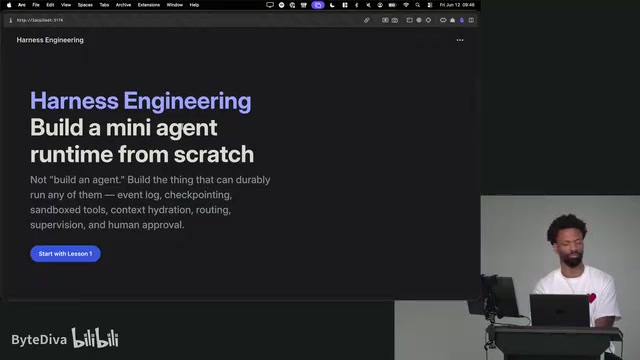
Harness Engineering: The Core Infrastructure for Taking AI Agents from Demo to Production
Deep dive into Harness Engineering: why AI Agents need memory management, durable execution, guardrails & approvals to go from demo to production.
Read more →

·4 min
Harness Engineering: The Core Infrastructure for Taking AI Agents from Demo to Production
Deep dive into Harness Engineering: why AI Agents need memory management, durable execution, guardrails & approvals to reach production. Based on Scott Moss's workshop.
Read more →

·5 min
Opus 5 Builds a No Man's Sky-Style Exploration Game in One Day: MCP and Sub-Agent Architecture Explained
A developer used Anthropic's Opus 5 model to build a No Man's Sky-style space exploration game in one day using Blender MCP and sub-agents. Deep dive into the technical architecture and industry implications.
Read more →

·4 min
LangChain Guardrails Explained: Building Safe and Controllable AI Agents
A detailed guide to LangChain Guardrails covering layered ecosystem architecture, middleware implementation, deterministic and model-driven protection for building production-grade secure AI Agents.
Read more →

·5 min
Learn AI Agent Development from Scratch: A 3-Step Practical Path to Get Started Quickly
How to learn AI Agent development from scratch? This article outlines a clear 3-step path: Python crash course, LLM theory & practice, and LangChain framework project implementation.
Read more →

·3 min
How to Choose an AI Agent Platform for Your Team: 5 Evaluation Dimensions and a Decision Framework
Choose the right AI Agent platform by evaluating model flexibility, observability, tool integration, security compliance, and total cost. A complete decision framework to help technical leaders avoid vendor lock-in.
Read more →

·3 min
How to Choose an AI Agent Platform for Your Team: 5 Evaluation Dimensions & Decision Framework
Choose an AI Agent platform by evaluating model flexibility, observability, tool integration, security compliance, and total cost. A complete decision framework to avoid vendor lock-in.
Read more →

·4 min
WebMCP in Practice: How MakeMyTrip Is Reshaping the Travel Booking Experience
India's largest OTA platform MakeMyTrip uses WebMCP to standardize AI Agent interactions with web apps, replacing fragile DOM scraping with natural language-driven test automation and simplified complex booking scenarios.
Read more →

·4 min
WebMCP in Practice: How MakeMyTrip Is Reshaping the Travel Booking Experience
India's largest OTA platform MakeMyTrip uses WebMCP to standardize AI Agent interaction with web apps, solving DOM scraping fragility, enabling natural language test automation, and simplifying complex international flight bookings.
Read more →