#OpenClaw Full mode
104 related articles

·2 min
Memmy Agent: Cross-Platform AI Memory Sharing Tool, A Local-First Personal Memory Hub
Memmy Agent is a local-first open-source AI memory hub enabling cross-platform memory sharing across Claude Code, Codex, and more. Free 2M tokens included.
Read more →

·2 min
Memmy Agent: A Cross-Platform AI Memory Sharing Tool and Local-First Personal Memory Hub
Memmy Agent is a local-first, open-source AI memory hub enabling cross-platform memory sharing across Claude Code, Codex, and more. Free 2M token tier included.
Read more →

·4 min
Complete Guide to Pi Coding Agent: Core Usage and Extension Techniques for a Minimalist Terminal AI Coding Tool
Complete guide to Pi coding agent: design philosophy, installation, shortcuts, session management, and 7-layer customization architecture. How this 45K-star minimalist terminal tool redefines AI coding workflows.
Read more →

·2 min
Comparing Three Self-Hosted AI Agents: How to Choose Between OpenClaw, Odysseus, and Hermes
An in-depth comparison of three leading self-hosted AI agents: OpenClaw, Odysseus, and Hermes. From positioning to core features and security risks, find the right tool for your needs.
Read more →

·2 min
Deep Dive into the OpenClaw Multi-Agent Framework: From Dify Workflows to Autonomous AI Execution
An in-depth analysis of the OpenClaw multi-agent framework: its TypeScript single-process gateway design, inter-agent scheduling, advantages over Dify workflows, and the three evolutions of AI execution.
Read more →

·3 min
Enterprise Long-Running Agent Engineering: A Complete Guide from Demo to Production
A deep dive into enterprise Agent engineering: long-running execution, HITL safety approvals, and event sourcing — with two real-world commercial projects for content ops and SRE.
Read more →

·7 min
Enterprise AI Agent Security Isolation and Memory Design: NanoClaw Founder Breaks Down Real-World Lessons
NanoClaw founder David Boyd breaks down the core engineering of enterprise autonomous Agents: a triple security isolation model, LLM Wiki memory design, and the real-world path from personal Agents to team-scale deployment.
Read more →
AstrBot: A Deep Dive into the Multi-Pl…
·2 min
AstrBot: A Deep Dive into the Multi-Platform AI Agent Development Framework
AstrBot is an open-source AI Agent framework supporting WeChat, QQ, Telegram and more, with multi-LLM compatibility and plugin extensibility. Full technical breakdown inside.
Read more →

·3 min
Opal: A Designer Built an AI Pet Assistant on Raspberry Pi Using OpenClaw
Microsoft designer Tua Nguyen built Opal, an AI rabbit assistant on Raspberry Pi using OpenClaw — capable of browsing the web, finding recipes, and operating GitHub.
Read more →

·2 min
How Designers Can Thrive in the AI Era: Build Fun, Hands-On Agents
AI agents are reshaping what designers do. A senior designer shares why understanding agent infrastructure is essential and how to learn by building fun projects.
Read more →

·3 min
OpenClaw Multi-Agent AI Programming Workflow in Practice: From Coder to Manager
Deep dive into OpenClaw multi-agent AI programming workflows: context layering, CMUX parallel terminal management, work trees, and manager-perspective debiasing for scalable AI dev automation.
Read more →

·3 min
AI Agent Home Server Selection Guide: Low-Cost OpenClaw Deployment in Practice
Discover why AI Agents burn through API budgets fast, and how to deploy OpenClaw on a home server using Ollama, DeepSeek, and Gemini in a cost-effective hybrid setup.
Read more →

·6 min
A Deep Dive into OpenAI Codex: How AI Engineers Are Reimagining Software Development with Agents
OpenAI Codex is redefining how AI engineers work: from code completion to autonomous Agents, from single-threaded to parallel Value Maxing. A deep dive into the Codex App architecture, open ecosystem, and Manager of Agents practice.
Read more →

·3 min
Getting Started with Agent Skills: Structure, Principles, and Practical Usage
A deep dive into Agent Skills: learn the file structure (SKILL.md, references, scripts, assets), core principles, and how they differ from prompts. Build your own AI skill bundle from scratch.
Read more →

·3 min
Langchain.js Agent Development: A Guide to Deconstructing the OpenClaw Engine Architecture
An in-depth analysis of AI agent development based on Langchain.js—comparing workflow agents and Agent Loops, deconstructing the TypeScript implementation path of an OpenClaw-like engine, covering structured output, MCP, and LangGraph.
Read more →

·5 min
The Complete Guide to Building an AI-Powered Second Brain with Obsidian + Hermes Agent
An in-depth guide to building an AI-driven second brain with Obsidian + Hermes Agent. Covers living files, VPS deployment, core memory mechanisms, and skill visualization.
Read more →
·7 min
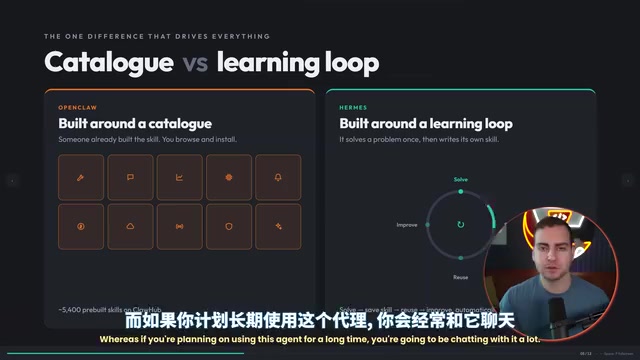
OpenClaw vs Hermes: An In-Depth Comparison and Selection Guide for AI Agent Tools
An in-depth comparison of OpenClaw and Hermes Agent, covering skill management, memory mechanisms, security, and gateway configuration to help you find the right AI agent solution.
Read more →

·5 min
A Deep Dive into Cloud Coding Agents: How Users in China Can Choose Wisely
What exactly is the Cloud Coding Agent Silicon Valley is hyping? This article breaks down the core concept across three axes—where it runs, who watches, where tasks start—and gives users in China practical advice on local alternatives.
Read more →

·4 min
9 Proven Methods to Make Hermes Agent Actually Work for You
9 battle-tested methods from hundreds of hours with Hermes Agent: model selection (Opus/ChatGPT/GLM), multi-agent failover, cross-device coordination via Tailscale, and reverse prompting workflows.
Read more →

·3 min
OpenClaw Local Deployment Guide: Free Access to Claude Opus 4.5 and Building an Autonomous AI Assistant
Step-by-step OpenClaw local deployment guide: use Claude Opus 4.5 for free via Google Anti-Gravity, set up Telegram remote control, and test autonomous Agent capabilities including web search and plugin auto-install.
Read more →