#Python vector index
287 related articles
·4 min
Building an LLM Wiki with Agents: Let AI Automatically Manage Your Knowledge Base
A deep dive into the LLM Wiki: how Agents auto-build indexes and bidirectional links to solve slow, Token-heavy retrieval in growing knowledge bases. Full breakdown of its three-layer structure.
Read more →

·5 min
GPT-5.6 In-Depth Field Test: A Real-World Log After Burning Through $200K
A developer stress-tested GPT-5.6 for six weeks across 67 projects, burning $180K-$240K in inference. Real cases of task persistence, Rust rewrites, autonomous browser control — plus honest frontend and 3D shortfalls.
Read more →
·4 min
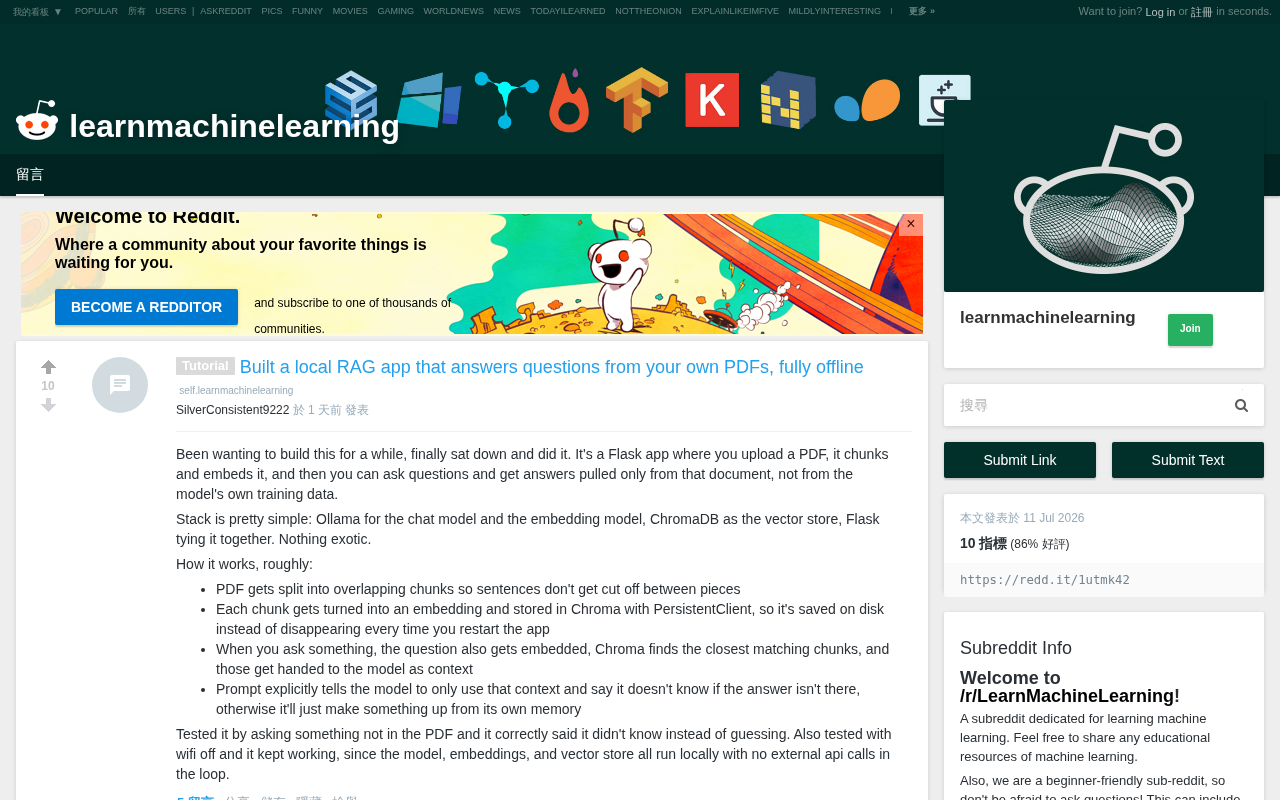
Building an Offline RAG Application from Scratch: A Complete Guide to a Private PDF Knowledge Base
A step-by-step breakdown of building a local RAG app: Ollama local models + ChromaDB vector database + Flask, enabling PDF document Q&A, fully offline operation, and zero data leakage. Perfect for developers new to RAG.
Read more →

·4 min
From Engineer to Machine Learning Practitioner: A Practical Roadmap from Data Compliance to Deployment
Have an engineering or data background and want to transition to machine learning? This article covers data anonymization compliance essentials, knowledge base tech route selection (RAG/traditional ML/BI), and a phased practical learning path.
Read more →

·5 min
Multi-Model Tiered Deployment: Is an AI Gateway Worth Adopting?
More teams are adopting multi-model tiered scheduling. AI gateways solve cross-vendor API management, automatic fallback, and cost tracking — but add a new abstraction layer. Learn when a gateway is worth it.
Read more →

·4 min
AI Agents Powering the Full Research Pipeline: A Practical Guide to Automation from Topic Selection to Publication
Learn how to use AI Agents to link the entire research pipeline—from literature management, data analysis, and paper writing to scientific illustration and dissemination—building a reusable research automation workflow with NotebookLM, N8N, and Ollama.
Read more →

·4 min
Four Major LangChain Updates: OpenWiki, Voice Agents, and Sub-Agent Orchestration Explained
LangChain releases four major updates: OpenWiki for auto-generating codebase docs, voice agent tutorials, Harbor evaluation integration, and deepagents programmable sub-agents.
Read more →

·6 min
AI Agent Development in Go: A Hands-On Guide to ByteDance's Eino Framework and Its Seven Core Capabilities
Build production-grade AI Agents with a pure Go stack using ByteDance's Eino framework. A deep dive into seven core capabilities: multi-Agent orchestration, long-task execution, command approval, RAG, MCP, Skills, and database reporting.
Read more →

·5 min
Getting Started with LangChain: LLM Invocation, Agent Practice, and Environment Setup Guide
Starting from the three limitations of LLMs, this guide systematically explains LangChain's core positioning, environment setup, API key prep, model init, and the message system. Learn init_chat_model and AIMessage/HumanMessage/SystemMessage.
Read more →

·7 min
Complete Guide to Installing and Deploying Claude Code: Configure Your AI Coding Tool from Scratch
A detailed walkthrough of the full Claude Code installation process: environment setup, npm installation, proxy configuration for networks in China, API integration, and CC Switch provider management—helping beginners quickly get started with this AI coding tool.
Read more →

·4 min
4 Skills to Completely Transform Claude Code: Say Goodbye to Token Waste and Cut Daily Coding to 2 Hours
Does Claude Code always give irrelevant answers? This article breaks down 4 core Skill plugins: Project Context Engine, PRD Requirements Translator, Code Review tool, and Daily Report Generator—showing you how to transform Claude Code from a money-burner into a true AI coding assistant.
Read more →

·4 min
Tencent Open-Sources Agent Memory: A Fully Local AI Long-Term Memory Solution with Zero External Dependencies
Tencent Cloud open-sources TencentDB Agent Memory — a fully local AI Agent memory system with a 4-tier progressive pipeline, zero external API dependencies, and 8,100+ GitHub Stars. Ideal for finance, healthcare, and privacy-sensitive use cases.
Read more →

·2 min
VR Teleoperation Robotics: A Practical Guide to Swapping Left/Right Controller Data and Aligning Coordinate Systems
How to programmatically swap left/right controller mappings in MuJoCo when using Pico 4 Ultra and XRoboToolkit for VR robot teleoperation, including coordinate frame alignment and quaternion mirroring.
Read more →

·3 min
GPT-5 Is Here — Is Learning Java Still Worth It? How Programmers Can Pivot in the AI Era
Is learning Java still worth it after GPT-5? Explore why programming fundamentals still matter and how to pivot toward AI application development in the AI era.
Read more →

·4 min
Electrical Engineer to AI Engineer: A Real Story and Practical Transition Roadmap
A 6-year electrical engineer from Brazil weighs transitioning to AI engineering. This deep-dive covers the stability vs. freedom tradeoff, transition advantages, and a practical roadmap for engineers with similar backgrounds.
Read more →

·3 min
Microsoft SQL Major Upgrade: AI Capabilities, Security Enhancements, and Fabric Integration — A Deep Dive
Microsoft SQL team's major updates: Azure SQL adds AI embeddings and dynamic data masking, Fabric SQL gets a Migration Assistant and Fabric Apps, SQL Server CU5 brings memory improvements, SSMS adds a SQL Formatter and Agent mode, and DP-800 certification is now open.
Read more →

·6 min
GPT-5.6 Fully Available: A Deep Dive into the Sol/Terra/Luna Three-Tier Models and Four-Agent Parallelism
GPT-5.6 is now officially available to all users, launching the three-tier Sol, Terra, and Luna models with four-agent parallelism. An in-depth look at the official benchmarks, API pricing, safety, and Ultra mode.
Read more →

·7 min
Getting Started with AI Agents: A Deep Dive into the Perception-Decision-Action Loop
A clear, in-depth guide to how AI Agents work: the paradigm shift from traditional programs, the perception-decision-action loop, and the four pillars—LLMs, tool calling, memory, and RAG.
Read more →

·4 min
AI Agent Development Deep Dive: Opportunities, Real Entry Barriers, and Learning Paths
A deep dive into AI Agent development: real architecture, entry barriers, and learning paths. From ReAct to multi-agent systems and LangChain — cut through the hype.
Read more →

·3 min
AI Application Development Learning Roadmap: From Agents and RAG to Real-World Career Success
Want to break into AI application development? This guide covers the full learning path — from Agents and RAG to Prompt Engineering — helping you master LLM engineering skills and land the job.
Read more →