#Qdrant
128 related articles
·7 min
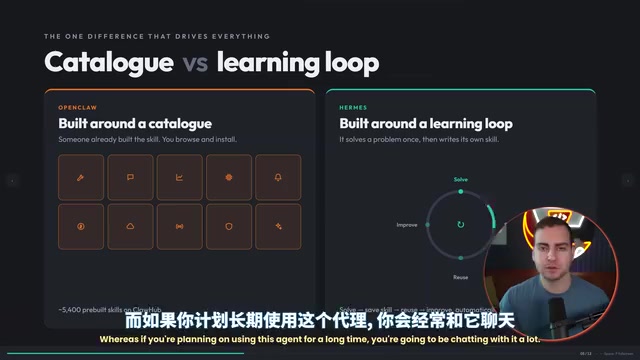
OpenClaw vs Hermes: An In-Depth Comparison and Selection Guide for AI Agent Tools
An in-depth comparison of OpenClaw and Hermes Agent, covering skill management, memory mechanisms, security, and gateway configuration to help you find the right AI agent solution.
Read more →

·4 min
433 Fitness Exercises Open-Source Dataset: Structured Fields + Animation Demos Fully Explained
GitHub trending project exercises-dataset features 433 fitness exercises with target muscles, equipment types, instructions, and animation demos—ideal for fitness apps, AI coaches, and RAG systems.
Read more →

·4 min
AI Persistent Memory Three-Layer Architecture Explained: In-Depth Comparison of Mem0, Zep, and ContextNest
Deep dive into the three-layer architecture of AI persistent memory systems—storage, management, and retrieval—with an in-depth comparison of Mem0, Zep, and ContextNest to help developers choose the right memory solution for AI Agents.
Read more →

·5 min
From Large Models to AI Agents: A Complete Analysis of the Four Evolutionary Stages and Four Major Commercial Tracks
Prompt engineering and RAG can no longer meet enterprise digital transformation needs—AI Agents are the key. This article breaks down the four evolutionary stages of large model deployment and the four major Agent commercial tracks.
Read more →

·4 min
Dify Getting Started: A Complete Guide to Building AI Workflows Without Code
A complete guide to Dify's core features and 1.8.0 deployment. Covers 5 app types, Docker setup, Workflow vs Chatflow differences, and RAG knowledge bases for beginners.
Read more →

·5 min
MemoryOps AI: Building a Governable, Auditable Memory Layer for AI Assistants
MemoryOps AI is an open-source governed memory runtime that gives AI assistants policy-before-storage validation, context admission, and deletion-proof lineage—solving compliance, multi-tenancy, and deletion verification challenges in LLM memory systems.
Read more →

·6 min
Zuckerberg Says AI Will Run Your Entire Business — But Data Ownership Risks Can't Be Ignored
Meta launched an enterprise AI agent, with Zuckerberg claiming it can "run your entire business." This article explores the commercial value of AI agents, the hidden risks of data ownership, and how different businesses can balance efficiency with data sovereignty.
Read more →

·6 min
Vibe Coding in Practice at Big Tech: How Frontend Engineers Can Avoid Being Replaced in the AI Era
A big-tech interviewer reveals: junior/mid frontend dev is being replaced by AI. This article breaks down 3 core Vibe Coding interview questions to help you master key skills for the AI-assisted coding era.
Read more →

·2 min
GBrain Local Deployment Guide: An AI Knowledge Engine That Outperforms Traditional RAG by 31%
GBrain is an open-source AI knowledge base supporting full local offline deployment. Its 12-step retrieval pipeline and knowledge graph boost accuracy 31% over traditional RAG.
Read more →

·6 min
Dify Local Deployment in Practice: A Complete Guide to Building an AI Application Platform with Docker
A complete guide to Dify local deployment: from Docker environment setup, source code pulling, and container startup to first access. Build a private AI app development platform across Linux, Windows, and Mac for fast enterprise AI deployment.
Read more →

·7 min
Previewing the AI Engineer Summit: Industry Signals of AI Engineering Reaching Maturity
An exclusive look at the AI Engineer Summit dress rehearsals, decoding the paradigm shift from research to production. A deep dive into AI Engineer challenges, RAG, agent systems, and AI engineering as a distinct discipline.
Read more →

·7 min
Dify Enterprise System Integration in Practice: Building a Project Management AI Copilot with Workflows
Using a project management system as an example, this article details how to use the Dify low-code platform to achieve AI-powered integration of enterprise internal systems through interface capture and workflow orchestration.
Read more →

·7 min
Dify 1.8.0 in Practice: A Complete Guide to Building Enterprise-Grade AI Workflows with Zero Code
An in-depth walkthrough of deploying Dify 1.8.0 and building applications: three-step Docker deployment, five app types compared, and Workflow vs Chatflow use cases—build enterprise AI apps with zero code.
Read more →
·6 min
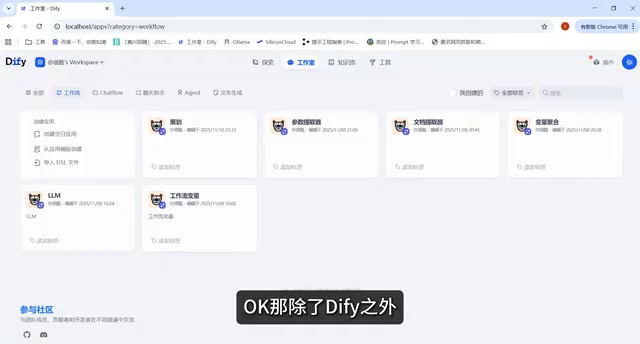
Complete Guide to Deploying Dify Locally: Docker + Ollama + RAG Setup Tutorial
A detailed guide to deploying the Dify agent platform locally: from Docker setup and integrating Ollama + DeepSeek local LLMs to workflow orchestration and RAG knowledge base construction.
Read more →

·7 min
Getting Started with Dify: A Complete Guide from Local Deployment to Building Enterprise-Grade AI Applications
A detailed guide to Dify, the open-source LLM app development platform, covering its core features and full local deployment via VMware + Ubuntu + aaPanel + Docker. Supports 100+ models like DeepSeek and ChatGPT to build enterprise AI apps fast.
Read more →

·6 min
Getting Started with Dify: A Complete Guide to Deployment, Configuration, and Workflow Practice
A systematic guide to Dify's three deployment methods (Docker/source/online), five application types, and hands-on workflow nodes—covering LLM integration, MySQL config, and app publishing.
Read more →

·7 min
Getting Started with LangChain: The Core Framework Connecting LLMs and AI Applications
A deep dive into LangChain's positioning and value—why do LLMs need a middle layer? How does LangChain serve as the 'glue' unifying multi-model interfaces and supporting Agent development? Learn its core modules and learning path.
Read more →

·7 min
A Java Developer's Guide to AI: Framework Selection and Practical Tutorial for LangChain4J
As LLM costs keep falling, how can Java developers seize the AI opportunity? This article explores LangChain4J's core capabilities, supported models and vector databases, and compares LangChain4J vs. Spring AI to help you build local knowledge bases and intelligent customer service systems.
Read more →

·7 min
The Trap of AI Visibility Dashboards: Why Most Metrics Are Meaningless
Can a brand's "visibility" in AI answers really be quantified? This article deeply dissects the methodological flaws of AI visibility dashboards—from LLM output randomness and black-box mechanisms to vanity metric traps.
Read more →
·7 min
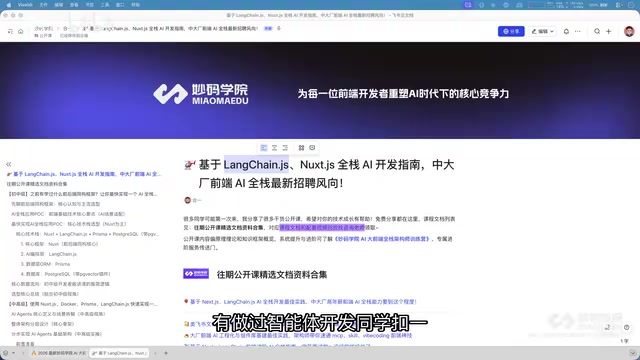
LangChain.js + Nuxt.js: An AI Full-Stack Advancement Path for Frontend Engineers
Frontend hiring now treats AI capabilities as a core assessment, covering RAG knowledge bases, AI Agent development, and LangChain.js engineering. Learn how LangChain.js + Nuxt.js helps frontend developers build memory- and retrieval-capable AI full-stack apps.
Read more →