#RTX 4090 AI
177 related articles

·2 min
MiniMax H3 Local AI Video Generation: Deployment Methods, Hardware Requirements & Hands-On Analysis
In-depth analysis of MiniMax H3 local video generation capabilities, exploring hardware requirements, advantages, challenges, and the trend of AI video moving from cloud to local deployment.
Read more →

·3 min
Dual RTX 3060 Running DeepSeek V4 Flash: IQ2_M Quantized Inference Benchmarked at 3.5 tok/s
Benchmarking DeepSeek V4 Flash on dual RTX 3060 GPUs with 96GB RAM at IQ2_M quantization achieving 3.5 tokens/sec. Covers hardware choices, 2-bit quantization techniques, and local LLM deployment optimization.
Read more →

·2 min
LTX 2.3 + ComfyUI Local Video Generation Hands-On: A New Open-Source AI Video Option
A deep dive into the LTX 2.3 + ComfyUI combo for local AI video generation, covering deployment advantages, VRAM requirements, community ecosystem, and real-world output quality assessment.
Read more →

·2 min
DeepSeek V4 Flash Weights Open-Sourced: A New Option for Lightweight LLM Deployment
DeepSeek V4 Flash model weights reportedly open-sourced. This article analyzes its lightweight positioning, open-weight value, comparisons with closed-source models, and deployment guidance.
Read more →

·2 min
Running Kimi K3 with 29GB of RAM: The Trade-offs and Costs of Extreme Quantization
Running Kimi K3 with 29GB RAM at just 0.5 tok/s. An in-depth analysis of extreme quantization techniques, performance trade-offs, and the impossible triangle of local LLM deployment.
Read more →

·2 min
Running Kimi K3 in 29GB of RAM: The Trade-offs and Costs of Extreme Quantization
Running Kimi K3 with 29GB RAM at just 0.5 tok/s. A deep analysis of extreme quantization techniques, performance trade-offs, and the impossible triangle of local LLM deployment.
Read more →

·3 min
No Python Required: A Unified Multimodal Local AI Generation CLI Tool
A CLI tool that enables local text, image, video, music, and 3D generation without Python. Explore its technical approach, advantages, limitations, and the growing trend of local AI tooling.
Read more →

·3 min
No Python Required: A Unified Multimodal Local AI Generation CLI Tool
A CLI tool requiring no Python that supports local text, image, video, music, and 3D generation. Explore its technical approach, advantages, limitations, and the growing trend of local AI toolification.
Read more →

·3 min
LLM Inference Speed Formula: Memory Bandwidth Determines Your tokens/sec
Learn why memory bandwidth (GB/s)—not VRAM size—determines local LLM inference speed. Get the tokens/sec formula, GPU bandwidth comparisons, and a practical card selection hierarchy.
Read more →

·3 min
LLM Inference Speed Formula: Memory Bandwidth Determines Your tokens/sec
Why memory bandwidth (GB/s), not VRAM size, determines local LLM inference speed. Includes tokens/sec formula, GPU bandwidth comparison, and a practical card selection framework.
Read more →

·2 min
SenseNova-Vision Training Data Pipeline Explained: A Guide to Fine-Tuning Unified Vision Models
SenseNova-Vision adds a complete training data pipeline with dataset registration, format converters, and end-to-end docs, making unified vision model fine-tuning for segmentation, OCR, and editing far more accessible.
Read more →

·3 min
Local LLM Agent Lagging? Lowering num_gpu Is the Key
Local LLM crashing in Agent frameworks? The issue may be num_gpu set too high. Learn what num_gpu really controls (GPU layer offloading, not GPU count) and how to tune it for stable Agent performance.
Read more →

·2 min
HuggingFace Open-Source Voice Assistant: A Complete Guide to Local Deployment
A deep dive into HuggingFace's speech-to-speech open-source project, covering its modular VAD, STT, LLM, and TTS pipeline architecture and the advantages of local deployment for privacy, cost, and latency.
Read more →
·3 min
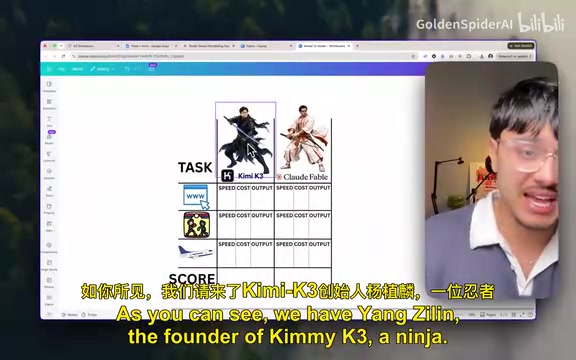
Kimi K3 vs Claude Real-World Test: Near-Equal Performance at 1/8 the Price
Real-world comparison of Kimi K3 vs Claude flagship across e-commerce pages, 3D fighting games, and flight simulators. Kimi K3 delivers 90% output quality at 1/8 the price with faster speeds and local deployment support.
Read more →

·3 min
Kimi K3 Reaches 2.5T Parameters, MiniMax M3 Pro Brewing Simultaneously: China's LLM Arms Race Escalates
Kimi K3 adopts new architecture with 2.5T parameters and 1M token context. MiniMax M3 Pro targets 2.7-3T. OpenAI surpasses 7M users, HY-OCR 1.5 achieves SOTA, Amap launches world model.
Read more →

·3 min
A 9B Model Beats Frontier LLMs After Just $500 in RL Fine-Tuning
Just $500 in RL fine-tuning enables a 9B open-source model to outperform frontier LLMs on catalog review tasks. Analysis of when small-model RL works and its enterprise implications.
Read more →
·3 min
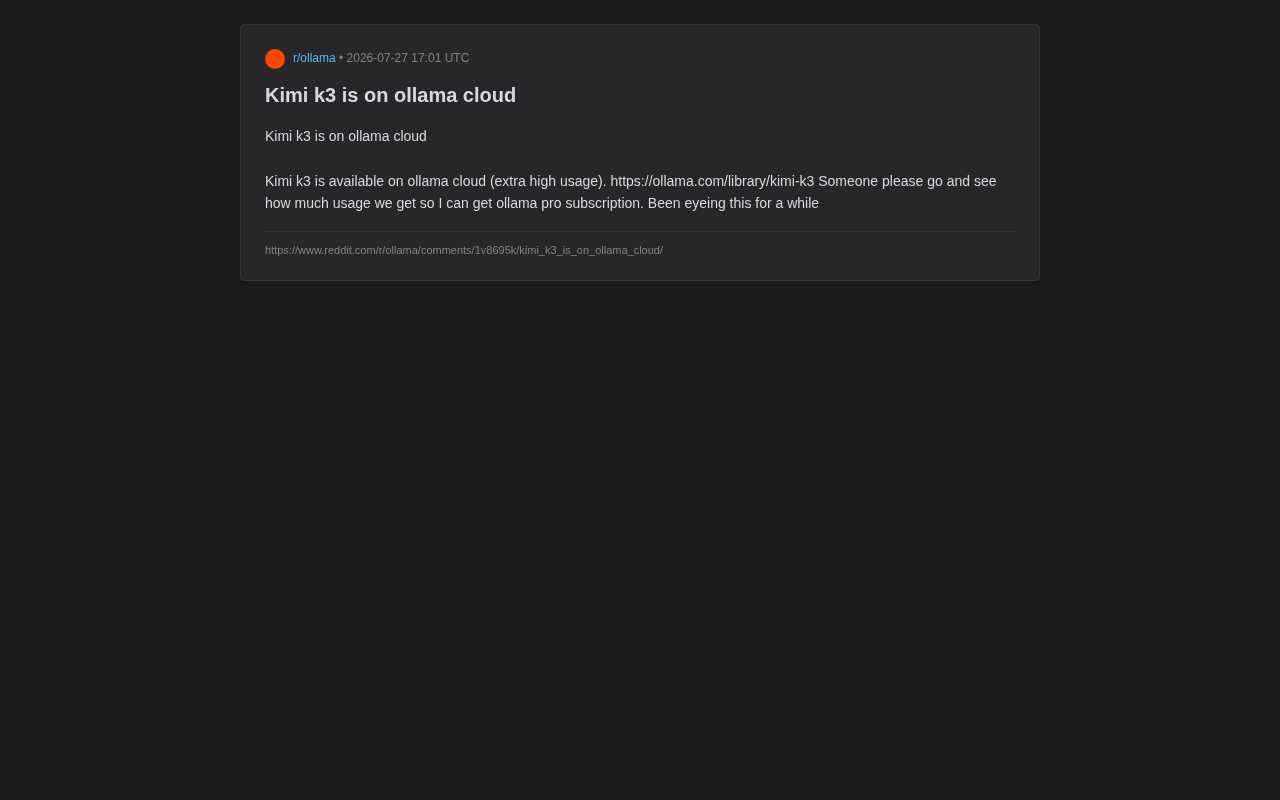
Kimi K3 Launches on Ollama Cloud: Free Tier, User Experience, and Developer Guide
Kimi K3 officially launches on Ollama Cloud as an "extra high usage" model. This guide covers free tier quotas, cloud inference experience, technical advantages, and how developers can seamlessly call this high-performance LLM.
Read more →

·3 min
Is Ollama Pro Worth It? An In-Depth Comparison of the $20 Subscription vs. API Costs
In-depth analysis of Ollama Pro's $20/month subscription value, comparing usage quotas, equivalent API costs, and ZDR privacy policy to help developers decide if it's worth it.
Read more →
·3 min
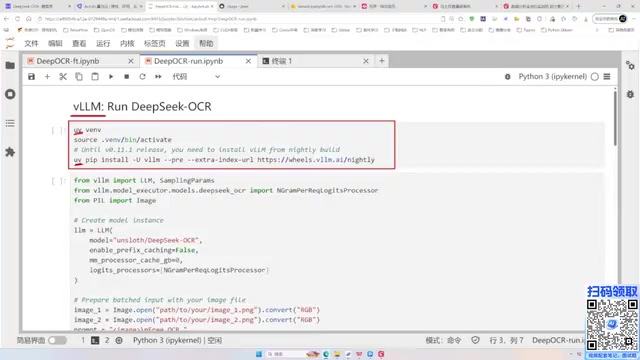
DeepSeek-OCR Deployment & Fine-Tuning in Practice: From vLLM Inference to Unsloth Fine-Tuning
Complete guide to DeepSeek-OCR from vLLM inference deployment and Unsloth model loading to fine-tuning, covering cloud server setup, GPU selection, and code examples — all on a single 4090 GPU.
Read more →

·3 min
Is Ollama Pro Worth It? A Deep Comparison of the $20 Subscription vs. API Costs
Deep analysis of Ollama Pro's $20/month subscription value, comparing usage quotas, equivalent API costs, and ZDR privacy policy to help developers decide if it's worth it.
Read more →