#Reranker
45 related articles

·4 min
The More Complex the AI Agent, the More It Hallucinates? The Hidden Cost of Architectural Complexity
Why do AI Agents hallucinate more as they grow more complex? This article analyzes the causes from error accumulation, context noise, and model completion nature, with 5 practical production strategies.
Read more →

·4 min
Dify Local Deployment Guide: One-Click Private AI Platform with Docker
Step-by-step guide to deploying Dify AI platform locally with Docker. Covers Linux, Windows, macOS setup, docker compose launch, and first-time initialization in under 30 minutes.
Read more →

·7 min
The Complete Guide to LLM Application Engineer Interviews: Six High-Frequency Topics in the Agent Domain
A focused guide to the core interview topics for LLM application engineers, covering agent architecture, Multi-Agent, Langfuse evaluation & tracing, security, and RAG optimization.
Read more →

·7 min
The Complete Guide to LLM Application Engineer Interviews: Six High-Frequency Agent Topics
A focused guide to core LLM application engineer interview topics, covering agent architecture, Multi-Agent, Langfuse evaluation, security, and RAG optimization.
Read more →

·3 min
The Truth Behind Three RAG Pipeline Crashes: Why Inter-Stage Data Contracts Matter
A RAG pipeline crashed three times due to inter-stage data format mismatches. Learn how JSON Schema and Pydantic explicit contracts turn fragile AI pipelines into maintainable systems.
Read more →

·3 min
Java Developers Pivoting to AI: Why RAG Knowledge Bases Are the Best Entry Point
Traditional Java roles are shrinking while AI demand surges. Learn the three paths into AI for developers, and why RAG knowledge bases are the highest-ROI entry point for Java engineers.
Read more →

·2 min
Agent Skill Hit Rate Dropping? 4 Methods to Solve the Skill Routing Problem
Skill hit rate dropping as your Agent scales? Learn how Progressive Disclosure works and explore 4 solutions: better descriptions, Skill Trees, negative samples, and recall + rerank.
Read more →

·3 min
Java Developers Transitioning to AI: A Practical Guide to Building RAG Knowledge Bases
How can Java developers break into AI? This guide covers the AI application engineer career path, RAG knowledge base fundamentals, vector database retrieval, and enterprise-grade RAG challenges.
Read more →

·3 min
Can Small Local Models Become Software Domain Experts? A RAG Architecture Deep Dive
Can small local models (1.5B–3B) become software domain experts? This article breaks down CPT, SFT, RAG, and Agent architectures, with a layered RAG-centric design for CPU-only local deployment.
Read more →
·6 min
The Eight-Step Method for Agent Development: A Practical Path from Pitfalls to Production
Many enterprises fail at AI Agents due to choosing the wrong tools and lacking methodology. This article outlines an eight-step Agent development method—from cognitive foundations, scenario selection, hand-writing ReAct, and structured output to Tool Use, RAG, evaluation sets, and production fallback.
Read more →

·5 min
Embedding Fine-Tuning in Practice: A Core Technique for Improving RAG Retrieval Quality
Poor RAG retrieval? The root cause often lies in the Embedding model. This article explores why fine-tuning embedding models is necessary, the limits of general Embeddings, and where Embedding fine-tuning fits in RAG optimization.
Read more →

·6 min
Cursor Meets Grok 4.5: A Hands-On Test of an AI Coding Assistant That's 5x Faster with Cleaner Output
A developer deeply tests Grok 4.5 High Fast in Cursor, finding it rivals Claude Opus in quality but runs 5x faster with cleaner, filler-free output. Full hands-on review and analysis.
Read more →

·7 min
Getting Started with AI Agents: A Deep Dive into the Perception-Decision-Action Loop
A clear, in-depth guide to how AI Agents work: the paradigm shift from traditional programs, the perception-decision-action loop, and the four pillars—LLMs, tool calling, memory, and RAG.
Read more →

·5 min
Real-World Comparison of 6 Open-Source LLMs for On-Premise Deployment: A Selection Guide to Avoid Pitfalls
A hands-on comparison of 6 open-source LLMs (DeepSeek, Qwen3, Zhipu GLM, Kimi K2, MiniMax M3, Tencent Hunyuan 3) for on-premise deployment—covering hardware cost, inference efficiency, and deployment difficulty.
Read more →

·5 min
28 Enterprise-Grade AI Agent Projects: A Complete Guide That Even Beginners Can Deploy
A collection of 28 fully reproducible enterprise-grade AI Agent projects covering code debugging, financial analysis, customer service, and multi-agent collaboration—deployable even for beginners.
Read more →

·4 min
AI Agent Learning Roadmap: From Zero to Real-World Projects
A complete AI Agent learning roadmap covering agent principles, prompt engineering, RAG, multi-agent systems, and hands-on projects — from zero to real-world deployment.
Read more →

·4 min
Switching Careers to LLM Development: The Four Core Competency Layers Companies Actually Need
Want to break into LLM development but not sure where to start? This guide breaks the core skills into four progressive layers — from basic knowledge to RAG, fine-tuning, Agents, and multimodal — so you can align with real enterprise needs and land the job.
Read more →

·7 min
Previewing the AI Engineer Summit: Industry Signals of AI Engineering Reaching Maturity
An exclusive look at the AI Engineer Summit dress rehearsals, decoding the paradigm shift from research to production. A deep dive into AI Engineer challenges, RAG, agent systems, and AI engineering as a distinct discipline.
Read more →

·7 min
Dify 1.8.0 in Practice: A Complete Guide to Building Enterprise-Grade AI Workflows with Zero Code
An in-depth walkthrough of deploying Dify 1.8.0 and building applications: three-step Docker deployment, five app types compared, and Workflow vs Chatflow use cases—build enterprise AI apps with zero code.
Read more →
·6 min
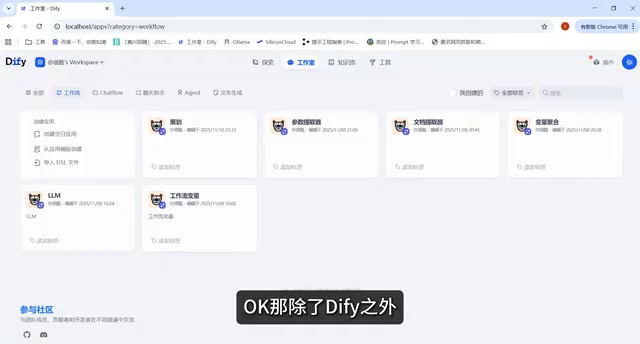
Complete Guide to Deploying Dify Locally: Docker + Ollama + RAG Setup Tutorial
A detailed guide to deploying the Dify agent platform locally: from Docker setup and integrating Ollama + DeepSeek local LLMs to workflow orchestration and RAG knowledge base construction.
Read more →