#Stanford course notes
26 related articles

·2 min
Top University Machine Learning Lecture Notes Collection: Free Open-Source Course Notes from MIT, Stanford, and Harvard
Curated collection of free, open-source ML lecture notes from MIT, Stanford, and Harvard—more current than textbooks, with GitHub list and selection criteria explained.
Read more →

·3 min
Underrated Machine Learning Resources: Hidden Gems You Wish You'd Found Sooner
A roundup of seriously underrated machine learning resources including visualization tools, niche YouTube channels, and quality blogs. Learn why great resources get buried and how to build your personalized ML learning path.
Read more →

·4 min
Getting Started with Machine Learning: How to Overcome Math Anxiety and Find a Pragmatic Learning Path
Scared off by math when starting ML? This article addresses beginners' math anxiety, clarifies how much linear algebra, calculus, and statistics you actually need, and provides a pragmatic top-down learning path with recommended resources.
Read more →

·2 min
Top University Machine Learning Course Notes Collection: Free and More Practical Than Textbooks
Curated collection of free ML course notes from MIT, Harvard, Stanford & more. These professor-written notes rival textbooks in depth, with strict inclusion criteria and open-source collaboration.
Read more →

·3 min
LangChain v1.3 Hands-On Tutorial: Deep Dive into Agents, RAG, and Local Model Deployment
Deep dive into LangChain v1.3: compare LangChain, LangGraph, and DeepAgent paradigms, explore RAG pipelines, multi-agent systems, and local LLM deployment for enterprise AI apps.
Read more →

·2 min
AI Agent Beginner's Guide: A Structured Learning Path and Hands-On Project Roadmap
New to AI Agents? This guide breaks down the full learning path — covering Agent principles, Prompt Engineering, RAG, multi-Agent systems, and hands-on projects to get you building fast.
Read more →

·2 min
Peer Instruction for ML Self-Learners: A Practical Guide to Breaking Through Plateaus
A civil engineering student's Reddit plea reveals ML self-learning's most overlooked obstacle: lack of feedback and peers. Explore peer instruction theory and actionable tips for cross-disciplinary AI learners.
Read more →

·2 min
How to Get Vizuara Robot Learning Course Notes & Free Resource Guide
Want free Vizuara 'Modern Robot Learning from Scratch' course notes? This guide covers official channels, GitHub resources, and recommends free courses like UC Berkeley CS285.
Read more →

·2 min
How to Choose a Machine Learning Video Course: From Language Barriers to an Efficient Learning Guide
Struggling to choose an ML course? This guide covers language fit, instructor style, and platform resources to help you find the right machine learning learning path.
Read more →
·4 min
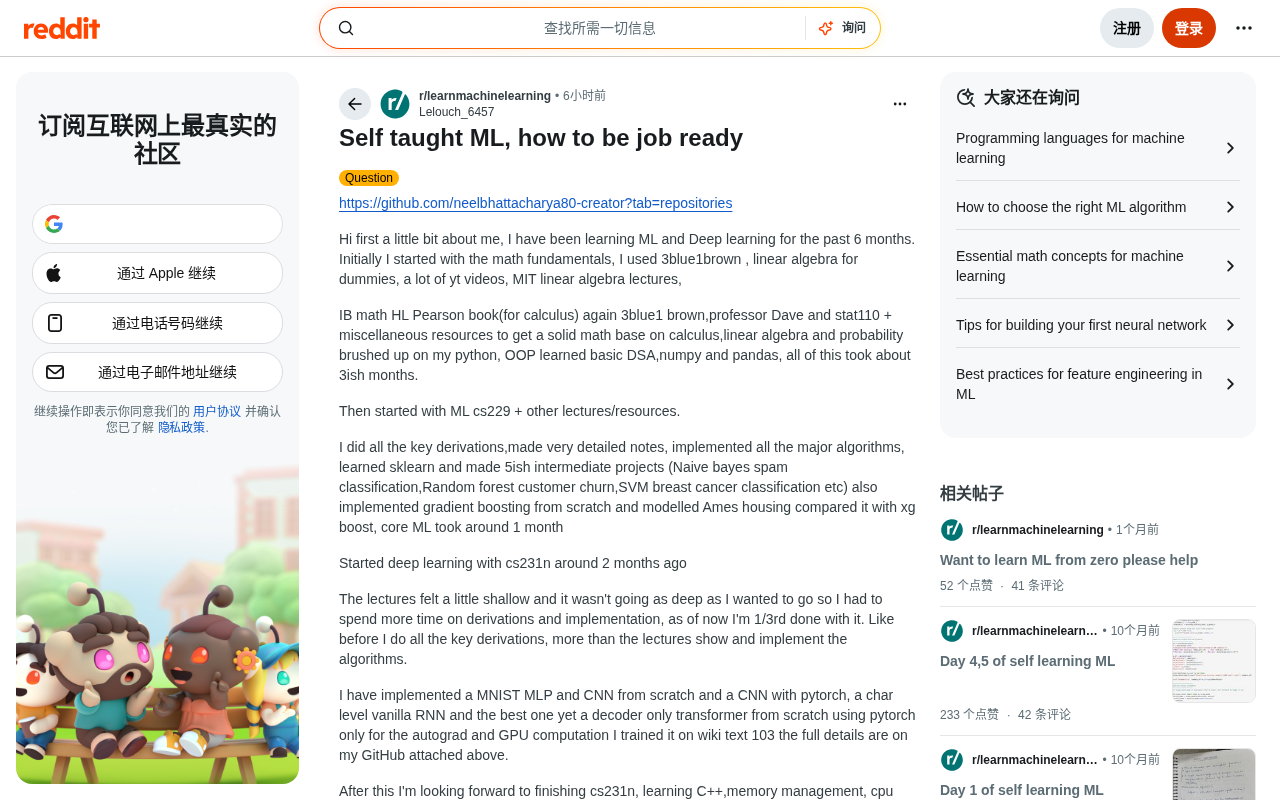
6 Months of Self-Taught Machine Learning: A Complete Roadmap from Zero to Job-Ready
A self-learner completed a full progression from math foundations and core ML to deep learning in 6 months—hand-writing a Transformer and implementing gradient boosting from scratch. This article breaks down the highlights and blind spots of this real roadmap.
Read more →

·5 min
How Can Working IT Professionals Learn AI Efficiently? A Practical Learning Path from Zero to Real-World Projects
Limited time but want to learn AI systematically? This guide maps out a practical learning path for working IT pros—from AI application engineering and prompt engineering to RAG and Agents.
Read more →

·4 min
How to Choose a Machine Learning Course for Beginners: A Complete Roadmap
Not sure where to start with machine learning? This guide covers the community-approved ML roadmap: from math and Python basics to Andrew Ng, fast.ai, Kaggle, and CS229.
Read more →

·3 min
How to Choose a Practical LLM/RAG/AI Agent Course: Four Key Criteria
Learn how to pick the best LLM, RAG, and AI Agent courses. Discover 4 key criteria for hands-on AI learning and top resources for developers.
Read more →

·7 min
From Vibe Coding to Engineered AI Programming: A Practical Guide to Enterprise Development
AI coding tools are changing development, but Vibe Coding hides risks in code quality and maintenance. This article explores Engineered AI Programming, compares Codex and Claude Code, and reveals real enterprise development paths.
Read more →

·5 min
6 Self-Hosted AI Agents Compared: Which One Is a Truly Self-Evolving Digital Employee?
An open-source AI Agent with 380K stars ranks only third? This comparison of 6 self-hosted AI Agents scores them on persistence, self-evolution, and data control—revealing why Generic Agent won with just 3,000 lines of code.
Read more →

·5 min
OSWorld 2.0 Benchmark: Top AI Agent Achieves Only 20% Completion Rate — Long-Horizon Tasks Are the Achilles' Heel
OSWorld 2.0 benchmark tests 108 long-horizon computer tasks. Claude Opus tops at only 20.6% completion, exposing critical AI weaknesses in state tracking and error self-correction.
Read more →

·4 min
AI's Impact on the Entry-Level Developer Job Market: Crisis or Opportunity?
Generative AI is reshaping software development, shrinking demand for junior developer roles. This article analyzes why entry-level positions are most at risk, the talent pipeline implications, and how junior developers can leverage AI tools to stay competitive.
Read more →
Three Role Shifts for Engineers in the…
·4 min
Three Role Shifts for Engineers in the AI Agent Era: From Coders to System Designers
As AI Agents handle long-horizon autonomous tasks, engineers are shifting from writing code to setting direction, reviewing output, and designing systems around models.
Read more →

·3 min
AI Agent vs. Automation Scripts: Goal-Driven vs. Fixed Workflows
AI Agents aren't advanced scripts. Scripts follow fixed instructions; Agents pursue goals, plan dynamically, call tools, and self-correct. A deep dive using Linux ops examples.
Read more →

·3 min
The Tech Company AI Layoff Tracker: Which Jobs Are Being Replaced
A continuously updated tracker of AI-driven layoffs at tech companies, analyzing the most affected roles and offering career adaptation strategies for professionals.
Read more →