#algorithmic bias
140 related articles

·3 min
PIRL Framework Explained: A Smooth Transition from Open-Loop Exploration to Closed-Loop Reinforcement Learning
Deep dive into the PIRL reinforcement learning framework: how to smoothly transition from open-loop exploration to closed-loop RL, mitigating the exploration-exploitation dilemma and improving sample efficiency.
Read more →

·3 min
The Enigma of Harmony: Can Music Be Fully Explained by Scientific Theory?
Exploring the scientific foundations of musical harmony: from overtone physics and mathematical frequency ratios to auditory perception, examining why certain note combinations please the ear and the ambitions and limits of scientific music theory.
Read more →

·2 min
awesome-systematic-trading: A Complete Guide to the 9,000-Star Quantitative Trading Open Source Resource List
Deep dive into the 9,100-star awesome-systematic-trading GitHub project covering backtesting frameworks, strategy implementations, data tools, and classic books for quantitative traders.
Read more →

·4 min
Kimi K2/K3 Technical Speculation: Deep Dive into RL Hyperparameters and Multi-Teacher Distillation
Deep analysis of RL hyperparameter tuning challenges and 9-policy multi-teacher distillation in Kimi K2/K3 training, exploring the shift from scale to training craft.
Read more →
·2 min
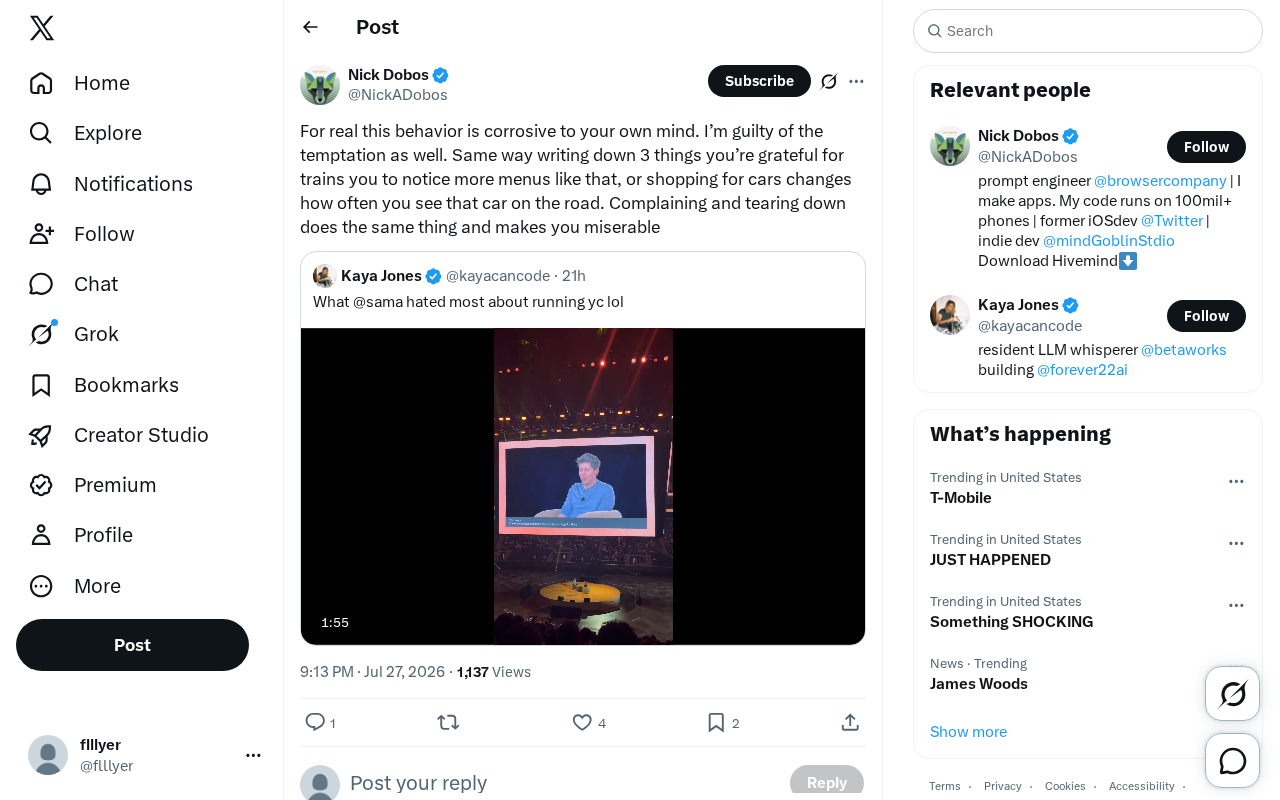
How Complaining Erodes Your Mind: Understanding the Self-Reinforcing Nature of Attention
Habitual complaining trains your brain to find more negativity, creating a vicious cycle. Learn about the self-reinforcing nature of attention and practical ways to break free from negative loops.
Read more →

·2 min
How Complaining Erodes Your Mind: Understanding the Self-Reinforcing Nature of Attention
Habitual complaining trains your brain to find more negativity, creating a vicious cycle. Learn how the self-reinforcing nature of attention works and practical ways to break free from negative loops.
Read more →

·3 min
Low Initial Review Scores for NeurIPS 2026 Theory Papers? Community Discussion and In-Depth Analysis
NeurIPS 2026 theory papers are receiving low initial review scores. This article analyzes structural causes, scoring trends, and rebuttal strategies for theory researchers.
Read more →

·3 min
AI Companies Destroying Rare Books for Training Data: The Cultural Cost Behind Efficiency
Some AI companies are buying rare antique books, using destructive scanning for training data, then destroying the originals. This raises urgent questions about AI data ethics and cultural heritage.
Read more →

·3 min
The Rise of General AI: Breakthroughs in Mathematical Reasoning and Competitive Programming
Frontier AI is going general: costs are dropping, general models are beating specialized ones in math and competitive programming, and multi-agent workflows are maturing fast.
Read more →

·6 min
The AI Industrial Age Arrives: Compute Wars, Chip Reconstruction, and the GPT-5.6 Cheating Scandal Explained
Five key AI industry trends: Doubao surpasses 180 trillion daily calls, OpenAI's in-house AI chip, NVIDIA's $3-4 trillion compute forecast, China catching up, and the GPT-5.6 cheating scandal.
Read more →

·7 min
Getting Started with Claude Code: Five Dimensions to Understand Why It Outperforms Regular AI
Claude Code isn't just a chat AI—it can directly read projects, modify code, and run commands. This article compares Claude Code with regular AI across five dimensions to help you decide if it's worth trying.
Read more →

·7 min
Getting Started with Claude Code: Five Dimensions That Show Why It Outperforms Ordinary AI
Claude Code isn't just a chat AI—it can directly read projects, modify code, and run commands. This article compares Claude Code with ordinary AI across five dimensions: interaction, context, execution, memory, and tool calling.
Read more →

·7 min
DeepSeek's Mysteriously Retracted Paper: Breaking AI's Multimodal Reasoning Bottleneck with Visual Primitives
DeepSeek's paper 'Thinking with Visual Primitives' was online for just 4 hours before being pulled. It uses bounding boxes and points as reasoning primitives, letting models 'point at' images to outperform GPT, Gemini, and Claude on maze navigation and counting.
Read more →
Kronos Financial Foundation Model: Usi…
·7 min
Kronos Financial Foundation Model: Using AI to Read the Market Language of Candlesticks
Kronos is the first open-source foundation model treating candlestick data as the "language of financial markets," using an autoregressive Transformer and earning 32K GitHub Stars. A deep dive into its principles, applications, and limits.
Read more →

·7 min
The Complete Guide to LLM Application Engineer Interviews: Six High-Frequency Agent Topics
A focused guide to core LLM application engineer interview topics, covering agent architecture, Multi-Agent, Langfuse evaluation, security, and RAG optimization.
Read more →
Human-Centered AI: Real-World Implemen…
·6 min
Human-Centered AI: Real-World Implementation in Healthcare and Design
An MSR workshop reveals the truth about AI deployment: from a $20 corneal diagnostic device to expert-in-the-loop chatbots, researchers share real-world experiences of AI in healthcare and design within resource-scarce environments.
Read more →

·4 min
The Rise of Chinese Open-Source AI Models: A Head-On Challenge to Closed-Source Dominance
Chinese open-source models rapidly close the capability gap with top closed-source AI. DeepSeek shocks the industry while Qwen matches global benchmarks.
Read more →

·7 min
Alibaba Open-Sources 2.4T Qwen Model as Chinese AI Sweeps the Global Competitive Landscape
Alibaba open-sources a 2.4 trillion parameter Qwen model and launches the Qwen Token Plan. Chinese models surge, Kimi K3 tops global rankings, and China's AI is reshaping the global competitive landscape.
Read more →

·4 min
Teaching AI to Have "Taste": Exploring Multi-Agent Design with Open-Source Skill Taste
Why does AI-generated UI all look the same? Designer SEN open-sourced a Skill called Taste that uses a four-agent pipeline to reverse-engineer website "taste" into verifiable design principles called Taste DNA.
Read more →

·3 min
Career Pivot at 47: Midlife Job Anxiety and Redefining Competence in the Age of AI
A 47-year-old engineer who pivoted to data science faces re-employment struggles — a mirror of AI-era anxiety: does using AI count as coding? How to break the midlife career trap?
Read more →