#citizen developer AI
172 related articles
 Tutorials
·3 min
Building WeChat Mini Programs with AI from Scratch: A Complete Vibe Coding Walkthrough
A detailed guide on how Vibe Coding enables zero-background users to build WeChat Mini Programs, covering UI design, frontend code generation, and backend SDK integration with a complete workflow.
Read more →
 Industry Insights
·3 min
Six Foundational Upgrades to Claude Code: AI Programming Moves from Lab to Industrial Scale
Anthropic's largest-ever foundational upgrade to Claude Code fixes six critical issues at once—terminal flickering, thinking freezes, cryptic errors, context deadlocks, unstable connections, and session crashes—shifting AI coding competition to the infrastructure layer.
Read more →
 Tutorials
·2 min
Complete Guide to Connecting GPT-5.5 in Trae: API Proxy Configuration and Real-World Testing
Step-by-step guide to connecting GPT-5.5 in Trae IDE via API proxy, covering Base URL config, API Key setup, error troubleshooting, and real coding tests.
Read more →
 Product Reviews
·2 min
Trae Deep Dive: ByteDance Launches China's First AI-Native IDE — How Will It Transform the Programming Industry?
ByteDance launches Trae, China's first AI-native IDE, integrating Doubao, DeepSeek, and Claude 3.7. A deep dive into its Chat and Build modes, impact on outsourcing, and what it means for developers.
Read more →
 Product Reviews
·2 min
In-Depth Review of ByteDance's Trae: The Strengths and Limitations of a Free AI-Native IDE
In-depth review of ByteDance's AI-native IDE Trae: analyzing its three-layer engine architecture, Builder Mode, multi-modal code generation, and how it compares to Cursor as a free AI coding tool.
Read more →
 Product Reviews
·2 min
Forge Component Library: 100+ React Components That Let AI Build Complete Pages with a Single Prompt
Forge is a React component library designed for AI programming, with 100+ production-grade UI components that let AI assistants build complete pages from natural language prompts.
Read more →
 Product Reviews
·2 min
Kanwas Open-Source Knowledge Management Tool: Building a Knowledge Base That Serves Both Humans and AI Agents
Kanwas is a free, open-source knowledge management tool that turns your team's knowledge base into shared working memory for both humans and AI Agents.
Read more →
 Tutorials
·3 min
Building a Smart Home Quote Mini-Program with AI and Zero Code: A Full Workflow from Concept to Launch
Learn how to build a smart home quote mini-program with zero code using AI. Three steps from requirements to deployment, covering layout selection, budget tiers, and auto-generated quotes.
Read more →
 Industry Insights
·1 min
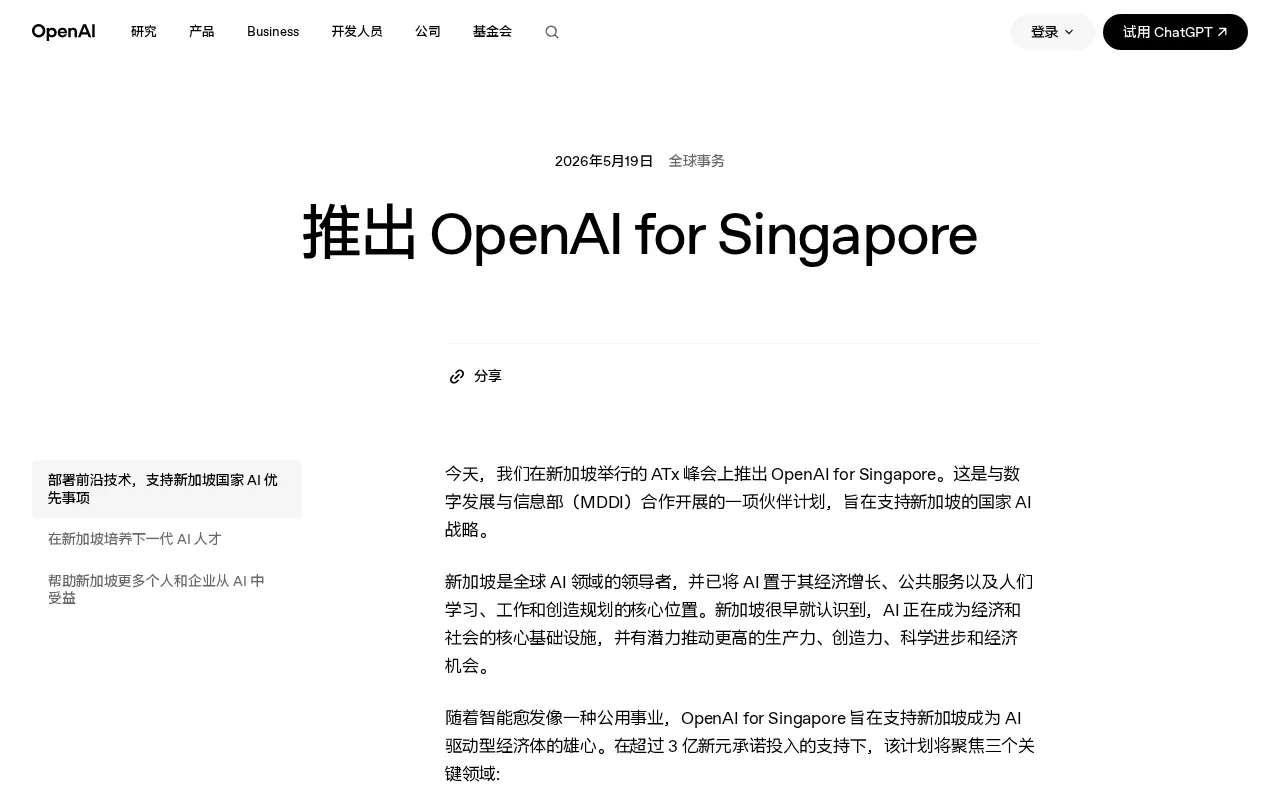
OpenAI Enters Singapore: A Comprehensive Guide to the Multi-Year AI Partnership
OpenAI launches "OpenAI for Singapore" — a multi-year strategic partnership covering AI deployment, local talent development, and enterprise empowerment. Deep analysis of Singapore's role in the global AI landscape.
Read more →
 Tutorials
·2 min
Zero to Launch in 7 Days: Building a Quiz App with GPT from Scratch (No Coding Experience)
A creator with zero coding experience used GPT to build a full quiz app in 7 days, featuring question bank import, dual practice/exam modes, and a wrong answer notebook.
Read more →
 Deep Dives
·2 min
AI Agent Conversation History Management: From Message Lists to Event-Driven Architecture
Traditional user-assistant alternating chat history can't meet complex AI Agent needs. This article explores modeling Agent interactions as event sequences, revealing Agents as workflow engines.
Read more →
 Tech Frontiers
·2 min
AI Weekly | OpenAI Codex Upgrade, Xiaomi Open-Sources Autonomous Driving Model, NVIDIA Open-Sources 2.6B Parameter World Model
This week's AI roundup covers NVIDIA's 2.6B parameter world model, Xiaomi's open-source autonomous driving model, OpenAI Codex upgrades, and Anthropic's $900B valuation funding round.
Read more →
 Tutorials
·3 min
Getting Started with J Language Module System: Differences Between import and load, Plus Multi-File Project Practice
Learn J language's module system: differences between import and load, main function definition, type-safe print with unified % placeholder, constant binding syntax, and custom import paths for multi-file projects.
Read more →
 Product Reviews
·2 min
iNaturalist AI Species Identification in Practice: A PyCon Developer's Birdwatching Record on the Los Angeles River
A Python developer goes birdwatching on the LA River after PyCon US, using iNaturalist's AI species identification to record four waterbirds. Exploring how citizen science, computer vision, and urban ecology converge.
Read more →
 Tutorials
·2 min
Getting Started with Physical AI Robot Full-Stack Development: A Complete Tech Stack Guide from Hardware to ROS2
A beginner's guide to physical AI robot development covering the complete tech stack from GPU hardware, Linux, Python, deep learning, computer vision to ROS2, with a clear learning roadmap.
Read more →
 Tutorials
·2 min
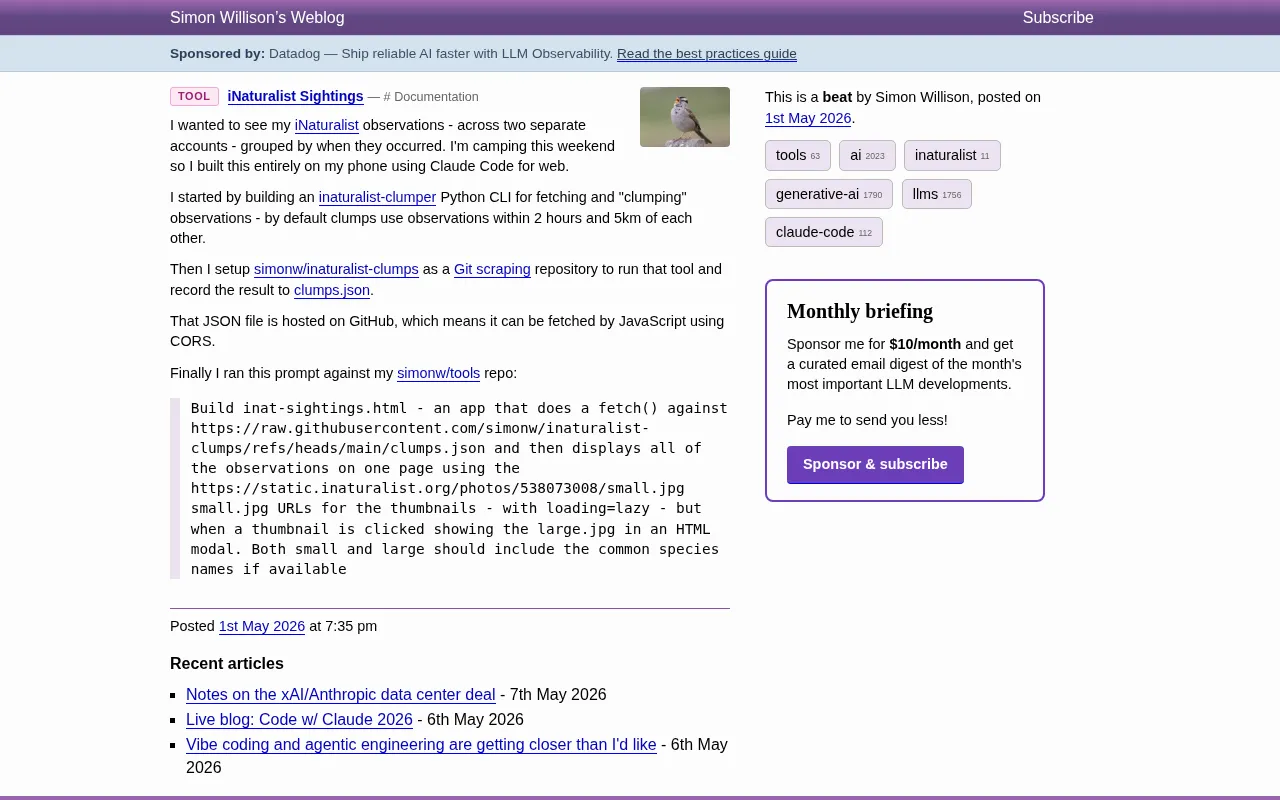
Simon Willison's Full Process of Building an iNaturalist Observation Tool with Phone + Claude Code
Simon Willison built a complete iNaturalist observation aggregation tool using only his phone and Claude Code while camping. A detailed look at the Python CLI, Git Scraping, and static frontend architecture.
Read more →
 Tutorials
·4 min
inaturalist-clumper: A Guide to Automatic Clustering of iNaturalist Observation Data
A detailed guide to Simon Willison's open-source tool inaturalist-clumper 0.1, which automatically clusters iNaturalist observation records by time and location, outputting JSON for nature blogs, data visualization, and static site integration.
Read more →
 Tech Frontiers
·2 min
GitHub Copilot Desktop App Released: How Agent Programming Is Reshaping the Development Workflow
GitHub Copilot launches a standalone desktop app with session-driven Agentic development. JetBrains gains CLI Agent capabilities. Deep analysis of Copilot's layered architecture strategy.
Read more →
 Tutorials
·3 min
Getting Started with Coze: A Complete Guide to Building AI Agents from Scratch
A detailed guide to ByteDance's Coze AI development platform, covering core advantages, domestic vs. international versions, agents vs. apps, and step-by-step instructions for building AI agents from scratch.
Read more →
 Tech Frontiers
·3 min
Hugging Face Open-Source Agent Ecosystem Explained: From Local Deployment to AI-Automated Training
Deep dive into Hugging Face's open-source Agent ecosystem: open models matching closed-source performance, local deployment options, Skills for conversational model training, and MCP integration.
Read more →