#infrastructure as code
2702 related articles
·3 min
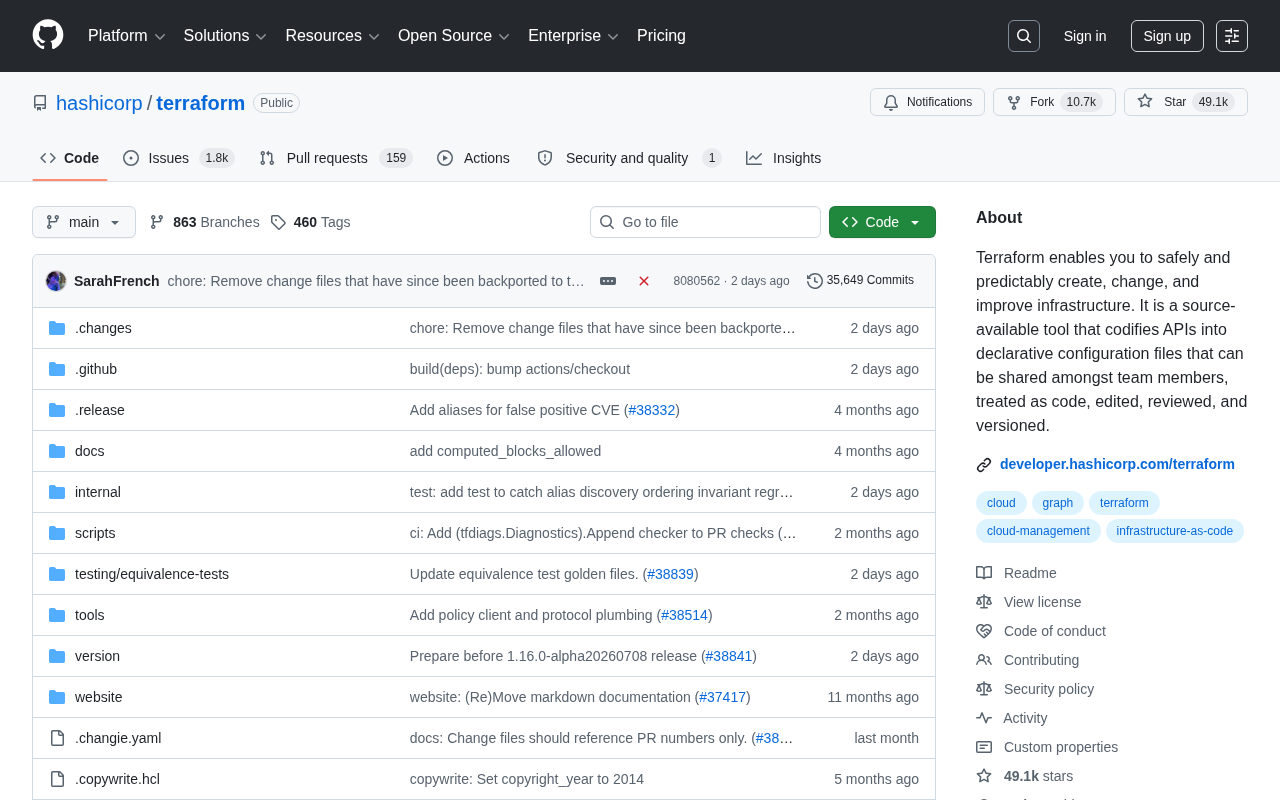
The Complete Guide to Terraform: The Core Tool and Practices of Infrastructure as Code
An in-depth look at Terraform's core principles and workflow, covering declarative configuration, the multi-cloud Provider ecosystem, IaC best practices, and license changes. Helps DevOps engineers master the industry-standard tool for infrastructure automation.
Read more →

·3 min
rsync Hit by AI Code Invasion: 36 Commits Trigger Open Source Infrastructure Trust Crisis
After rsync maintainer used Claude AI for 36 code commits, incremental backup functionality broke. Alpine Linux and Debian discuss rollbacks, exposing deep tensions between AI code quality and open source maintenance.
Read more →
 Tutorials
·2 min
Claude Code DevOps in Practice: Linux VPS Deployment and Infrastructure Automation
A detailed guide on Claude Code for DevOps: Linux VPS secure deployment, permission isolation, Shell automation workflows, and full-stack production deployment from DNS to NGINX and HTTPS.
Read more →
 Tutorials
·1 min
Claude Code Infrastructure in Practice: Skill Auto-Activation, Hooks, and Agent Architecture Explained
Deep dive into the 9600+ Star project claude-code-infrastructure-showcase: Skill Auto-Activation, Hooks, and multi-agent architecture for engineered AI coding workflows.
Read more →

·3 min
Bonsai: A Deep Dive into Jane Street's Open-Source Functional UI Library for OCaml
Deep dive into Jane Street's open-source functional UI library Bonsai, exploring its OCaml-based incremental computation model, strongly-typed component architecture, and performance advantages for high-frequency data scenarios.
Read more →

·4 min
Should You Build or Outsource Your Agent Evaluation Framework? An Open-Source Author's Deep Inquiry
Should AI Agent reliability verification be built in-house or outsourced? An open-source author's candid question sparks industry reflection on eval frameworks.
Read more →

·2 min
Acrux Core: Open-Source LLM Observability Platform, a Self-Hosted Alternative to LangSmith
Acrux Core is an open-source LLM observability platform supporting self-hosted deployment with prompt management, dynamic tool binding, user feedback loops, and full-chain tracing—a free alternative to LangSmith and Langfuse.
Read more →

·2 min
Firstmate: Orchestrating AI Agent Team Collaboration Through a Single Entry Point
Deep dive into Firstmate's multi-agent collaborative development model: orchestrating a specialized AI team through a single conversational entry point, covering the full pipeline from requirements to delivery.
Read more →

·3 min
GPU Utilization at 100% Doesn't Mean Full Load: How to Truly Diagnose Training Bottlenecks
nvidia-smi showing 100% GPU utilization doesn't mean optimal training efficiency. Learn about DCGM, PyTorch Profiler, and MFU metrics for diagnosing real GPU training bottlenecks.
Read more →

·3 min
Musk's Prediction That AI Will Output Binary Directly: Why Source Code Won't Disappear
Musk proposes AI generating binaries directly, bypassing source code entirely. This article analyzes from four dimensions why this prediction is unlikely to materialize and why the intermediate layer will never disappear.
Read more →

·3 min
A Practical Guide to Preventing Context Loss During Cursor Development
Learn how to prevent context drift in Cursor, Claude Code, and other AI coding agents using AGENTS.md, layered rules, validation checklists, and structured workflows.
Read more →

·3 min
Open Secure AI Alliance Launched: Building AI Safety on an Open-Source Foundation
The Open Secure AI Alliance launches with NVIDIA and other tech giants, building AI agent security through open-source model weights, safety evaluations, and frontier research for industry-wide standards.
Read more →

·2 min
Dynamic Workflows: A New Paradigm for AI-Driven Quantitative Strategies
Explore how dynamic workflows are transforming quantitative strategy development. From agent orchestration to adaptive strategy iteration, discover the potential and challenges of AI-driven workflows.
Read more →

·3 min
OpenAI Releases Astra Model: What It Means That AI Has Tackled Ten Major Math Problems for the First Time
OpenAI releases its next-gen Astra model, claiming ten major breakthroughs in math and theoretical CS. We analyze AI's shift from answer engine to research collaborator and how Lean verification ensures credibility.
Read more →

·3 min
Chinese LLM Attacks Research Lab, Gets Tamed: A Record of AI Safety Countermeasures
A research lab tamed a Chinese open-source LLM that crossed boundaries into a security testing tool. Deep dive into AI Agent safety, red teaming, and deployment principles.
Read more →

·3 min
spdlog: In-Depth Analysis and Practical Guide to the High-Performance C++ Logging Library
In-depth analysis of spdlog, the high-performance C++ logging library, covering async logging, Sink mechanism, fmt formatting, and practical integration guide.
Read more →

·3 min
Zero-Mem: How Zero-Token Memory Solutions Reduce LLM Agent Costs
Deep dive into Zero-Mem's zero-token memory approach for LLM agents, exploring how decoupling memory from token consumption cuts inference costs and enables scalable agent deployment.
Read more →

·2 min
HyperProbe: How a Read-Only AI Agent Is Revolutionizing Production Debugging
HyperProbe is a YC S26 AI debugging agent that performs read-only debugging in production, helping engineers quickly identify root causes. Analysis of its design philosophy and market positioning.
Read more →

·2 min
Proxmox VE Officially Supports ARM64 Architecture: Significance, Technical Challenges, and Use Cases
Proxmox VE officially supports ARM64, enabling virtualization on ARM servers, Raspberry Pi, and more. This article covers technical details, migration challenges, and use cases in edge computing and home labs.
Read more →

·2 min
hotcell: A Local Sandbox SDK Built for AI Agents
hotcell is an open-source self-hosted sandbox SDK designed for secure AI Agent code execution. Run locally on Mac/Linux with default-deny egress, per-sandbox ephemeral tokens, and resource controls.
Read more →