#open-source photo backup
28 related articles

·3 min
Practical Guide to Self-Hosted Security Architecture with Tailscale + Caddy + Authelia
Deep dive into the Tailscale + Caddy + Authelia self-hosted security architecture: traffic flow analysis, design strengths, and common pitfalls for building secure multi-server setups.
Read more →

·4 min
Guide to Securely Exposing Self-Hosted Services: From Tailscale to Defense in Depth
Complete guide to securely exposing self-hosted services: Tailscale zero-exposure, reverse proxy setup, Cloudflare Tunnel, Authelia auth gateway, server hardening, and 3-2-1 backup strategy.
Read more →

·4 min
Multi-Purpose Home Server Build Guide: Streaming + AI Inference + App Hosting on One Machine
How to build a $500 multi-purpose home server for Jellyfin streaming, Ollama local AI inference, web app hosting, and Pi-hole ad blocking with dual RTX 3060 GPUs.
Read more →

·6 min
Separate Domains vs. Subdomains for Self-Hosted Services? A Deep Dive into Security Isolation Strategies
Deep dive into domain security architecture for self-hosted services: Should services with different exposure levels use separate domains or subdomains? Analysis of subdomain enumeration risks, defense in depth, and practical isolation strategies.
Read more →

·3 min
Self-Hosted Notes & Task Management: A Minimalist Open-Source Approach with Memos + Vikunja
Looking for simple self-hosted notes and task management? This article recommends Vikunja and Memos as lightweight open-source alternatives to Nextcloud and Obsidian.
Read more →

·3 min
Self-Hosted Notes & Task Management: A Minimalist Open-Source Approach with Memos + Vikunja
Looking for simple self-hosted notes and task management? This guide recommends Vikunja and Memos as lightweight open-source alternatives to bloated tools like Nextcloud and Obsidian.
Read more →

·6 min
Securely Exposing Self-Hosted Services via VPS: Architecture & Practical Guide
Learn how to securely expose self-hosted services via VPS using WireGuard tunnels, Pangolin, and reverse proxies — enabling client-free access to Plex, Immich, and more while hiding your home IP.
Read more →

·3 min
Object Storage vs Cloud Drives: Cost, Reliability, and Strategy for Long-Term Backups
In-depth comparison of object storage (BackBlaze B2, OVH) vs cloud drives (Google Drive) for long-term backup cost, reliability, and convenience, with guidance on implementing the 3-2-1 backup rule.
Read more →

·3 min
Home Server Setup Guide: Self-Hosted Services Worth Deploying
From Jellyfin and Immich to Nextcloud, explore self-hosted services worth deploying on a home server, covering media, file sync, encrypted chat, and download automation.
Read more →

·3 min
Self-Hosting a GIF Server: A Complete Guide to Tenor Alternatives
A detailed guide on self-hosting a GIF server as a Tenor alternative, covering image hosting, searchable GIF management systems, and Discord Bot integration.
Read more →
·3 min
Open Archiver v0.5.2 Deep Dive: A Comprehensive Look at the New Features of This Open-Source Email Archiving Tool
Deep dive into Open Archiver v0.5.2: advanced search, index rebuilding, PST/Mbox import fixes, and more features for self-hosted email archiving and compliance.
Read more →

·3 min
Self-Hosting Hardware Upgrade Guide: From an Old NUC to a Game Server and Beyond
A detailed guide to self-hosting hardware upgrades: analyzing NUC performance bottlenecks, comparing used enterprise Mini PCs and custom ITX builds for Jellyfin, Immich, and Minecraft servers.
Read more →

·3 min
Self-Hosting Hardware Upgrade Guide: From an Old NUC to a Game Server and Beyond
A detailed guide to self-hosting hardware upgrades: analyzing NUC bottlenecks, comparing used enterprise Mini PCs and ITX builds for Jellyfin, Immich, and Minecraft servers.
Read more →

·3 min
Open Archiver v0.5.2 Deep Dive: A Complete Look at the New Features of This Open-Source Email Archiving Tool
Deep dive into Open Archiver v0.5.2: advanced search, index rebuilding, PST/Mbox import fixes, and more for self-hosted enterprise email archiving.
Read more →

·3 min
Why IPFS and Filecoin Failed to Gain Traction in the Self-Hosting Community
IPFS and Filecoin promise decentralized storage and censorship resistance, yet the self-hosting community ignores them. This article analyzes why simpler tools like Syncthing and BitTorrent win.
Read more →

·4 min
Underrated Self-Hosting Gems: A Roundup of Niche but Powerful Open-Source Tools
Discover underrated niche self-hosted open-source tools across bookmarks, passwords, document archiving, knowledge bases, and dashboards, with deployment tips.
Read more →

·3 min
InvokeAI In-Depth Review: Can It Replace SD WebUI and ComfyUI?
A hands-on InvokeAI review covering installation, VRAM optimization, infinite canvas, node workflows, and model management — with an objective comparison to SD WebUI and ComfyUI.
Read more →

·6 min
The Complete Codex Guide: From Beginner to Pro with the All-in-One AI Assistant
OpenAI Codex is more than a coding tool—it's an AI agent that writes code, makes slides, and operates browsers. This guide covers its four versions, permission modes, plugins, automation, and six best practices.
Read more →

·2 min
Goodbye Paid Subscriptions: A Complete Practical Guide to Self-Hosting
A complete guide to self-hosting: replace paid subscriptions with Nextcloud, Jellyfin, Vaultwarden and more. Covers Docker deployment, backup strategy, and secure remote access.
Read more →
·3 min
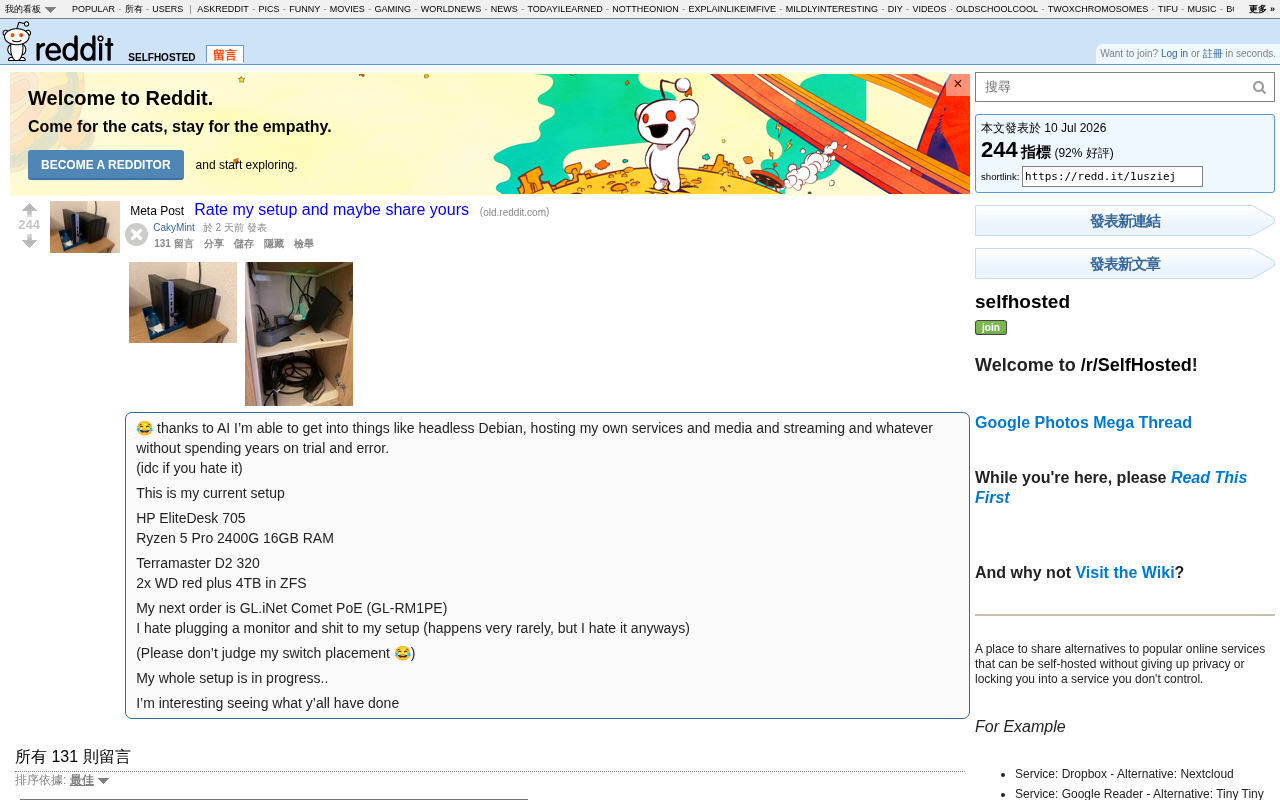
AI-Powered Home Server Setup from Scratch: Hardware Selection to Remote Management
With AI tools, beginners can build a home self-hosting server without years of experience. This guide covers hardware selection (HP EliteDesk, ZFS, IP-KVM), Docker deployment, and how AI compresses the technical learning curve.
Read more →