#self-hosted infrastructure
133 related articles

·5 min
A €35 IKEA Coffee Table Hides an Entire Home Server: Where Aesthetics Meets Function
A Reddit user hid a NAS, hard drive array, and modem inside a €35 IKEA Gillersberg coffee table, winning his partner's approval. Here's how this high-WAF home server solution works.
Read more →

·6 min
Connecting SQL Projects to Azure DevOps Pipelines: A Hands-On Guide to Automated Builds and Secure Deployment
Learn how to connect SSMS SQL projects to an Azure DevOps CI/CD pipeline—covering YAML build config, SQL code quality analysis, managed identity authentication, and dynamic firewall rules for secure Azure SQL deployment.
Read more →

·6 min
Zuckerberg Says AI Will Run Your Entire Business — But Data Ownership Risks Can't Be Ignored
Meta launched an enterprise AI agent, with Zuckerberg claiming it can "run your entire business." This article explores the commercial value of AI agents, the hidden risks of data ownership, and how different businesses can balance efficiency with data sovereignty.
Read more →
·6 min
OpenAI Releases GPT-5.6: Cybersecurity Capabilities Take Center Stage
OpenAI launches the GPT-5.6 model family with cybersecurity as its biggest highlight. A deep analysis of GPT-5.6's differentiation, double-edged-sword effect, and enterprise strategy.
Read more →

·4 min
AI Agent Development Deep Dive: Opportunities, Real Entry Barriers, and Learning Paths
A deep dive into AI Agent development: real architecture, entry barriers, and learning paths. From ReAct to multi-agent systems and LangChain — cut through the hype.
Read more →

·4 min
Switching Careers to LLM Development: The Four Core Competency Layers Companies Actually Need
Want to break into LLM development but not sure where to start? This guide breaks the core skills into four progressive layers — from basic knowledge to RAG, fine-tuning, Agents, and multimodal — so you can align with real enterprise needs and land the job.
Read more →

·7 min
GLM-5.2 Released: Open-Source Coding Capability Approaches Closed-Source Flagships for the First Time
GLM-5.2 tops open-weight models in coding with a 74.4 Frontiers-WE score, beating GPT-5.5. Its MIT license enables local deployment, and the gap with closed-source flagships is closing fast.
Read more →

·7 min
The Agent Engineer Transition Roadmap: A Deep Dive into Three Core Skill Systems
Want to become an Agent engineer? This article systematically covers three core skill tracks—LLM fundamentals, LangChain architecture development, and enterprise deployment—to help you avoid detours.
Read more →
·5 min
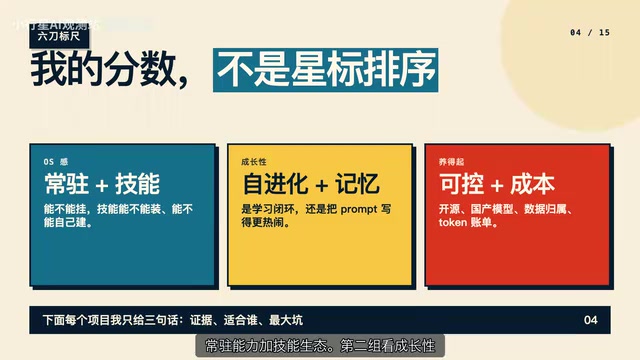
6 Self-Hosted AI Agents Compared: Which One Is a Truly Self-Evolving Digital Employee?
An open-source AI Agent with 380K stars ranks only third? This comparison of 6 self-hosted AI Agents scores them on persistence, self-evolution, and data control—revealing why Generic Agent won with just 3,000 lines of code.
Read more →

·5 min
OSWorld 2.0 Benchmark: Top AI Agent Achieves Only 20% Completion Rate — Long-Horizon Tasks Are the Achilles' Heel
OSWorld 2.0 benchmark tests 108 long-horizon computer tasks. Claude Opus tops at only 20.6% completion, exposing critical AI weaknesses in state tracking and error self-correction.
Read more →
·5 min
OSWorld 2.0 Benchmark: Top AI Agents Achieve Only 20% Completion Rate — Long-Horizon Tasks Are the Fatal Weakness
OSWorld 2.0 benchmark tests 108 long-horizon computer tasks (median 1.6 hrs for humans). Claude Opus tops out at 20.6% completion, exposing critical AI Agent weaknesses in state maintenance and self-correction.
Read more →

·7 min
Otari: A Comprehensive Look at the Open-Source LLM Control Plane Tool
An in-depth analysis of the open-source LLM control plane tool Otari—covering unified multi-model access, cost observability, and security compliance governance to help teams build manageable, production-grade AI infrastructure.
Read more →

·4 min
Complete Guide to Connecting External Models in Codex: Two Methods to Unlock Full Capabilities
Two methods for connecting external models to Codex: manually configure keys via relay services, or use the CC Tool to auto-bridge GPT, DeepSeek, and more. Covers auth/config files, CC Tool usage, and multi-model switching.
Read more →

·7 min
PP-OCRv6 Deployment Deep Dive: Invoice Recognition Results and the Font-Missing Pitfall Explained
PP-OCRv6 is PaddlePaddle's SOTA-level OCR model. This article covers Docker deployment, invoice recognition testing, and the critical font-missing pitfall causing entire regions to be skipped.
Read more →

·2 min
Flock: Building an AI Development Squad with Claude Code to Reshape Team Programming Workflows
Flock is a multi-agent development tool built on Claude Code. With roles like Planner, Coder, Tester, and Reviewer, it turns AI coding into a traceable development pipeline.
Read more →

·6 min
Dify Self-Hosted Deployment in Practice: Building an Enterprise-Grade AI Application Platform from Scratch
A complete guide to self-hosting Dify, the open-source AI platform: environment setup, Docker Compose deployment, LLM integration, and app building. Runs on just 2 cores and 4GB RAM.
Read more →

·4 min
How Daytona Is Redefining AI Agent Compute Sandbox Infrastructure
Deep analysis of how Daytona pivoted from browser IDE to AI Agent sandbox infrastructure, achieving 60ms startup times, 850K daily sandboxes on bare metal, and why Computer Use opens a trillion-dollar market.
Read more →

·3 min
CodeRabbit vs DeepSource vs Greptile: In-Depth Comparison of AI Code Review Tools
In-depth comparison of CodeRabbit, DeepSource, and Greptile — three leading AI code review tools analyzed across context understanding, static analysis, and architecture awareness to help teams choose the right solution.
Read more →

·2 min
Deep Dive into n8n Workflow Platform: Core Capabilities and Suitability Assessment for China
Deep dive into n8n's core capabilities including 500+ nodes, AI Agent building, and RAG integration, with an objective analysis of its limitations and suitability for use in China.
Read more →

·2 min
n8n from Beginner to Expert: A Complete Guide to Building AI Agent Workflows with Zero Code
Complete guide to n8n's AI capabilities covering AI Agent, Chain nodes, and Tool nodes. Learn to build enterprise-grade AI workflows with zero code, from setup to RAG systems.
Read more →