#tabular data classification
19 related articles

·4 min
How to Choose Machine Learning Starter Tools? A Beginner's Development Environment Setup Guide
Confused about choosing between VS Code, Jupyter, Google Colab, and Anaconda for ML? This guide clarifies each tool's role and recommends a zero-cost beginner setup to help you start learning fast.
Read more →

·4 min
A Beginner's Guide to Machine Learning: From Course Selection Confusion to a Systematic Learning Path
Confused by the overwhelming number of ML courses? This guide covers Udemy course evaluation, top free resources, and an actionable beginner learning path.
Read more →

·3 min
Introduction to Machine Learning: Core Concepts of Supervised Learning, Classification, and Featurization Explained
A systematic guide to core machine learning concepts including supervised learning as function mapping, classification characteristics, design matrices, and featurization for converting variable-length data.
Read more →

·4 min
From Zero to AI Engineer: A Real Growth Path from a Student's Resume
A CS student went from Python basics to model deployment in 3-4 months, building an AI portfolio through three real projects. This article breaks down the learning path, project value, and resume optimization strategies.
Read more →

·2 min
TabPFN: A Transformer Model for Tabular Classification That Predicts in One Second Without Training
Deep dive into TabPFN's core principles and use cases. Built on Transformer architecture and in-context learning, TabPFN classifies small tabular data in one second without hyperparameter tuning, matching XGBoost accuracy.
Read more →
·3 min
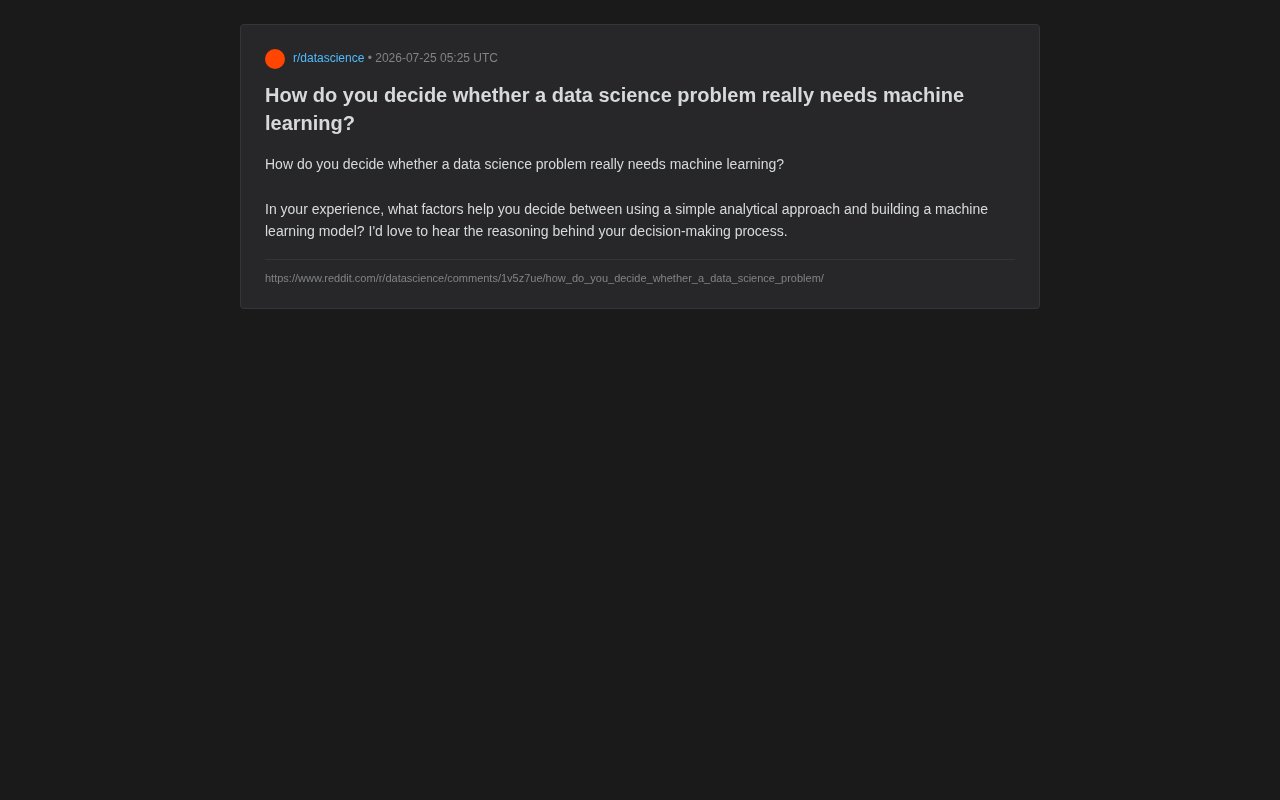
When Should You Use Machine Learning? A Pragmatic Decision Guide for Data Scientists
Not every data science problem needs ML. This guide offers a decision framework across four dimensions — rule complexity, data quality, prediction needs, and interpretability — to avoid over-engineering.
Read more →

·3 min
Zero-Code Research: Using AI Agents to Run Complete Machine Learning Experiments
No coding required: use AI agents like Codex and Claude Code to complete full ML experiments via natural language. A real case study with a heart disease dataset.
Read more →

·3 min
No-Code Research: Using AI Coding Tools to Complete the Full Machine Learning Pipeline
No coding skills? No problem. Learn how AI tools like Codex and Claude Code let researchers complete ML workflows — data cleaning, model training, visualization — using only natural language.
Read more →

·2 min
The Truth Behind Anthropic's Account Bans: Client Detection Logic and a Wave of AI Model Launches
Unpacking the technical truth behind Anthropic's account bans: hidden timezone and proxy detection logic sparks privacy debate. Plus Claude Sonnet 5, Linux support, and new releases from OpenAI, NVIDIA, and Google DeepMind.
Read more →

·2 min
Vibe Coding in Practice: AI Agents Complete Full Research Experiments in Minutes
No coding required — just describe your needs in natural language. AI Agents handle data cleaning, model training, and visualization automatically. We tested Codex and Claude Code on a heart disease prediction task.
Read more →

·3 min
Zer0Fit: Connecting Google's TabFM and TimesFM to LLM Chat Interfaces via MCP
Zer0Fit wraps Google's TabFM and TimesFM foundation models as MCP servers, letting users run classification, regression, and time series forecasting through a local LLM chat interface — no ML code required.
Read more →
·4 min
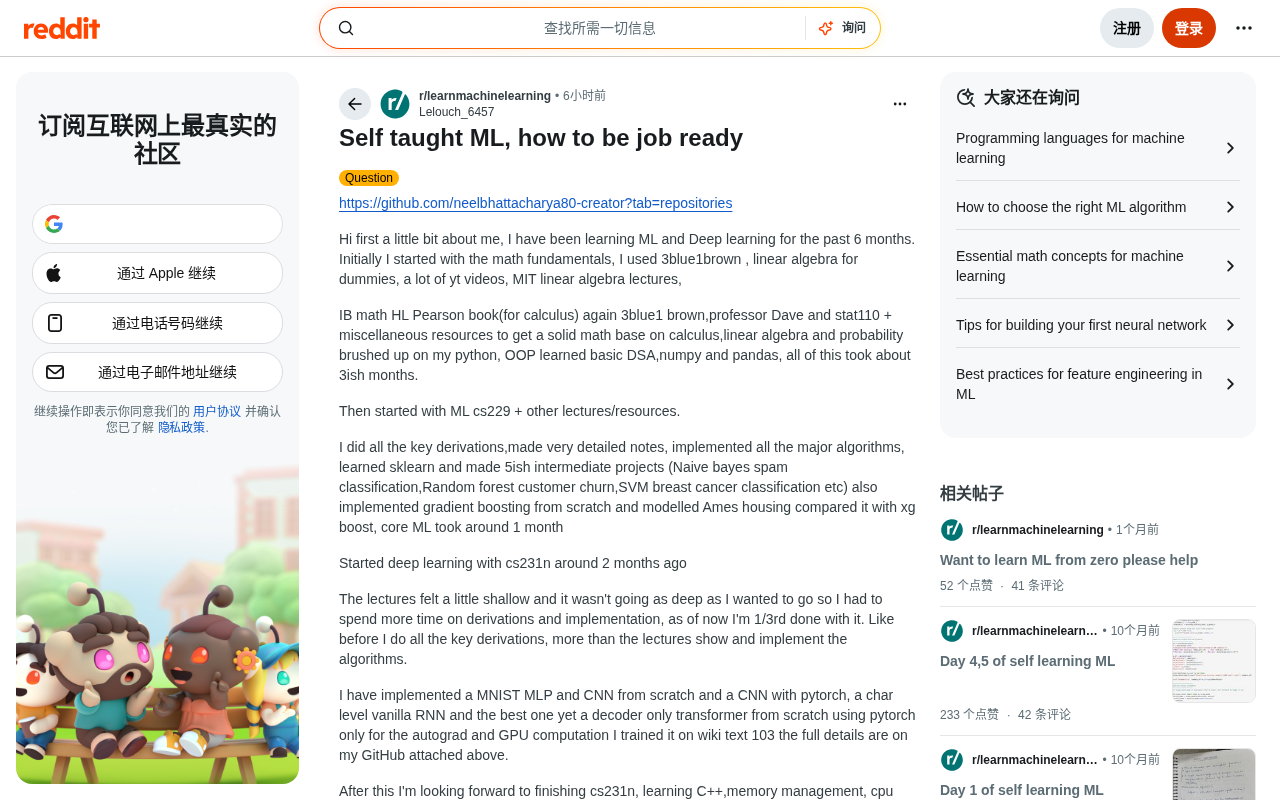
6 Months of Self-Taught Machine Learning: A Complete Roadmap from Zero to Job-Ready
A self-learner completed a full progression from math foundations and core ML to deep learning in 6 months—hand-writing a Transformer and implementing gradient boosting from scratch. This article breaks down the highlights and blind spots of this real roadmap.
Read more →

·3 min
TabFM: A Zero-Shot Foundation Model for Tabular Data That Disrupts Traditional Modeling
TabFM is a zero-shot foundation model designed for tabular data, enabling direct prediction without retraining on new datasets. This article analyzes TabFM's positioning, its relationship to TabPFN, key strengths, and real-world challenges.
Read more →

·7 min
Training Machine Learning Models from Scratch: A Complete Beginner's Guide
A complete walkthrough of training machine learning models from scratch—covering problem definition, data preprocessing, algorithm selection, hyperparameter tuning, and evaluation, with tool recommendations for beginners.
Read more →

·6 min
Databricks Agent Framework in Practice: A Guide to ChatAgent Wrapping and Production Deployment
A deep dive into Databricks Agent Framework (Mosaic AI): unify LangGraph/OpenAI agents via ChatAgent, log & evaluate with MLflow, version with Unity Catalog, and deploy Model Serving Endpoints for production AI agents.
Read more →

·7 min
Complete Guide to Training Small Models on Kaggle's Free Compute: GPU Quotas and Practical Tips
In-depth guide to Kaggle's free-tier compute: P100/T4 GPU with 30 hours/week quota, 12-hour sessions, suitable models like CNN and BERT fine-tuning, plus tips like mixed precision and checkpointing to start deep learning at zero cost.
Read more →
·6 min
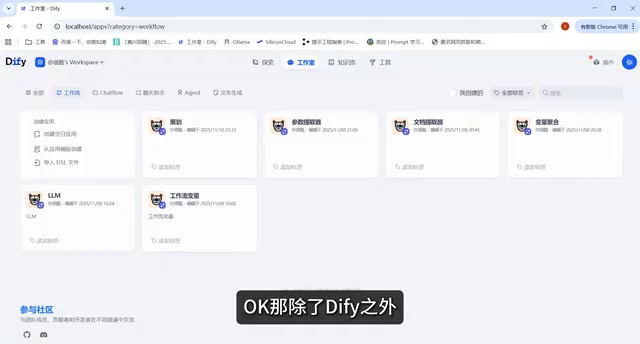
Complete Guide to Deploying Dify Locally: Docker + Ollama + RAG Setup Tutorial
A detailed guide to deploying the Dify agent platform locally: from Docker setup and integrating Ollama + DeepSeek local LLMs to workflow orchestration and RAG knowledge base construction.
Read more →

·3 min
Claude Code + Skills: Auto-Generating Test Cases in 10 Minutes — A Practical Guide
Learn how to use Claude Code's Skills system to auto-generate test cases from requirements docs in 10 minutes through a three-phase workflow of splitting, extraction, and generation.
Read more →
