#智能体架构
16 related articles

OpenSeal Agent Architecture Deep Dive: Persistent Orchestration and Approval Governance
A deep dive into OpenSeal's AI agent architecture: persistent execution via Objective/Run/Turn/Skill, lease recovery, capability checks, approval governance, and model routing design.

Inside Always-On AI Agents: Persistence, Proactivity, and Long-Running Task Architecture
Stanford CS146S: A deep dive into always-on AI agent architecture — from four developer eras and six model capabilities to thin-client/thick-server design, subagents, prompt caching, and compaction.

How Uber Solved MCP's Biggest Context Problem with Omni MCP
Uber's Omni MCP proxy server solves context explosion at 5,000+ tools using four meta-tools: discover server, discover tools, get tool schema, and invoke tool. A deep dive into its architecture, permissions, and response projection.

The Hidden Token Tax of MCP: One Server Burns 18,000 Tokens Before Doing Any Real Work
A single Chrome DevTools MCP server can burn 18,000 tokens before doing any work. Learn how to measure, prune, lazy-load, and optimize your MCP tool catalog.

Beyond Single Prompts: What Real-World Problems Actually Deserve an AI Agent?
What problems truly warrant an AI Agent? Based on Reddit developer discussions, this article outlines six criteria for identifying Agent-worthy scenarios and covers practical use cases like DevOps, travel, and research.
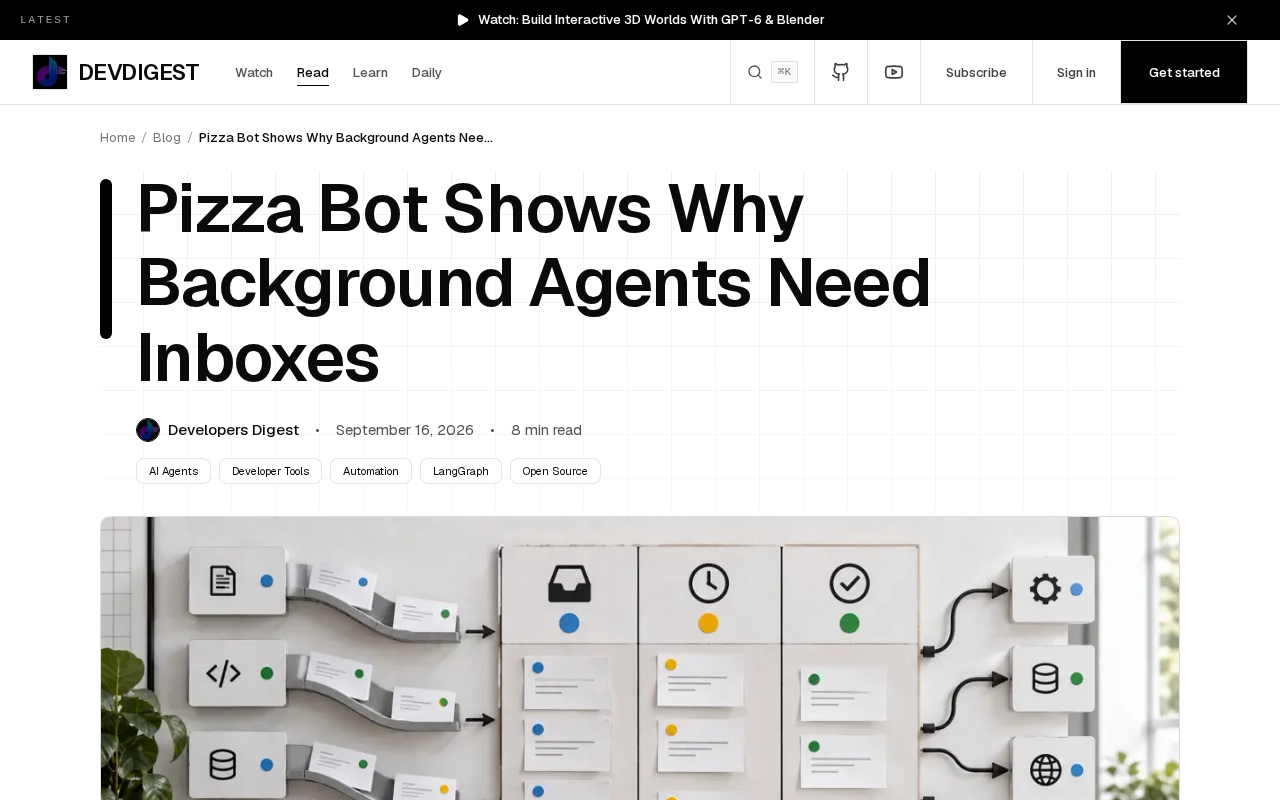
What Pizza Bot Reveals About Why Background AI Agents Need an Inbox
AWS's open-source Pizza Bot reveals the core design patterns for background AI agent collaboration: queue, approval, checkpoint, and return-path. Here's why they matter.
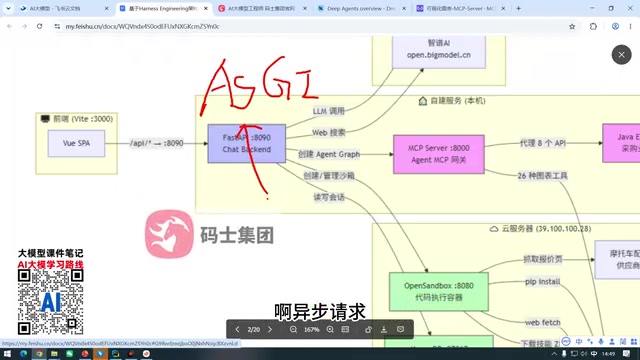
Harness Engineering in Practice: A Deep Dive into Enterprise Multi-Agent Architecture
A deep dive into an enterprise multi-agent architecture using Harness Engineering: Vue frontend, FastAPI/ASGI backend, DeepSeek multi-model orchestration, MCP protocol for ERP integration, and sandbox container isolation.
 Research
Deep Dive into Claude Code's Open-Source Architecture: The Design Philosophy Behind 510,000 Lines of Code
Deep analysis of Claude Code's open-source architecture: dual-loop design, 7-step tool pipeline, 4-layer token compression, memory systems, and multi-agent collaboration patterns.
 Deep Dives
AI Agents 101: Core Concepts, Technical Architecture, and How They Work
A beginner's guide to AI Agents: understand core concepts, the perception-decision-action loop, LLM, tool calling, memory systems, and RAG architecture explained from scratch.
 Research
Optimize Anything: One API to Unify Optimization of Code, Prompts, and Agent Architectures
UC Berkeley and Stanford propose Optimize Anything, a universal text optimization framework that unifies optimization of CUDA kernels, agent architectures, and prompts through one declarative API.
 Industry Insights
GPT-5.5 Reduces Error Rate by 46% in Databricks Document Parsing: Real-World Data and Architecture Breakdown
Databricks tests show GPT-5.5 cuts error rates by 46% in complex document parsing, the only model to break 50% accuracy. Detailed analysis of its breakthroughs in numerical parsing and multi-agent architecture.
 Industry Insights
Claude Code Open Source Analysis: 510K Lines of Code Reveal Industrial-Grade Agent Architecture
Deep analysis of Claude Code's open-source architecture: dual-loop execution engine, seven-step tool security pipeline, token compression, multi-agent collaboration, and memory system for AI Agent development.
 Deep Dives
Ralph Loop: The New AI Programming Paradigm That Beats Multi-Agent Systems Through Iterative Trial and Error
Ralph Loop is a 2025 AI programming paradigm: a memoryless AI Agent repeatedly reads the same Prompt, accumulates experience via file systems, beating multi-agent architectures through iterative loops.
 Deep Dives
AI Agent Core Principles Explained: The Decision Loop and Three-Component Architecture
Deep dive into AI Agent core principles: the Sense-Plan-Act-Observe decision loop, and how Planning, Memory, and Tools components transform LLMs into autonomous digital employees.
 Deep Dives
Two Root Causes of Agent Context Rot: Distraction vs. Poisoning Explained
AI Agent getting dumber over time? Context Rot has two root causes: Distraction (attention dilution) and Poisoning (causal chain contamination). Learn symptoms, mechanisms, and remediation strategies.
 Tech Frontiers
OpenAI Symphony: One Codex Agent Per Task — A New Paradigm for Multi-Agent Parallel Programming
Deep dive into OpenAI's Symphony: assigning an independent Codex agent to each task for multi-agent parallel programming. Explore its architecture, developer impact, and industry trends.