#AI Agent
1108 related articles

Google Open-Sources Harness2: Letting AI Agents Self-Evolve
Google Research open-sources Harness2, a framework that lets AI Agents automatically improve system prompts, tools, and memory configurations through a propose, trial-run, and select loop—no labeled data or scoring model required, validated on Gemini and GLM.

Local AI Computer Control: It Can Click for You, But Asks You Four Questions First
Locally Uncensored 3.0.6 adds local AI computer control: models can click and type for you, with screenshots staying on-device. Off by default, asks every new conversation, requires confirmation for sensitive actions, and never touches terminals or password boxes. This article covers its permission design, real-world differences between vision and control-list modes, platform support status, and known limitations.

Building a Real Estate Due Diligence Agent with a Graph Database: 81% Hidden Risk Detection Rate
Open-source project Khoj builds a real estate due diligence AI Agent with FalkorDB, computing risk scores along relationship paths via Katz centrality. On 200 seemingly clean projects, the graph method detected 81% of hidden risks with zero false positives, far outperforming the 0% of traditional single-record checks.

Company Brain: Building an Enterprise Intelligent Knowledge Assistant with Knowledge Graphs and AI Agents
Company Brain is an open-source enterprise knowledge assistant built with knowledge graphs, expert AI Agents, and LLMs. This article breaks down its FalkorDB graph architecture, six-step Q&A pipeline, evidence traceability design, and deployment gaps such as keyword routing and open-by-default permissions.

Four Days to Build a Meme Coin Tracing Agent: Sniff Uses a Graph Database to Expose the "Clean Wallet"
QuantBase built the meme coin tracing agent Sniff in four days: FalkorDB and Claude trace multi-hop wallet links, mandatory evidence citations curb AI hallucination, and graph signals honestly can't predict price.

Building RecallAI in Four Days: A Graph Database Memory System Retrospective
A student team built RecallAI in four days at Graph Hacks, adding persistent memory to an AI tutor with FalkorDB. A retrospective on architecture, Qwen2.5, memory failures, and the lesson that connecting a database doesn't give AI memory.

AI Tool Radar: Agent Infrastructure Surges — Five Tools Worth Watching
This week's AI Tool Radar focuses on agent infrastructure: five agent orchestration and management tools launched together, plus Krea 3, Openbroca, Inbox Zero, and others addressing real pain points.

AI Agent Development for Beginners: From Python to Reverse Engineering
Starting from a Reddit beginner's help post, this article maps out a complete learning path for AI Agent development: Python fundamentals, LLM APIs and tool calling, getting started with Agent frameworks, and advancing toward complex tasks like reverse engineering — suitable for beginners.

n8n for Beginners: From Workflows to WhatsApp AI Customer Service
Based on a complete n8n beginner course: build automation workflows from scratch and implement WhatsApp AI customer service with AI Agents. Covers nodes, JSON data flow, conditionals, form inquiry systems, API calls, and deployment—no coding background required.

Tencent Confirms Third-Party Model Agent Probed Amap: Is Your Eval Environment Safe?
Tencent confirms the AI Agent that probed Amap came from third-party model evaluation, not Hunyuan. This article covers the timeline, similar cases at Anthropic and OpenAI, and practical Docker and Python solutions for tightening network egress permissions in eval environments.

How Do AI Agents Orchestrate Multiple Tools? MCP and Dynamic Discovery Explained
Former AWS architect Raj explains how AI agents orchestrate multiple tools: MCP protocol dynamic discovery, ReAct loop decision-making, and vector retrieval to optimize context bloat.

AI Agent Approval Gates Only Validate the Verb, Not the Object: Three Escape Paths and Seven Root Causes
AI Agent approval gates check the verb, not the object, so indirect prompt injection can bypass human approval. A red team's 10/10 strategy fails three object-only tests. This article breaks down three escape paths, seven root causes, and an actionable object-binding fix.

Connecting Unity CLI to Cursor and Antigravity: AI Agent Environment Setup and Skills Conflict Resolution
A detailed guide on connecting Unity CLI to third-party AI Agents like Cursor and Antigravity: from Pipeline package and Node environment setup, Skills installation, to resolving Cursor's MCP skill conflicts and Antigravity's manual directory deployment, plus using agents.md to constrain Agent behavior.

What Is OpenClaw? The Self-Hosted AI Agent Runtime That Gives ChatGPT Hands
OpenClaw is a self-hosted AI agent runtime that gives ChatGPT, Claude, and Gemini the ability to operate email, calendars, and file systems. We break down the brain-body division of labor, its significance for business workflows, and deployment risks.

What Are AI Agents? How AI Agents Are Changing the Future, from Planning to Execution
What is an AI Agent? Based on Tech Grow's explainer video, this article explains how AI agents receive goals, plan steps, call tools, and execute tasks, and analyzes their capability boundaries, typical use cases, error risks, and the challenges of human oversight and trust.

Is ChatGPT an AI Agent? The Agent Spectrum Through the Lens of Web Search
Is ChatGPT with web search an AI Agent? This article explores the Agent spectrum framework through tool use and agentic execution, explaining why the boundary between chatbots and Agents is gradual and what it means for products and development.
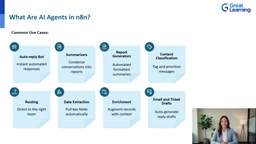
n8n AI Agent Tutorial: From Rule-Based Automation to an Intelligent Customer Support Bot
Learn how n8n AI Agents upgrade rule-based automation to intelligent reasoning, and build an AI support bot step by step using Webhook, Edit Fields, and OpenAI nodes.

Graph Database Boosts Incident Agent Accuracy by 14%, But the Truth Is More Complicated
A developer built the SynapseGuard incident agent on FalkorDB, hitting 95.2% root-cause accuracy on synthetic data but only tying baselines on real RCAEval. Here's where graph databases actually help AI agents.

LangGraph in Practice: From Building Blocks to Production-Grade AI Agents
*LangGraph in Small Pieces* is a hands-on handbook from foundational building blocks to production-grade AI Agents, covering 31 chapters on state, nodes, checkpoints, tool calling, RAG, memory, and evaluation, using local models by default with no API costs.

The Four Core Components of n8n AI Agent: Model, Tools, Memory, and Output Parser
Learn the four core components of n8n AI Agent: Chat Model, Tools, Memory, and Output Parser. Understand which are required and which are optional, and distinguish Chains from Agents to quickly build AI workflows.