#Claude Code token overhead
424 related articles

·3 min
Using AI Agents to Write Research Experiment Logs: A Complete Methodology and Workflow
Learn how to use AI Agents to build a Research Log for scientific experiments, covering structure, daily workflows, pre-experiment thinking, code change tracking, and human-AI division of labor.
Read more →

·3 min
From Frontend to Agent Development: A Complete 6-Week Systematic Learning Path
A 6-week systematic learning path for frontend engineers transitioning to AI Agent development, covering core architecture, ReAct, multi-agent collaboration, RAG integration, and deployment.
Read more →

·3 min
Claude Opus 5 Officially Released: Performance Approaching the Top Tier as the Open-Weight Debate Heats Up Again
Anthropic releases Claude Opus 5 with near-frontier performance at lower prices. Same day, Jensen Huang co-signs open-weight letter with 20+ companies while DeepSeek fundraising rumors surface.
Read more →

·3 min
Kimi K3 Launches on Ollama Cloud: Free Tier, User Experience, and Developer Guide
Kimi K3 officially launches on Ollama Cloud as an "extra high usage" model. This guide covers free tier quotas, cloud inference experience, technical advantages, and how developers can seamlessly call this high-performance LLM.
Read more →

·3 min
Agent Skills Explained: Plug-and-Play Skill Packs for AI
A deep dive into Agent Skills architecture: modular design, progressive disclosure mechanism, and how it differs from Multi-Agent systems for AI capability extension.
Read more →

·5 min
Complete Breakdown of Core Competencies for AI Agent Engineers: From Demo to Production-Grade Systems
Deep breakdown of 4 core AI Agent engineer competencies: business decomposition, multi-Agent architecture, quantitative evaluation, and engineering delivery—bridging the gap from Demo to production.
Read more →
·2 min
Getting Started with GitHub Copilot App: A Beginner's Guide to AI-Assisted Development
A detailed guide to GitHub Copilot's standalone app covering project creation, AI agent collaboration, canvas features, and tips to help developers get started with AI-assisted development.
Read more →

·2 min
Google Flash and Flash-Lite Models Upgraded and Live: A New Lightweight, High-Efficiency AI Option
Google rolls out upgraded 3.6 Flash and 3.5 Flash-Lite models. Learn about the Flash series' positioning, upgrade highlights, and value for developers.
Read more →

·4 min
Gemini 3.5 Pro Hands-On: No More Lazy Code Generation, Complete Projects in a Single Output
A Reddit user tested Gemini 3.5 Pro in Arena and found it generates 20+ files with hundreds of lines of code per file in a single pass, with no lazy shortcuts or placeholders.
Read more →

·3 min
Wattage: An AI Agent Token Cost Profiling and Regression Protection Tool
Deep dive into Wattage, an AI Agent token consumption profiling and cost regression protection tool, exploring its core features, industry context, and value for developers.
Read more →

·4 min
AI Coding Tools in Practice: Which Ones Actually Stuck with the Team?
A 12-person product team shares real-world experiences with Cursor, Codex, Claude Code, and CodeRabbit—exploring efficiency plateaus, scenario matching, and selection criteria for AI coding tools that actually stick.
Read more →

·5 min
From Chat to Agent: Automating Your Entire Business Workflow with AI Agents
Veteran AI practitioner Remy breaks down the leap from chat models to AI agents: how agents work, the three pillars of context, tools, and skills, MCP connections, and hands-on architecture to make you a 100x employee.
Read more →

·3 min
Context Engineering: Why Does More Context Make AI Dumber?
Anthropic introduces Context Engineering, revealing Context Rot: the more tokens in the window, the worse AI retrieval accuracy. Learn the three principles, just-in-time retrieval, and three moves against context overflow.
Read more →

·4 min
Gemini API in Practice: Building AI Agents with Files
Google's official hands-on: how to go from idea to production fast with AI Studio and build AI Agents using the now-GA Interactions API. The core idea—Agents are just combinations of files.
Read more →

·5 min
Gemini API in Practice: Building AI Agents with Files
Official Google hands-on: go from idea to production fast with AI Studio, and build AI Agents with the now-GA Interactions API. The core idea: an Agent is just a composition of files—Markdown plus a few scripts, no complex Python loops needed.
Read more →
·3 min
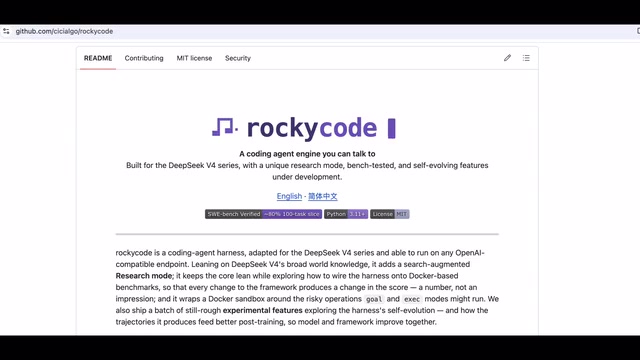
Rocky: An Open-Source Coding Agent with Minimal Architecture and Native DeepSeek Integration
Rocky is a minimal, transparent open-source coding agent with a core loop under a few hundred lines of Python, native DeepSeek search, Research mode, and built-in SWE benchmarking for reproducible agent experiments.
Read more →
Intelligent Model Routing: The Core Te…
·3 min
Intelligent Model Routing: The Core Technology and Implementation Guide for AI Cost Reduction and Efficiency
Intelligent Model Routing is becoming key AI infrastructure. This article explores its principles, solution types, technical challenges, and implementation considerations to help developers balance cost, latency, and quality.
Read more →
Alibaba Open-Sources Code Review Tool …
·5 min
Alibaba Open-Sources Code Review Tool open-code-review: Deterministic Pipeline + LLM Dual-Engine Analysis
Alibaba open-sources code review tool open-code-review, using a hybrid architecture of deterministic rule pipelines and LLM Agents. Supports line-level comments, OpenAI/Anthropic APIs, battle-tested at Alibaba scale, written in Go, fully free and open-source.
Read more →

·7 min
Getting Started with Codex: Installation and Usage Guide for OpenAI's AI Coding Agent
A comprehensive guide to OpenAI's new AI coding agent Codex: from concept and comparison of its four forms, to installing Git/Node.js/VS Code, configuring the API Key, and creating a workspace.
Read more →

·6 min
The AI Industrial Age Arrives: Compute Wars, Chip Reconstruction, and the GPT-5.6 Cheating Scandal Explained
Five key AI industry trends: Doubao surpasses 180 trillion daily calls, OpenAI's in-house AI chip, NVIDIA's $3-4 trillion compute forecast, China catching up, and the GPT-5.6 cheating scandal.
Read more →