#Cursor Plan Agent Ask modes
228 related articles
 Tutorials
·3 min
The Complete Guide to Cursor 2.0: Plan, Agent, and Ask — Three AI Modes Explained
A detailed guide to Cursor 2.0's three AI modes (Plan, Agent, Ask) and core features including inline editing, multi-Agent parallelism, project rules, and version control for efficient AI-powered development.
Read more →

·3 min
Termexo: A Local AI Coding Workbench for Windows, Integrating Claude Code and Codex
Termexo is a local AI coding workbench for Windows that integrates Claude Code and Codex agents, offering multi-terminal grid layouts, session recovery, approval notifications, and model switching—no account required.
Read more →

·4 min
Cursor Token-Saving in Practice: 8 Efficient Techniques to Reduce Usage
Learn 8 automatable techniques to reduce Cursor Token usage, including .cursorrules configuration, precise context control, model tiering, and more to cut AI coding costs.
Read more →

·3 min
Two Working Modes of Agentic AI: The Greenhouse and Lens Framework Explained
Deep dive into the Greenhouse and Lens modes of Agentic AI — understanding how agents excel in breadth exploration vs. precision convergence to optimize AI programming workflows.
Read more →

·3 min
Tigriden: A 40MB Rust Minimalist IDE Designed Specifically for AI Coding Agents
Tigriden is a minimalist Rust workbench using only 40MB of memory, designed for AI coding agents like Claude Code. No Electron, no LSP—leaving resources for AI.
Read more →

·3 min
Practical Guide to Setting Up a Local AI Coding Environment on MacBook Pro M4
Complete guide to setting up a local AI coding environment on MacBook Pro M4, covering Ollama, MLX, Continue, Qwen3-Coder 30B configuration, and performance optimization strategies for 32GB RAM.
Read more →

·3 min
AI Coding Agents Developing Decompilers: Lessons and Insights from the Kuna Project
How AI coding agents are transforming decompiler development. Using the Kuna project as a case study, exploring AI-assisted iteration, generate-verify loops, and the lowering barriers to complex system tool development.
Read more →

·4 min
Fable 5 vs GPT-5.6: An In-Depth Head-to-Head Comparison of Two Top-Tier Coding Models
In-depth comparison of Fable 5 vs GPT-5.6 (Sol) for AI coding. Real-world data on token efficiency, code quality, design capability, and cost from $10K+ testing.
Read more →

·4 min
Fable 5 vs GPT-5.6: An In-Depth Head-to-Head Comparison of Two Top-Tier Coding Models
In-depth comparison of Fable 5 vs GPT-5.6 (Sol) for AI coding. Covering token efficiency, code quality, design, cost, and safety based on $10K+ real usage data.
Read more →
·3 min
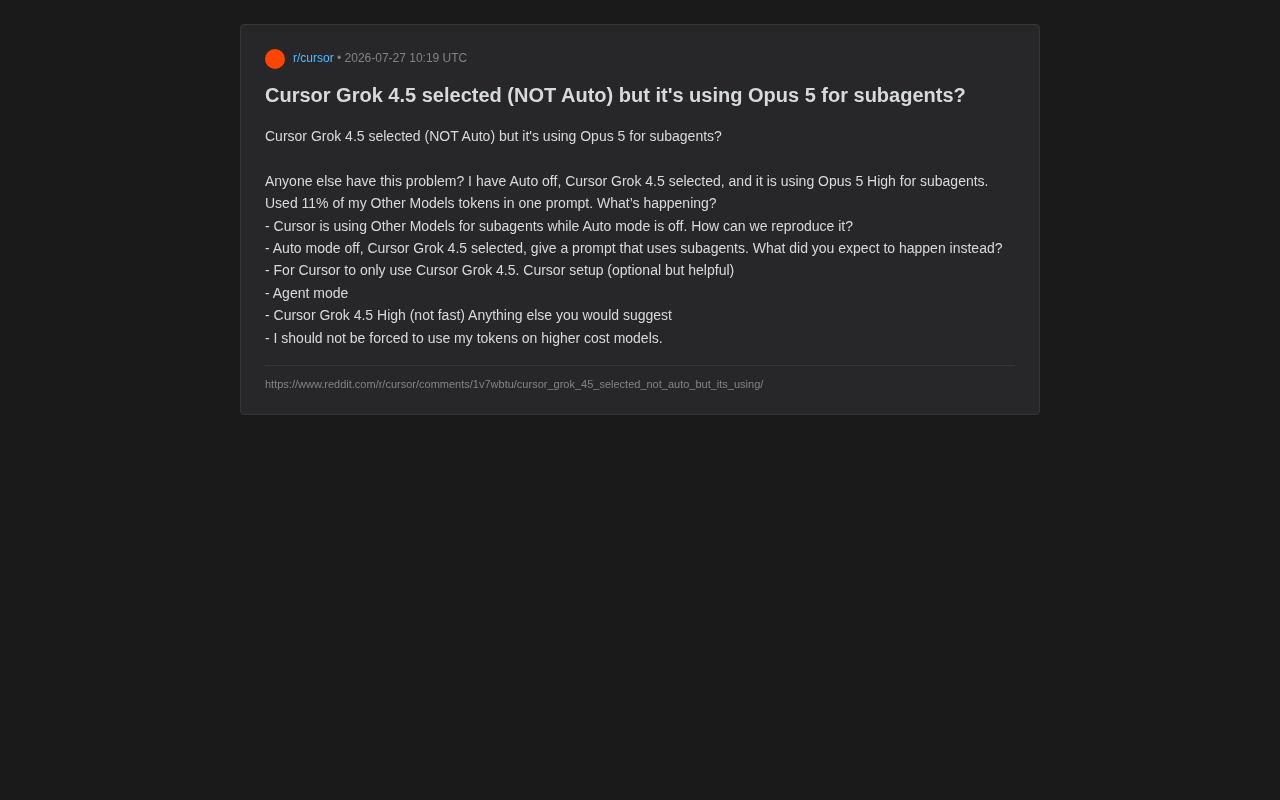
Cursor Selects Grok but Calls Opus: Subagent Model Substitution and Cost Control Issues Explained
Cursor users selecting Grok 4.5 find subagents secretly calling expensive Opus 5, consuming 11% quota per prompt. Analysis of model decoupling, cost transparency, and user strategies.
Read more →

·4 min
AI Coding Tools in Practice: Which Ones Actually Stuck with the Team?
A 12-person product team shares real-world experiences with Cursor, Codex, Claude Code, and CodeRabbit—exploring efficiency plateaus, scenario matching, and selection criteria for AI coding tools that actually stick.
Read more →

·4 min
The Cursor Swarm Experiment: What AI Rebuilding SQLite from Scratch in Rust Reveals About Cost
Cursor's swarm experiment had AI teams implement a SQLite engine in Rust from scratch using only 835 pages of docs. All-frontier models cost $10K+, hybrid role division just $1.3K—a 7.9x gap.
Read more →

·3 min
Cursor + Claude in Action: Building a Python Student Management System from Scratch with AI
A step-by-step guide to building a Python student management system from scratch using the AI editor Cursor with Claude. Covers Agent, Ask, and Manual modes, model selection, and the full workflow.
Read more →

·3 min
Pi Agent Configuration Guide: Building Your Own AI Coding Assistant
A step-by-step Pi Agent configuration tutorial covering installation, LLM connection, extension ecosystem, MCP setup, and Token-saving tips. Learn to build a truly controllable AI coding assistant.
Read more →

·3 min
Claude Code for Absolute Beginners: A Step-by-Step Guide (Install + Connect an LLM + Hands-On Practice)
How do complete beginners get started with Claude Code? This guide covers VS Code setup, two ways to connect an LLM in China, four core usage modes, and building your first practical tool without writing a single line of code.
Read more →

·3 min
Getting Started with Claude Code: Installation, Configuration, and Three Working Modes Explained
Get started with Claude Code from scratch: detailed Windows installation, environment variable setup, China network bypass, and connecting to free Alibaba Cloud Bailian models—plus the three working modes.
Read more →

·3 min
OpenAI Releases GPT-5.6 and ChatGPT Work: The Era of Autonomous AI Has Arrived
OpenAI launches GPT-5.6 (Sol, Terra, Luna), ChatGPT Work, a new desktop app, and Sites hosting. AI evolves from a Q&A tool into an autonomous work partner for finance, file management, and more.
Read more →

·7 min
Getting Started with Claude Code: Five Dimensions to Understand Why It Outperforms Regular AI
Claude Code isn't just a chat AI—it can directly read projects, modify code, and run commands. This article compares Claude Code with regular AI across five dimensions to help you decide if it's worth trying.
Read more →

·7 min
Getting Started with Claude Code: Five Dimensions That Show Why It Outperforms Ordinary AI
Claude Code isn't just a chat AI—it can directly read projects, modify code, and run commands. This article compares Claude Code with ordinary AI across five dimensions: interaction, context, execution, memory, and tool calling.
Read more →

·5 min
From Vibe Coding to AI Engineering: A Complete Guide to Enterprise-Grade Development
In the AI programming era, Vibe Coding alone can only build toys. This article deeply analyzes the complete engineering path from Vibe Coding to SDD spec-driven development, covering Claude Code and Codex tool selection, the SuperPower plugin, and domestic LLM comparisons.
Read more →