#GPU offloading
62 related articles

·3 min
ComfyUI Integration with MiniMax H3: Complete Video Generation Workflow Deployment and Optimization Guide
Complete guide to deploying MiniMax H3 video generation in ComfyUI, covering text-to-video, image-to-video, first/last frame animation, environment setup, VRAM optimization, and prompt techniques.
Read more →

·3 min
Local LLM Selection Guide: Practical Applications for Cybersecurity Purple Teams
A deep dive into how cybersecurity Purple Teams and SOC analysts can select locally deployed LLMs, covering hardware constraints, censored vs. uncensored models, specific recommendations, and RAG integration.
Read more →

·2 min
When Claude Goes Down: The Anxiety Over Independent Thinking Behind AI Dependence
When AI services like Claude go down, dependent employees are lost while veteran colleagues think independently. Exploring the cognitive outsourcing risks behind AI dependence.
Read more →

·3 min
Unsloth Teams Up with Thinking Machines: Dynamic 1-bit Quantization Achieves 86% Compression, Running Multimodal LLMs in 270GB
Unsloth and Thinking Machines release dynamic 1-bit GGUF quantization for Inkling, compressing the model from 1.9TB to 270GB (86% reduction) while retaining 74.2% accuracy and adding vision/audio multimodal support.
Read more →

·3 min
Quantprobe: An Open-Source Tool for Running 30B LLMs on 6GB GPUs
Quantprobe is an open-source memory optimization framework that enables 30B LLMs to run at 22 tokens/s on 6GB GPUs through per-layer quantization and intelligent CPU/GPU splitting.
Read more →

·3 min
Fine-Tuning 8B LLMs on a 4GB GPU: A Deep Dive into VRAM Optimization Techniques
Learn how to fine-tune 8B parameter LLMs on a 4GB laptop GPU using QLoRA quantization, gradient checkpointing, and gradient accumulation VRAM optimization techniques.
Read more →

·3 min
Locally Deploying LLMs for Trading Bots: Hardware Selection & Model Recommendations
How to deploy LLMs locally on AMD RX 7800 XT 16GB for trading bots: ROCm ecosystem, 7B-14B model picks (Qwen2.5, Llama 3.1), Ollama/LM Studio setup, and system architecture design.
Read more →

·3 min
Dual RTX 3060 Running DeepSeek V4 Flash: IQ2_M Quantized Inference Benchmarked at 3.5 tok/s
Benchmarking DeepSeek V4 Flash on dual RTX 3060 GPUs with 96GB RAM at IQ2_M quantization achieving 3.5 tokens/sec. Covers hardware choices, 2-bit quantization techniques, and local LLM deployment optimization.
Read more →

·3 min
20W Home Server: Unraid Self-Hosting and Usenet Streaming in Practice
A six-year Unraid user shares a 20W ultra-low-power home server using Intel N100, hot/cold data separation, and NZBDAV Usenet streaming to replace 30TB of local hard drives.
Read more →

·3 min
LLM Inference Speed Formula: Memory Bandwidth Determines Your tokens/sec
Learn why memory bandwidth (GB/s)—not VRAM size—determines local LLM inference speed. Get the tokens/sec formula, GPU bandwidth comparisons, and a practical card selection hierarchy.
Read more →

·3 min
LLM Inference Speed Formula: Memory Bandwidth Determines Your tokens/sec
Why memory bandwidth (GB/s), not VRAM size, determines local LLM inference speed. Includes tokens/sec formula, GPU bandwidth comparison, and a practical card selection framework.
Read more →

·2 min
JusTTY: A Deep Dive into the Minimalist Native macOS Terminal Built on libghostty
JusTTY is a minimalist native macOS terminal built on libghostty and Swift, focused on being lightweight, fast, and ready to use. A deep dive into its architecture and place in the terminal ecosystem.
Read more →

·3 min
Self-Hosting Kimi K3: Is Spending 20% More on Hardware Worth a 20% Improvement in Task Performance?
Analysis of whether spending 20% more on hardware for self-hosting Kimi K3 to gain 20% task performance improvement is worthwhile, covering inference precision, VRAM optimization, and tiered deployment.
Read more →

·3 min
Local LLM Agent Lagging? Lowering num_gpu Is the Key
Local LLM crashing in Agent frameworks? The issue may be num_gpu set too high. Learn what num_gpu really controls (GPU layer offloading, not GPU count) and how to tune it for stable Agent performance.
Read more →

·3 min
SCAIL 2 Deep Dive: Character Replacement, Physics Simulation & Object Permanence Performance Analysis
In-depth testing of SCAIL 2 video generation AI across character replacement, physics simulation, object permanence, and more—covering reference image prep, ComfyUI workflows, and real results.
Read more →

·3 min
How to Fix AI Tool Error 1076? Root Cause Analysis and Solutions
Getting "Something went wrong 1076" from an AI service? This article analyzes common causes including server overload and session issues, with practical troubleshooting steps to restore normal usage.
Read more →
·3 min
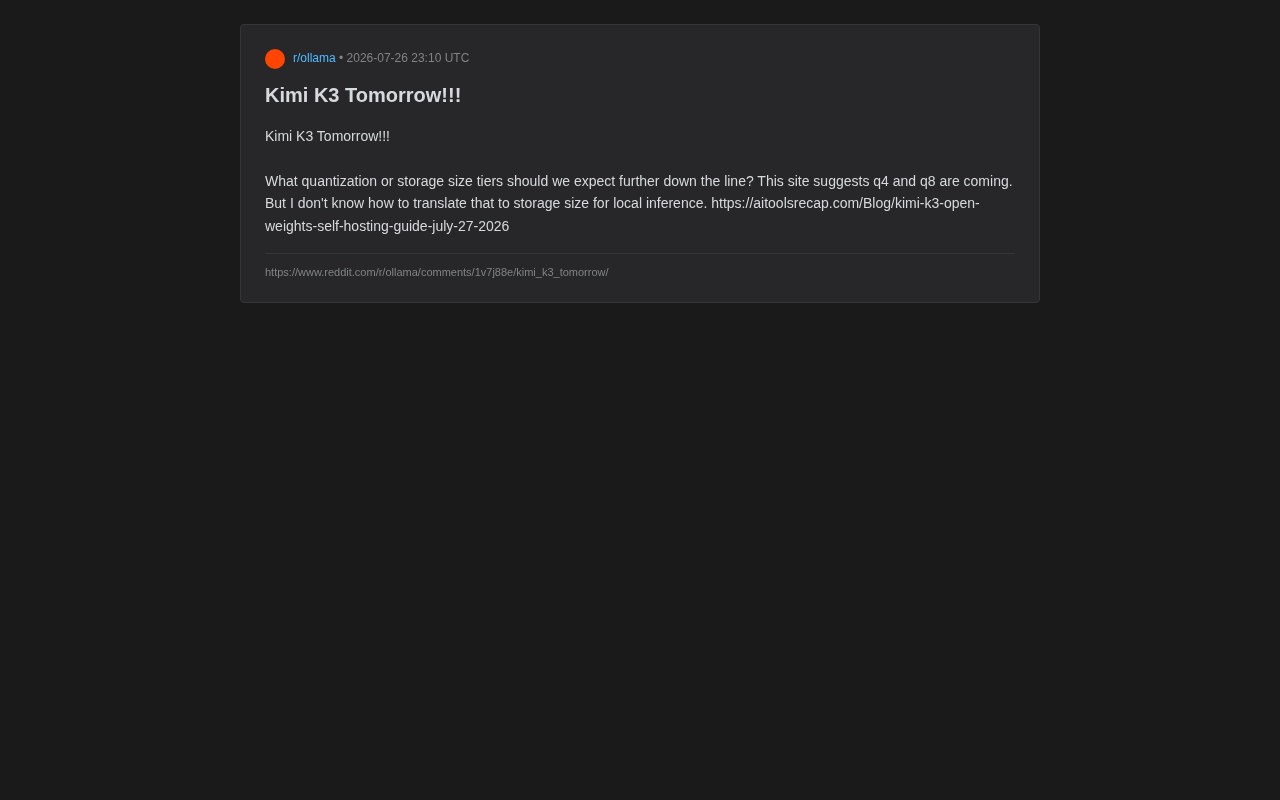
Kimi K3 Local Deployment Guide: Storage Requirements for q4 and q8 Quantization Explained
Detailed analysis of Kimi K3 quantization deployment options, comparing q4 vs q8 storage requirements, precision trade-offs, and hardware configurations for local self-hosting.
Read more →

·5 min
Ollama Performance Degrades After Connecting to OpenWebUI? A Complete Troubleshooting Guide
Complete guide to troubleshooting Ollama performance degradation with OpenWebUI, covering num_ctx truncation, sampling parameter differences, GPU resource contention, and system prompt interference.
Read more →

·4 min
Dify Local Deployment Guide: One-Click Private AI Platform with Docker
Step-by-step guide to deploying Dify AI platform locally with Docker. Covers Linux, Windows, macOS setup, docker compose launch, and first-time initialization in under 30 minutes.
Read more →

·3 min
InvokeAI In-Depth Review: Can It Replace SD WebUI and ComfyUI?
A hands-on InvokeAI review covering installation, VRAM optimization, infinite canvas, node workflows, and model management — with an objective comparison to SD WebUI and ComfyUI.
Read more →