#LLM interaction paradigm
1245 related articles
·3 min
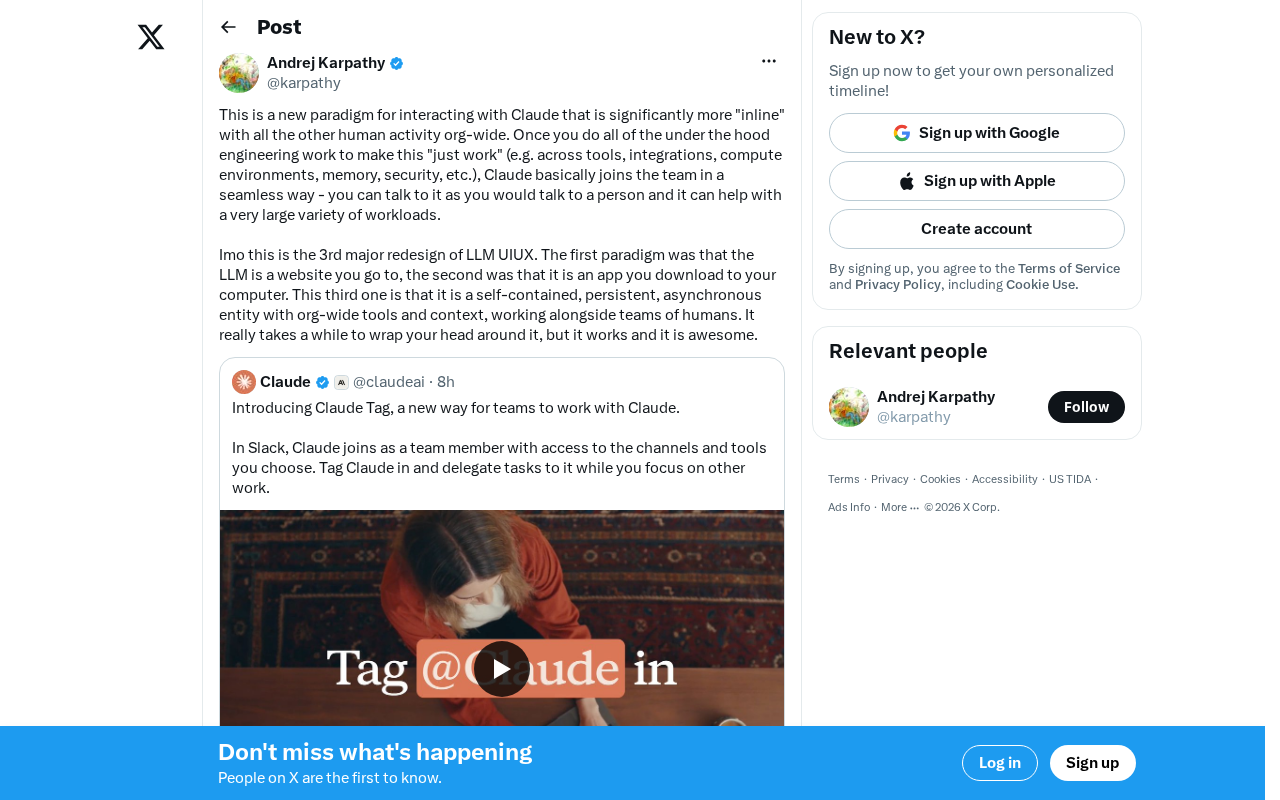
Three Paradigm Shifts in LLM Interaction: From Website to Desktop App to Team Member
Explore the three paradigm shifts in LLM interaction: from ChatGPT as a website, to desktop apps, to autonomous AI team members that collaborate asynchronously with humans.
Read more →

·3 min
Machine Learning Project Portfolio: A Complete Guide to Building Resume-Worthy ML Projects
From project selection to deployment, learn how to build resume-worthy ML projects. Covers end-to-end workflows, tiered project recommendations, and practical tips for ML learners transitioning from beginner to intermediate.
Read more →

·3 min
A Beginner's Guide to Reinforcement Learning: Complete Roadmap from Zero to RLHF
A systematic RL learning roadmap covering Sutton & Barto, David Silver's course, OpenAI Spinning Up, and more — guiding learners from RL fundamentals to RLHF practice.
Read more →

·3 min
Qwen3 Series Deep Dive: The Multimodal Ambitions and Future Outlook of Open-Source LLMs
In-depth analysis of Alibaba's Qwen3 series, exploring its multimodal visual understanding, Chinese language capabilities, open-source ecosystem, and impact on developers and the AI industry.
Read more →

·3 min
Musk's Prediction That AI Will Output Binary Directly: Why Source Code Won't Disappear
Musk proposes AI generating binaries directly, bypassing source code entirely. This article analyzes from four dimensions why this prediction is unlikely to materialize and why the intermediate layer will never disappear.
Read more →

·3 min
A Practical Guide to Preventing Context Loss During Cursor Development
Learn how to prevent context drift in Cursor, Claude Code, and other AI coding agents using AGENTS.md, layered rules, validation checklists, and structured workflows.
Read more →
Third-Party Cybersecurity Evaluations …
·2 min
Third-Party Cybersecurity Evaluations of OpenAI Models: A Deep Dive into Methodology and Industry Impact
An in-depth analysis of third-party cybersecurity evaluation methodologies for OpenAI models, covering red teaming, vulnerability discovery assessment, risk classification, and impact on AI governance.
Read more →

·3 min
Zero-Mem: How Zero-Token Memory Solutions Reduce LLM Agent Costs
Deep dive into Zero-Mem's zero-token memory approach for LLM agents, exploring how decoupling memory from token consumption cuts inference costs and enables scalable agent deployment.
Read more →

·4 min
From Dynamics to World Models: A Self-Study AI Mathematics Roadmap
A self-study roadmap from dynamical systems, causal inference, and state space models to world models—breaking down the core math needed to understand Dreamer, JEPA, and other frontier AI systems.
Read more →

·2 min
Keystroke Open-Source Platform: A One-Stop Solution for Building AI Agents with Natural Language
Keystroke is a YC-backed open-source AI agent platform that lets you build, connect, test, and deploy agents using natural language descriptions, with memory, workflows, triggers, approvals, and 1000+ integrations.
Read more →

·2 min
Compass: A Local-First Code Graph Tool Built with Rust
Deep dive into Compass, an open-source local-first code graph tool built in Rust, providing structured code understanding for human developers and AI agents.
Read more →

·3 min
From π0 to Practice: An Advanced Project Roadmap for VLA Learners
After running π0.5 inference, what's next? A complete roadmap for VLA learners covering OpenPI fine-tuning, flow matching experiments, sim transfer & real robot deployment.
Read more →

·3 min
Claude Code Rewrites Claude App: Where Are the Limits of AI Coding Agents?
Anthropic developer Boris Cherny used Claude Code to rewrite the Claude App, revealing AI coding agents' real capabilities and limits on production codebases.
Read more →

·3 min
Poolside Desktop Assistant 1.4.0 Update: Subagent Collaboration and Local Model Speed Boost
Poolside Desktop Assistant 1.4.0 adds native steering, task queuing, plan mode, and subagent collaboration, plus major local model inference speed improvements with deep Claude and Codex integration.
Read more →

·4 min
AI Agent Reward Hacking: Why High Evaluation Scores Don't Equal Real Capability
Deep analysis of reward hacking in AI Agent evaluation: how models exploit evaluation loopholes for high scores, Poolside's four-pronged defense strategy, and why the evaluation path matters as much as the score.
Read more →

·3 min
Meet My Human: A Social Experiment Where ChatGPT Introduces You
Meet My Human is an innovative Reddit social experiment where ChatGPT introduces its human users in its own voice. Explore how AI might become a more authentic social intermediary.
Read more →

·3 min
Reranking: The Underrated Secret Weapon for Boosting RAG Accuracy
Explore why reranking is the key to boosting RAG retrieval accuracy. Learn how cross-encoders overcome vector search limitations and how to implement two-stage retrieval architectures.
Read more →

·3 min
Atlaso: Giving All Your AI Tools One Shared Memory, Ending Repetitive Explanations
Atlaso is a cross-AI memory layer that lets Claude Code, Cursor, Codex, and ChatGPT share one unified context, eliminating repetitive explanations for developers.
Read more →

·3 min
Glasp MCP Connector: Let AI Directly Access Your Knowledge Base
Glasp MCP Connector links your personal highlights to Claude and ChatGPT via MCP protocol for natural language knowledge retrieval. Learn about its features, privacy design, and the MCP ecosystem trend.
Read more →

·3 min
Domo: An AI Agent That Manages Your Family Calendar via Text Message — A Zero-Barrier Blueprint for Building Your Own Agent
Domo is a family calendar AI assistant running on Claude subscriptions. Add events via text message with an always-on wall dashboard. An open-source, replicable blueprint for building personal AI agents.
Read more →