#LangChain v0.3
39 related articles

·3 min
Complete Guide to LangChain 0.3: Module Architecture & Core Development in Practice
A deep dive into LangChain 0.3's module architecture, message abstraction, prompt templates, output parsers, LCEL chains, LangSmith tracing, and LangGraph for mastering LLM application development.
Read more →
 Tutorials
·2 min
LangChain v0.3 Agent Tutorial: Complete Guide to Tool Definition, Building, and Execution
Complete guide to building AI Agents in LangChain v0.3, covering @tool decorator, Agent Executor, parallel tool calls, Google Search integration, and ReAct framework with code examples.
Read more →

·2 min
DeepSeek-V4-Flash-0731: Achieving Agent Capabilities Beyond Pro at Flash Prices
DeepSeek-V4-Flash-0731 delivers frontier agentic capabilities at Flash-tier pricing, claiming to surpass V4-Pro on key benchmarks. Native Responses API and Codex CLI support for AI coding and Agent developers.
Read more →

·5 min
Have AI Doomers Actually Used AI? A Developer Exposes the Gap Between Hype and Reality
AI Doomers warn AI will destroy humanity, but have they actually built AI apps? A developer's sharp critique reveals the vast gap between AI demos and real engineering practice.
Read more →

·5 min
Opus 5 Builds a No Man's Sky-Style Exploration Game in One Day: MCP and Sub-Agent Architecture Explained
A developer used Anthropic's Opus 5 model to build a No Man's Sky-style space exploration game in one day using Blender MCP and sub-agents. Deep dive into the technical architecture and industry implications.
Read more →

·2 min
OfficeCLI Hands-On: AI Batch Read, Edit & Generate Word/Excel/PPT Without Installing Office
Hands-on test of open-source OfficeCLI: a single binary reads, edits, and generates Word/Excel/PPT. 1,000 cells rewritten in 0.37s, Chinese text supported. Covers XML internals, real failures, and AI Agent integration.
Read more →

·3 min
LangChain v1.3 Hands-On Tutorial: Deep Dive into Agents, RAG, and Local Model Deployment
Deep dive into LangChain v1.3: compare LangChain, LangGraph, and DeepAgent paradigms, explore RAG pipelines, multi-agent systems, and local LLM deployment for enterprise AI apps.
Read more →

·2 min
LangGraph Multi-Agent Architecture in Practice: From Core Components to Production Deployment
A deep dive into LangGraph multi-agent architecture — covering hierarchical, network, and pipeline patterns with three hands-on projects using LangGraph 0.3.
Read more →

·3 min
LangChain V1.3 in Practice: Mastering AI Engineering Mindset — From Tool User to Tool Master
Why do AI results vary so dramatically? LangChain V1.3 reveals the answer: engineering mindset. Covers LangGraph, Deep Agent, RAG, Time Travel, and more.
Read more →
·3 min
AI Agent 4-Week Learning Roadmap: A Complete Guide from Zero to Independent Development
A structured 4-week AI Agent learning roadmap: Week 1 covers LLMs & Prompt engineering, Week 2 ReAct paradigms, Week 3 RAG memory systems, Week 4 multi-agent architectures.
Read more →

·3 min
How to Choose an AI Agent Development Course? 5 Practical Screening Criteria to Avoid Common Pitfalls
How to choose a quality AI Agent development course? This guide covers 5 key criteria: complete delivery pipeline, resume-worthy projects, real engineering perspective, update frequency, and mentorship.
Read more →

·4 min
LangChain in Practice: Mastering the Four Core Modules of the Agent Ecosystem
A deep dive into LangChain's four core modules: LangChain components, LangGraph orchestration, Deep Agents, and LangSmith. Build your first Agent from scratch.
Read more →

·4 min
LangChain V1.3 in Practice: Master AI Engineering Thinking and Break Free from Tool Dependency
LangChain V1.3 course deep-dive: why engineering thinking beats tool-chasing. Covers RAG accuracy myths, Token cost control, and LangChain/LangGraph/Deep Agent breakdowns.
Read more →
·3 min
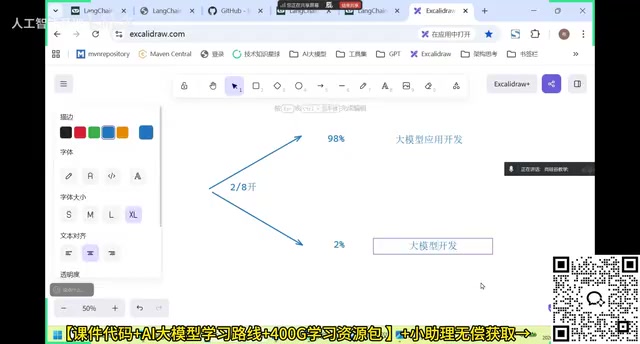
LangChain Practical Guide: From RAG Applications to Intelligent Agent Development
A comprehensive guide to LangChain: core concepts, RAG applications, Agent development, version selection (0.3/1.0), and career opportunities for Java/Python developers entering LLM development.
Read more →

·3 min
How to Choose AI Courses: A Practical Guide to Avoiding Pitfalls and Leveling Up
How to find AI courses worth paying for amid the flood of beginner content. A guide to evaluating courses on Agentic workflows, RAG, fine-tuning, and more.
Read more →

·5 min
Getting Started with LangGraph: Building AI Agent Workflows with Graph Structures
Master LangGraph core concepts: nodes, edges, and routing functions. Learn StateGraph, MemorySaver, and ToolNode through a weather-query Hello World example, and understand how LangGraph relates to LangChain and powers Agent workflows.
Read more →

·3 min
A Physical Status Light for Claude Code: Using ESP32 to Stop Staring at Your Terminal
Tired of staring at a terminal waiting for AI? An ESP32 + RGB light maps Claude Code's states to blue/yellow/green/red physical light effects. See what the AI is doing at a glance.
Read more →

·7 min
The Agent Engineer Transition Roadmap: A Deep Dive into Three Core Skill Systems
Want to become an Agent engineer? This article systematically covers three core skill tracks—LLM fundamentals, LangChain architecture development, and enterprise deployment—to help you avoid detours.
Read more →

·4 min
Career Switch to LLM Development: A Four-Level Skill Progression Roadmap
Want to switch careers into LLM development but don't know where to start? This guide breaks down a four-level skill roadmap — from basics and API calls to RAG, fine-tuning, Agent development, and multimodal — to help you build real AI career value.
Read more →

·7 min
LangSmith Engine: An Intelligent Operations Tool That Automatically Diagnoses and Fixes Agent Failures
LangChain's LangSmith Engine is an intelligent agent tool for tracking Agent failures, prioritizing issues, and auto-drafting fixes. Deep dive into its core capabilities, sandbox isolation, sub-Agent architecture, and continuous evaluation challenges.
Read more →