#MCP
506 related articles

MCP vs REST API: What Do AI Agents Really Need?
A deep comparison of MCP vs REST API: MCP lets AI Agents autonomously discover and invoke services, while REST serves human developers. They collaborate in layers rather than replace each other — this article breaks down the workflow, security context passing, and selection advice.

Why Does Claude Code Load None of Its 170 MCP Tools?
Claude Code uses tool search to load only MCP tool names at startup instead of full manuals, cutting a 55,000-token tool overhead by over 85%. This article examines how it works, its real-world results, and its limits.

MCP + CLI > MCP vs. CLI: The Protocol Didn't Lose — Agents Just Used It Wrong
MCP is dismissed because agents use it badly. Apify's mcpc shows MCP for remote + CLI for local, with progressive tool discovery and code mode.

MCP's Major 2026 Overhaul: A Stateless Core and Production-Grade Agent Protocol
MCP's 2026 revision removes session binding for a stateless core, drops the initialize handshake and Mcp-Session-Id, adds server/discover, and moves the Agent protocol toward production-grade deployment.
Connecting AI Agents to Real-Time Amaz…
Connecting AI Agents to Real-Time Amazon Data: A Practical Guide to MCP and REST
A complete, runnable guide to connecting AI Agents to real-time Amazon data: MCP endpoint setup, three-step test, Python reference implementation, and the verifiability gap between grounded and bare models on business questions, with cost, security, and platform integration status.

Turn Any Existing API into an AI-Ready MCP Server Without Writing Code
See how to turn any existing OpenAPI contract into an MCP server with one command, letting AI agents act on your real APIs — no code, no backend changes.

Cyango MCP in Action: Generating XR Interactive Experiences with AI in Cursor
Connect Cursor's AI agent to Cyango XR Studio via MCP to generate 3D interactive quiz experiences from a single prompt. Full walkthrough of setup, model selection, bug fixing, and visual customization.

AI Agent Reverse Engineering Games: REA Lets Ghidra Write C Code Automatically
REA is an open-source MCP server plus agent skill that lets an AI coding agent drive Ghidra, IDA, or Hopper with one npx command. In the demo, it starts from DXBall's incomplete decompilation output, rewrites a C function, and passes 3,205 test cases with a 63-byte full match—but the gap between a single function and a complete game is still enormous.

Context Mode Tested: Is the 98% AI Agent Context Reduction Real or Hype?
Context Mode claims 98% AI Agent context compression. We break down the real numbers, community traction, and user feedback.

Anthropic's Official MCP Python SDK: Standardizing AI Agent Tool Integration
Anthropic's official open-source MCP Python SDK turns local async functions into AI Agent-callable tools via the @mcp.tool decorator, supporting stdio and SSE transports, standardizing AI tool discovery and invocation to lower Agent integration costs.

What Exactly Is the Difference Between MCP and Tool Calling?
Is MCP the same as Tool Calling? This article breaks down their essential difference: Tool Calling lets AI request function execution, while MCP provides a standardized communication protocol. With Spring AI scenarios, it explains when to use MCP and when you don't need it.

Connecting Claude Code to Dawnwood via MCP: Running an AI Studio from Your Chat
Dawnwood uses MCP to let Claude Code, Cursor, and Claude Desktop drive an AI studio directly: generate an API Token, log in from the terminal, register the MCP server—about 90 seconds to onboard, with agents handling episode planning, scripts, rendering, and delivery while approval gates stay in human hands.

Fabric IQ MCP Server: What AI Agents Can Read from Power BI
Fabric IQ MCP Server is now GA: Microsoft-hosted, Entra ID delegated sign-in, six read-only tools—letting AI agents query Power BI semantic models directly. We break down its architecture, permission boundaries, when to use it, and how it differs from Fabric Core MCP Server.

Building 6 B2B APIs in 6 Days: A Cloudflare Workers + MCP + x402 Post-Mortem
A developer built 6 B2B API products, 2 MCP servers, and 914 SEO pages in 6 days using Cloudflare Workers + MCP + x402. HS classifier benchmarks 24.5% accuracy at $0.01/call — full stack and growth post-mortem.

Keyword Research Inside AI Chats: A Practical MCP Guide
MCP lets you do keyword research right inside AI chats — no tool switching. A 15-minute workflow covering seed extraction, intent clustering, and AI citation layer checks, with real data from a small team and common failure modes.

MCP Servers: The New Visibility Entry Point in the Age of AI Answer Engines
MCP protocol is changing the visibility rules of AI answer engines. This article explains how MCP servers let tools be called by agents, how to design citable tool descriptions, the real support status of ChatGPT and Perplexity, and how to measure AI citation share.

When AI Queries Your Database, Where Does Your Data Actually Go?
When AI assistants query databases, data travels through four layers: the chat app, the AI model, the MCP server, and the database. Credentials stay in one place, but results travel everywhere. This article traces a query's full journey, maps four places data may linger, and offers five practical ways to shrink your data footprint.
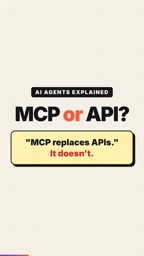
Will MCP Replace API? The Essential Difference Explained in 40 Seconds
Will MCP replace API? No. This article uses a concise comparison to clarify the essential difference: API is designed for programmers, MCP for AI applications — it still calls APIs underneath, an abstraction layer rather than a replacement.

Azure AI Language + MCP: Giving AI Agents Real NLP Capabilities in Practice
Learn how to connect Azure AI Language NLP capabilities to Microsoft Foundry Agent via MCP for language detection, entity extraction, PII detection, plus regional pitfalls and permissions setup.

MCP Protocol Explained: Build Your AI Server with 10 Lines of Python
What is MCP (Model Context Protocol)? This article visualizes the MCP architecture, explains Host/Client/Server roles, the three primitives Tools/Resources/Prompts, and JSON-RPC messaging, demonstrates building an MCP server with 10 lines of Python, and analyzes security risks like tool poisoning.