#Ollama engineering runtime
148 related articles

·2 min
Text-Only Models Controlling a Linux Desktop: Inside PawFlow's Dual-Model Architecture
PawFlow decouples vision and reasoning into two models, letting a text-only LLM reliably control a Linux desktop. A deep dive into its dual-model architecture, pre-click guard, and caching strategy.
Read more →

·3 min
Complete Guide to Deploying LLMs Locally on RobotCore Mini: From Ollama Installation to Web Interface Setup
A complete guide to deploying LLMs locally on RobotCore Mini using Ollama — covering model pulling, CLI verification, Web backend setup, and LAN access.
Read more →

·3 min
Waku Agent Deep Dive: The Four Core Pillars of a Local-First AI Assistant
A deep dive into Waku Agent's four pillars: Loop Engineering, three-tier Memory system, Eval assessment, and the Harness scaffold. Full walkthrough of a local-first AI assistant from task execution to memory consolidation.
Read more →
·3 min
Uncensored AI Models Deep Dive: How They Work, Local Deployment, and the Truth About Self-Learning
A deep dive into uncensored AI models: how censorship is removed, whether self-learning is real, and hardware requirements for local deployment. Covers Ollama, LM Studio, Llama, quantization, and more.
Read more →

·2 min
QuantaMind: An Open-Source Tool for Testing AI Agent Reliability Locally
QuantaMind is a free, open-source local AI Agent reliability testing tool using pass^k scoring and deterministic evaluation, supporting Ollama, llama.cpp, vLLM, and more.
Read more →
Building an Offline RAG App from Scrat…
·3 min
Building an Offline RAG App from Scratch: A Complete Guide to Local PDF Q&A
Learn how to build a fully offline RAG app using Ollama, ChromaDB, and Flask for local PDF Q&A. Covers chunking, vectorization, retrieval, and hallucination prevention.
Read more →

·2 min
A College Student Built a Cross-Model Persistent Memory System with Ollama: Decoupled Architecture + AES-256 Encryption
A college student built a ~40K-line Mac app around Ollama featuring a decoupled persistent memory system: standalone embeddings, local vector index, self-healing, AES-256 vault, and local voice mode.
Read more →

·2 min
Microsoft Open-Sources .NET Skills: Making AI Coding Agents Master C# Development
Microsoft open-sources dotnet/skills, packaging .NET/C# best practices as structured skills for AI coding agents. Bridges domain knowledge gaps in general LLMs, improving code quality for GitHub Copilot and other tools.
Read more →

·6 min
AI Agent Development in Go: A Hands-On Guide to ByteDance's Eino Framework and Its Seven Core Capabilities
Build production-grade AI Agents with a pure Go stack using ByteDance's Eino framework. A deep dive into seven core capabilities: multi-Agent orchestration, long-task execution, command approval, RAG, MCP, Skills, and database reporting.
Read more →

·4 min
Complete Guide: Connecting Claude Code to DeepSeek — Local Setup + VS Code Integration
A step-by-step guide to installing Claude Code locally on Windows and swapping its underlying model for the DeepSeek API—enabling low-cost AI coding with no VPN required. Covers Node.js setup, Claude Code config, and getting a DeepSeek API Key.
Read more →

·6 min
GPT-5.6 Now Widely Available: The Era of Three-Tier Models and Multi-Agent Orchestration Arrives
OpenAI releases GPT-5.6 (SOUL/TERRA/LUNA), with Ultra mode running four agents in parallel; Meta launches Muse Spark 1.1 with million-token context; ChatGPT desktop unifies Chat, Work, and Codex.
Read more →

·5 min
Ollama Raises $65M Series B: 85% of Fortune 500 Have Already Deployed Local LLMs
Local LLM tool Ollama closes a $65M Series B, bringing total funding to $88M. With 9M developers and 85% of Fortune 500 having deployed internally, this deep dive explores why enterprises embrace local LLMs: compliance, Agent cost savings, and open-source ecosystem.
Read more →

·3 min
Connecting Codex to Ollama: A Complete Guide to Deploying AI Large Models Locally
A step-by-step guide to combining Codex with Ollama to deploy open-source AI large models locally. Private data, no subscription, offline operation, no VPN needed. Includes hardware selection and setup.
Read more →

·6 min
Why Is Qwen3 27B So Slow on a 4090? A Hands-On Guide to Local Inference Performance Optimization
RTX 4090 taking over 400 seconds to run Qwen3 27B inference? This article analyzes the core causes—VRAM overflow and CPU offloading drag—and offers targeted fixes.
Read more →

·5 min
Why Did Ollama Rise So Fast? Decoding the Success of a Local LLM Tool
How did Ollama grow from a niche open-source project into developers' default choice for running local LLMs? This article breaks down its rise across product design, technical strategy, and ecosystem building.
Read more →

·5 min
28 Enterprise-Grade AI Agent Projects: A Complete Guide That Even Beginners Can Deploy
A collection of 28 fully reproducible enterprise-grade AI Agent projects covering code debugging, financial analysis, customer service, and multi-agent collaboration—deployable even for beginners.
Read more →

·4 min
BingoCode: An Open-Source AI Coding Tool for Offline Deployment — A Claude Code Alternative
BingoCode is an MIT-licensed open-source AI coding tool supporting offline intranet deployment, compatible with DeepSeek, Claude, OpenAI, and Gemini. Pure CLI design, four-step setup, high cache hit rates for lower costs — ideal for security-conscious teams.
Read more →

·2 min
GBrain Local Deployment Guide: An AI Knowledge Engine That Outperforms Traditional RAG by 31%
GBrain is an open-source AI knowledge base supporting full local offline deployment. Its 12-step retrieval pipeline and knowledge graph boost accuracy 31% over traditional RAG.
Read more →
·6 min
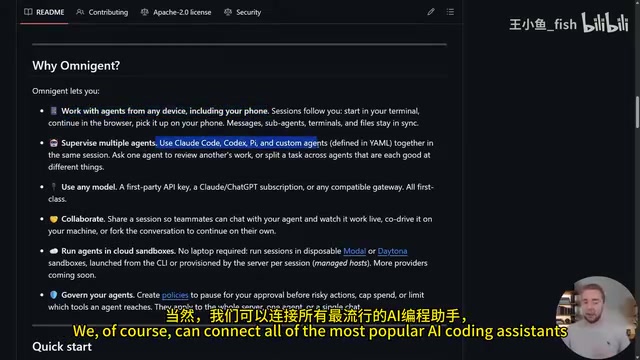
Omnigent Open-Sourced: A Meta-Harness for AI Coding Agents Built by Databricks
Databricks open-sources Omnigent, a Meta-Harness for orchestrating Claude Code, Codex, and more AI coding assistants together—with built-in guardrails, cross-model workflows, and real-time collaboration. Get started in 10 minutes.
Read more →

·6 min
Dify Local Deployment in Practice: A Complete Guide to Building an AI Application Platform with Docker
A complete guide to Dify local deployment: from Docker environment setup, source code pulling, and container startup to first access. Build a private AI app development platform across Linux, Windows, and Mac for fast enterprise AI deployment.
Read more →