#Rerank
173 related articles

·7 min
The Complete Guide to AI-Powered Customer Service: How AI Is Reshaping Enterprise Service Systems
AI customer service is a core tool for digital transformation. This guide covers its value, use cases, and implementation logic, including efficiency gains, cost reduction, and data-driven optimization.
Read more →

·6 min
5 Critical Engineering Pitfalls in Enterprise RAG Knowledge Base Deployment: The Real Barriers from Demo to Production
Why do enterprise RAG knowledge bases dazzle in demos but fail in production? This article dissects five critical engineering pitfalls with real-world case studies from million-doc platforms and ops agents.
Read more →

·3 min
Harness Architecture Explained: The Next-Generation Design Paradigm for Agent Development
A deep dive into Harness Architecture — the next-gen Agent design paradigm. Covers its evolution from prompt engineering and context engineering, multi-agent collaboration, sandbox security, feedback loops, and why it's a must-have for LLM developer interviews.
Read more →

·3 min
LLM Development Learning Path: From Zero to Enterprise-Level Projects
A complete LLM development learning roadmap covering prompt engineering, RAG, AI Agents, and fine-tuning — helping beginners master LangChain, LlamaIndex, and more.
Read more →

·3 min
Building a RAG Q&A Workflow with Dify: A 4-Step Guide to Enterprise Knowledge Base Chatbots
Learn RAG fundamentals and build an enterprise knowledge base chatbot with Dify in 4 steps: data prep, model config, knowledge base import, and workflow orchestration.
Read more →

·2 min
Why Banks and Hospitals Must Use Local AI: A Complete Guide to Private Large Model Deployment
Why do banks and hospitals build Local AI instead of using cloud services? This guide covers the full tech stack — Ollama, RAG, vector databases — and real-world enterprise deployment use cases.
Read more →

·3 min
Why Claude Code Ditched RAG for Grep: The Engineering Logic Behind the Decision
Why did Claude Code abandon RAG for Grep? Breaking down the three root causes — undiagnosability, the multiplication effect, and index staleness — behind the shift to Agentic Search.
Read more →

·3 min
Full-Stack AI Development with Vercel: A Complete Guide to AI SDK, RAG, and Production-Ready Applications
Master full-stack AI development with Vercel: from LLM, RAG, and vector embeddings to AI SDK, AI Gateway, and v0 — build production-ready AI web apps end to end.
Read more →

·7 min
Hermes Agent Deep Dive: An AI Agent Framework That Uses Fewer Tokens Than Open Cloud
Full comparison of Hermes Agent vs Open Cloud: lower token usage, 200+ model support, auto Skill encapsulation, WeChat/DingTalk integration. A cost-effective AI Agent alternative for long-term deployment.
Read more →

·4 min
AI Workbench: One-Click Content Creation from Topic Research to Final Output
AI Workbenches automate the full content creation pipeline — from topic research to visual output. Multi-model routing, transparent execution, and reusable workflow templates redefine how creators work.
Read more →

·7 min
AI Agent Development: A Four-Stage Competency Model from 15K to 40K RMB Salary Growth Path
A detailed four-stage competency model for AI Agent development: from Python/RAG basics (15K) to workflow orchestration (20K), inference optimization (30K), and Agent cluster governance (40K RMB).
Read more →

·6 min
Dify Self-Hosted Deployment in Practice: Building an Enterprise-Grade AI Application Platform from Scratch
A complete guide to self-hosting Dify, the open-source AI platform: environment setup, Docker Compose deployment, LLM integration, and app building. Runs on just 2 cores and 4GB RAM.
Read more →
·8 min
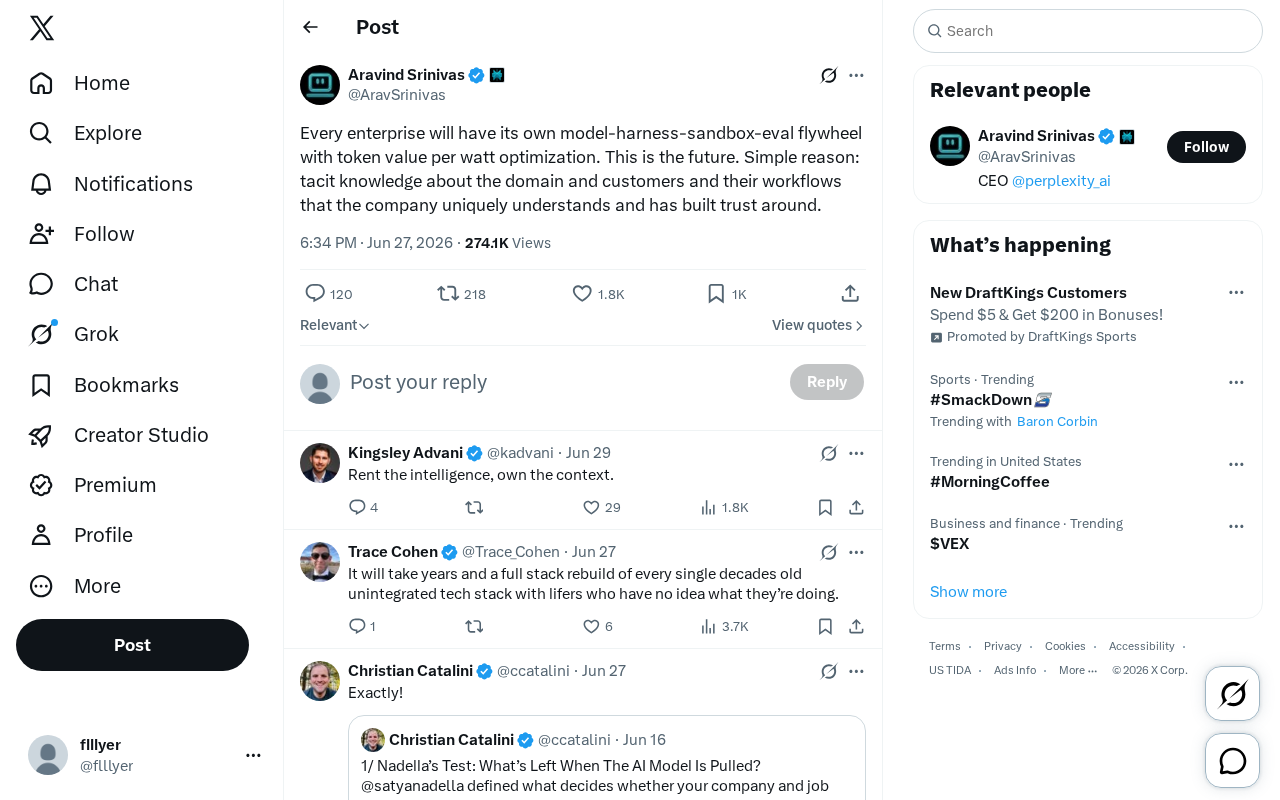
The Enterprise AI Flywheel: Building a Model-Eval Loop as a Competitive Moat
The core of enterprise AI isn't calling general models—it's building a self-reinforcing "model-harness-sandbox-eval" flywheel. This article analyzes the four components, tacit knowledge moats, and the "token value per watt" efficiency metric.
Read more →

·3 min
Complete RAG System Development Guide: Data Preprocessing, Vector Retrieval, and Output Optimization in Practice
A complete guide to building RAG systems: covering data preprocessing, vector databases, embedding models, hybrid search, re-ranking, and advanced topics like Graph RAG and multimodal RAG.
Read more →

·4 min
AI Agent Learning Roadmap for Beginners: A Three-Stage Journey from Fundamentals to Hands-On Practice
A systematic AI Agent learning roadmap for beginners covering core theory, the ReAct paradigm, and multi-agent collaboration, with hands-on project suggestions.
Read more →

·4 min
Building an Enterprise Knowledge Base with RAG: A Complete Guide from Principles to Optimization
A comprehensive guide to building enterprise knowledge bases with RAG, covering vector database selection, text chunking, Embedding models, multi-strategy retrieval, re-ranking, and Agent integration for high-accuracy AI Q&A systems.
Read more →

·4 min
LLM Job Interviews: Multi-Agent and Harness Engineering Are Now Must-Know Topics
Deep analysis of LLM job interview essentials: Multi-Agent architecture, Harness engineering, Agent Loop, sandbox isolation, and memory management with career transition tips.
Read more →

·4 min
Feishu-Style Docs + AI Knowledge Base in Practice: A Complete Guide to RAG and TipTap Editor Development
Learn how to build a Feishu-style document system with TipTap editor, integrating AI auto-completion, document continuation, and RAG knowledge base Q&A with vector databases and Embedding.
Read more →

·3 min
AI Large Language Model Learning Roadmap from Scratch: From Beginner to Enterprise-Level Practice
A systematic AI LLM learning roadmap from scratch, covering Python basics, Prompt Engineering, RAG, Agent development, and enterprise-level projects.
Read more →

·3 min
Why AI Engineer Is the Hottest Career Track Right Now: Insights from the AI Engineer Conference
AI Engineer is evolving from a vague concept into a fast-growing career track. This article analyzes the role's core skills—Prompt Engineering, RAG, Agent development—and industry trends from the AI Engineer Conference.
Read more →