#SAST for AI code
202 related articles

·5 min
AI Penetration Testing Learning Roadmap: A Four-Stage Progressive Guide from Beginner to Enterprise-Level Practice
A systematic breakdown of the four-stage AI + penetration testing learning roadmap, covering Agent fundamentals, Web vulnerability discovery, enterprise automation, and advanced practice.
Read more →

·3 min
Gitar: An AI Code Review Tool That Doesn't Just Find Issues — It Fixes Them
Gitar is an AI code review tool that automatically fixes issues it finds, supports PR review & repair, CI failure diagnosis, and Flaky Test handling. Now part of Sonar.
Read more →

·2 min
What to Do When Cursor Slows Down: Causes and Solutions for AI Coding Tool Performance Fluctuations
Cursor users report 3-5x slower response times. This article analyzes the technical causes of AI coding tool performance fluctuations and provides practical solutions including context reduction and model switching.
Read more →

·2 min
GPT-5.6 Price Cut Over 20%: A Complete Analysis of AI Competition from OpenAI, DeepSeek Multimodal, and More
OpenAI cuts GPT-5.6 Sol prices by over 20%; Codex hits 20M active users with security scanning; DeepSeek launches V4 Flash Vision multimodal model; anonymous OS Alpha tops API call rankings.
Read more →

·3 min
Getting Started with Claude Code: A Complete Tutorial for the Terminal-Native AI Programming Assistant
Complete guide to Claude Code setup, multi-model switching, code generation, and project refactoring. Master this terminal-native AI coding tool for efficient command-line development.
Read more →

·3 min
Using Codex as a Storyboard Artist: A Practical Guide to the End-State Backward Planning Method for AI Video
How to use ChatGPT/Codex as an AI video shot planner with end-state backward planning to solve Seedance's last-second failures. Includes 5-step workflow, cost analysis, and transferable constraint-solving methodology.
Read more →

·4 min
Deep Dive into Cursor Origin: Why an AI Editor Is Building a Code Hosting Platform
Cursor launches Origin, a Git platform for the Agent era. Deep analysis of strategic intent, technical architecture, security audit mechanisms, and competition with GitHub, with practical migration advice.
Read more →

·5 min
OpenAI Open-Sources Codex Security: An In-Depth Review of the AI Security Scanning Tool's Strengths and Limitations
In-depth analysis of OpenAI's open-source Codex Security code scanning tool, comparing it with Snyk, Semgrep, and CodeQL, examining its AI Agent verification, real test data, and current limitations.
Read more →
·2 min
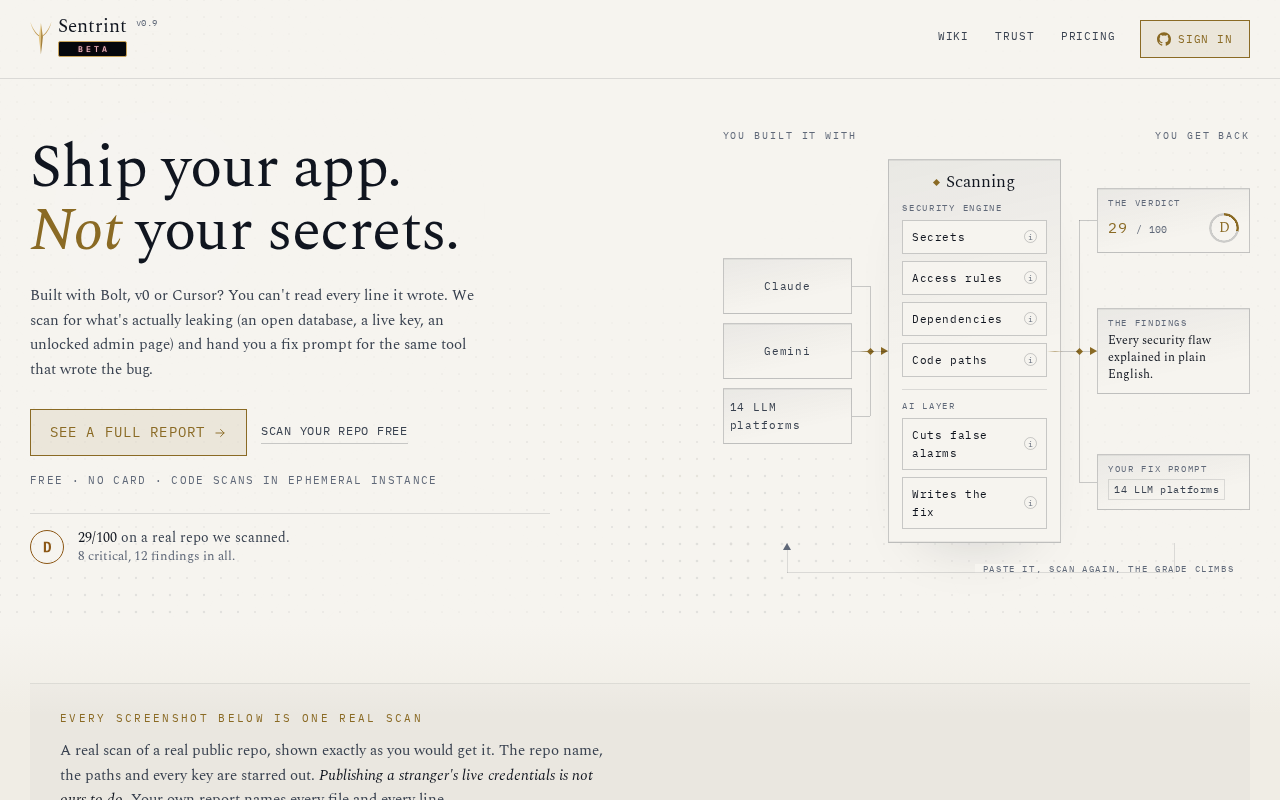
Sentrint: A Security Scanner Built Specifically for AI-Generated Code
Sentrint is a security scanner designed for LLM-generated code, detecting secret leaks, hallucinated dependencies, and injection vulnerabilities in AI code.
Read more →

·3 min
PBS Loses 50TB of Data: A Storage Security Wake-Up Call After a Cloud Provider Goes Bankrupt
PBS permanently lost 50TB of irreplaceable 70-year TV archives when its cloud provider went bankrupt. Learn about vendor lock-in risks, the 3-2-1 backup rule, and cross-provider redundancy strategies.
Read more →

·3 min
Vibe Coding in Practice: Why Senior Engineers Write Skills, Not Code
Deep dive into enterprise Vibe Coding: why senior engineers spend 70%+ of their time writing Skills instead of code, covering Claude Code vs Codex strategies and domestic model alternatives.
Read more →

·3 min
How Do AI Coding Assistants Write Code? Breaking Down the Inner Workings of Copilot
Deep dive into how AI coding assistants work: from token prediction and context tracking to agentic workflows, revealing how Copilot and Claude Code generate code, plus key limitations developers must know.
Read more →

·3 min
Is 60% of Cursor's Code Copied? The Truth About AI Coding Tool Originality
Cursor allegedly has 60% of its code from existing open-source projects. We analyze AI coding tool originality, how LLMs generate code, and how developers can use Vibe Coding responsibly.
Read more →

·2 min
Gemini 3.5 Flash Cyber: Google's AI Security Model Built for Vulnerability Detection and Remediation
Google releases Gemini 3.5 Flash Cyber, a lightweight AI model for automated vulnerability detection and patching. Deep dive into its capabilities, architecture, and competitive positioning.
Read more →

·3 min
AI Assistant Nearly Leaked Bank Statements: A Real-World Prompt Injection Attack Case Study and Prevention Guide
A user's AI assistant nearly forwarded bank statements to a stranger, exposing the real threat of prompt injection attacks. Learn how these attacks work and how to protect your AI agents.
Read more →

·3 min
The Hacker Myth in Short-Form Drama: How Pop Culture Shapes Public Cybersecurity Perception
Deconstructing the hacker girlfriend trope in viral short dramas: how pop culture romanticizes hacking vs. real cybersecurity, social engineering parallels, and the impact on public tech perception.
Read more →

·2 min
LaraCopilot: The Paradigm Leap from AI Copilot to Autonomous Engineer
LaraCopilot positions itself as an agentic AI engineer that generates full production-ready apps from natural language, covering frontend, backend, database, auth, and APIs—with no vendor lock-in.
Read more →

·4 min
Vibe Coding Architecture Explained: The Trinity of Cognition, Execution, and Orchestration
Deep dive into Vibe Coding's three-layer architecture: how the Cognition Layer (LLMs), Execution Layer (local Agents), and Orchestration Layer (workflow frameworks) work together for reliable AI programming.
Read more →

·1 min
GPT-5.6 Free Unlimited Conversations, Kimi K3 Officially Joins GitHub Copilot
OpenAI announces GPT-5.6 Luna unlimited free conversations, Kimi K3 becomes the first Chinese model in GitHub Copilot. Google releases WeatherNext, NVIDIA advances Physical AI infrastructure.
Read more →

·5 min
The AI Agent Security Crisis: Why Generators Cannot Also Be Validators
Based on real data from Snyk's 4,800 enterprise customers, a deep analysis of three AI agent security pain points: automated attacks, untrusted outputs, and governance blind spots.
Read more →