#Skill MCP difference
256 related articles

·6 min
Skill vs MCP: The Essential Difference Between Two Types of AI Agent Capabilities and How They Work Together
Skill and MCP are two core concepts for building AI Agents. Skill encapsulates task execution methodology, while MCP provides a standardized protocol for connecting external tools. This article breaks down their core differences, abstraction levels, and collaboration.
Read more →

·3 min
The Essential Difference Between Agent Skills and MCP: Process Layer vs. Capability Layer
Deep dive into the essential difference between Skill and MCP in AI Agent development. Skill handles the process layer for codifying workflows; MCP handles the capability layer for connecting external systems.
Read more →

·2 min
The Essential Difference Between Skill and MCP: A Kitchen Analogy That Makes It Crystal Clear
Skill and MCP are two easily confused core concepts in AI Agent development. This article uses a kitchen analogy to explain how Skill (recipe/methodology) and MCP (kitchen assistant/tool connection) differ and work together.
Read more →

·4 min
AI Engineer Growth Roadmap: From Programming Fundamentals to RAG and MCP Agent Development
A systematic AI engineer learning roadmap covering programming, math, ML, and data engineering foundations, plus frontier AI technologies like LLM, RAG, Agents, and MCP with free open-source resources.
Read more →

·3 min
localskills.sh: A Unified Management Platform for Cross-Tool AI Skills and MCP – Full Review
localskills.sh is a team-level platform for managing AI Skills, Rules, and MCP servers across Cursor, Claude Code, and Windsurf with a single install command.
Read more →

·3 min
localskills.sh: A Unified Management Platform for Cross-Tool AI Skills and MCP — Review
localskills.sh is a team-level AI skill and MCP server management platform that unifies distribution and reuse of AI Skills and Rules across Cursor, Claude Code, Windsurf, and more with a single install command.
Read more →

·3 min
Implementing Zanzibar in Lean4: A Formally Verified Permission Engine for AI Projects
Deep dive into a Datalog permission DSL built on Google Zanzibar using Lean4 theorem prover. How formal verification strengthens AI permission management.
Read more →

·3 min
Kimi K3 Real-World Testing in 3D Modeling & Game Development: Can Open-Source Models Overtake Closed-Source Giants?
In-depth testing of Kimi K3 in 3D modeling, physics simulation, animation rigging, and game development vs Fable 5 and GPT Solve 5.6. Open-source model delivers top-tier results at one-quarter the price.
Read more →
·4 min
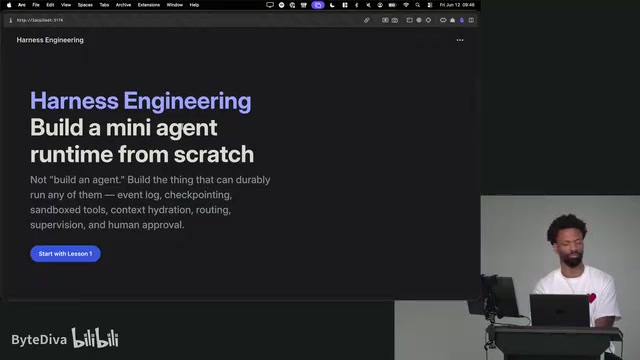
Harness Engineering: The Core Infrastructure for Taking AI Agents from Demo to Production
Deep dive into Harness Engineering: why AI Agents need memory management, durable execution, guardrails & approvals to go from demo to production.
Read more →

·4 min
Harness Engineering: The Core Infrastructure for Taking AI Agents from Demo to Production
Deep dive into Harness Engineering: why AI Agents need memory management, durable execution, guardrails & approvals to reach production. Based on Scott Moss's workshop.
Read more →

·4 min
OpenAI Employee Shares How to Build an AI Work Operating System with Codex
OpenAI's Jason Liu shares how he uses ChatGPT Workbench and Codex to build an AI work OS: Chief of Staff automation, persistent threads, Skills/Plugins, browser control, and app-building methodology.
Read more →

·3 min
Agent Skill Routing: Engineering Trade-offs Between Retrieval and LLM, and the Two-Stage Layered Architecture
Deep dive into Agent skill routing: comparing pure model vs. pure retrieval approaches, with a detailed two-stage layered architecture balancing accuracy, latency, and cost.
Read more →

·3 min
7 Vibe Coding Agents Tested & Ranked: Which AI Coding Tool Should Beginners Choose?
Hands-on comparison of 7 Vibe Coding agents including Trae, Cursor, Claude Code, Codex, WorkBuddy & CoderWork, ranked by beginner-friendliness and performance.
Read more →

·3 min
7 Vibe Coding Agents Tested & Ranked: Which AI Coding Tool Should Beginners Choose?
Side-by-side review of 7 Vibe Coding agents including Trae, Cursor, Claude Code, Codex, WorkBuddy, and CoderWork, ranked by beginner-friendliness, performance, and ease of use.
Read more →

·3 min
From Frontend to Agent Development: A Complete 6-Week Systematic Learning Path
A 6-week systematic learning path for frontend engineers transitioning to AI Agent development, covering core architecture, ReAct, multi-agent collaboration, RAG integration, and deployment.
Read more →

·3 min
Getting Started with Codex: A Complete Guide to AI Agent Programming Tools
Compare Codex and Claude Code AI agent programming tools. Learn AI Agent concepts, tool selection, cost analysis, and GPT account setup in this complete beginner's guide.
Read more →

·3 min
Agent Skills Explained: Plug-and-Play Skill Packs for AI
A deep dive into Agent Skills architecture: modular design, progressive disclosure mechanism, and how it differs from Multi-Agent systems for AI capability extension.
Read more →

·4 min
IntelliJ IDEA Efficiency Configuration Guide: Lessons from Seven Years of Java Development
A senior Java developer shares 7 years of IntelliJ IDEA configuration tips: JVM tuning, AI-assisted coding, Testcontainers testing, debugging tricks, and Spring toolchain setup.
Read more →

·5 min
The Complete Guide to AI Agent Development: A Four-Stage Progressive Roadmap
A systematic guide to AI Agent development across four stages: LLM fundamentals, ReAct paradigm, memory & tools, and multi-agent collaboration for developers.
Read more →

·3 min
Getting Started with Codex: The Right Way to Use AI Coding Agents
A detailed comparison of OpenAI Codex and Claude Code with hands-on testing. From AI agent concepts to account setup, helping developers quickly master AI coding agents.
Read more →