#machine vision software selection
144 related articles

·3 min
Multi-Agent AI Paper Writing System: A Full-Stack Breakdown of FastAPI + Vue3
A deep dive into an AI paper writing system built with FastAPI + Vue3, covering multi-agent collaboration, RAG, streaming output, and full academic workflow automation.
Read more →

·6 min
The Three-Layer GTM Agent Architecture: Enabling AI to Truly Recognize Buyer Intent and Identity
An in-depth analysis of the three-layer GTM Agent architecture—the Signal, Buyer Intelligence, and Action layers—revealing how context graphs identify anonymous visitors and capture purchase intent.
Read more →

·7 min
Getting Started with Codex: Installation and Usage Guide for OpenAI's AI Coding Agent
A comprehensive guide to OpenAI's new AI coding agent Codex: from concept and comparison of its four forms, to installing Git/Node.js/VS Code, configuring the API Key, and creating a workspace.
Read more →
·7 min
Auditing Cryptographic Libraries with AI: What We Found in Cloudflare's CIRCL
An in-depth look at using AI LLMs to audit Cloudflare's open-source cryptographic library CIRCL, covering constant-time detection, side-channel vulnerabilities, and human-AI collaboration.
Read more →

·5 min
China Weighs Restricting Top AI Model Exports as DeepSeek Develops Its Own Inference Chip
China's Commerce Ministry weighs restricting overseas access to top open-weight AI models from Alibaba, ByteDance, and DeepSeek, while DeepSeek develops its own inference chip amid a US-China AI export standoff.
Read more →

·7 min
Dify Local Deployment Guide: Full Walkthrough with BT Panel + Docker
A step-by-step guide to locally deploying the Dify open-source AI platform using BT Panel on a VMware virtual machine, covering Ubuntu setup, Docker config, and image pull troubleshooting—beginner-friendly.
Read more →

·7 min
Dify Local Deployment in Practice: A Complete Guide with BT Panel + Docker
A step-by-step guide to locally deploying the open-source Dify AI platform using the BT Panel on a VMware virtual machine—covering Ubuntu setup, Docker config, and image pull troubleshooting.
Read more →

·6 min
GPT-5.6 Hands-On Deep Dive: Three-Tier Models + Ultra Multi-Agent, Codex Fully Evolved
OpenAI launches GPT-5.6 with three tiered models—Sol, Terra, and Luna—Ultra multi-agent parallel collaboration, Codex integrated into ChatGPT desktop, and an upgraded Computer Use.
Read more →

·4 min
7 Core Components for Designing Long-Running AI Agents
A deep dive into the 7 core components for building long-running AI Agents: Goal, Evaluator, Verifier, Loop, Orchestration, Observability, and Memory.
Read more →

·3 min
Intent-Driven Development: Claude Code's Evolving Paradigm and Practical Tips
Anthropic engineer Lydia and YK Sugi break down Claude Code's Intent-Driven Development paradigm, covering dynamic workflows, auto mode, sub-agent orchestration, and the evolving role of software engineers in the AI era.
Read more →
·3 min
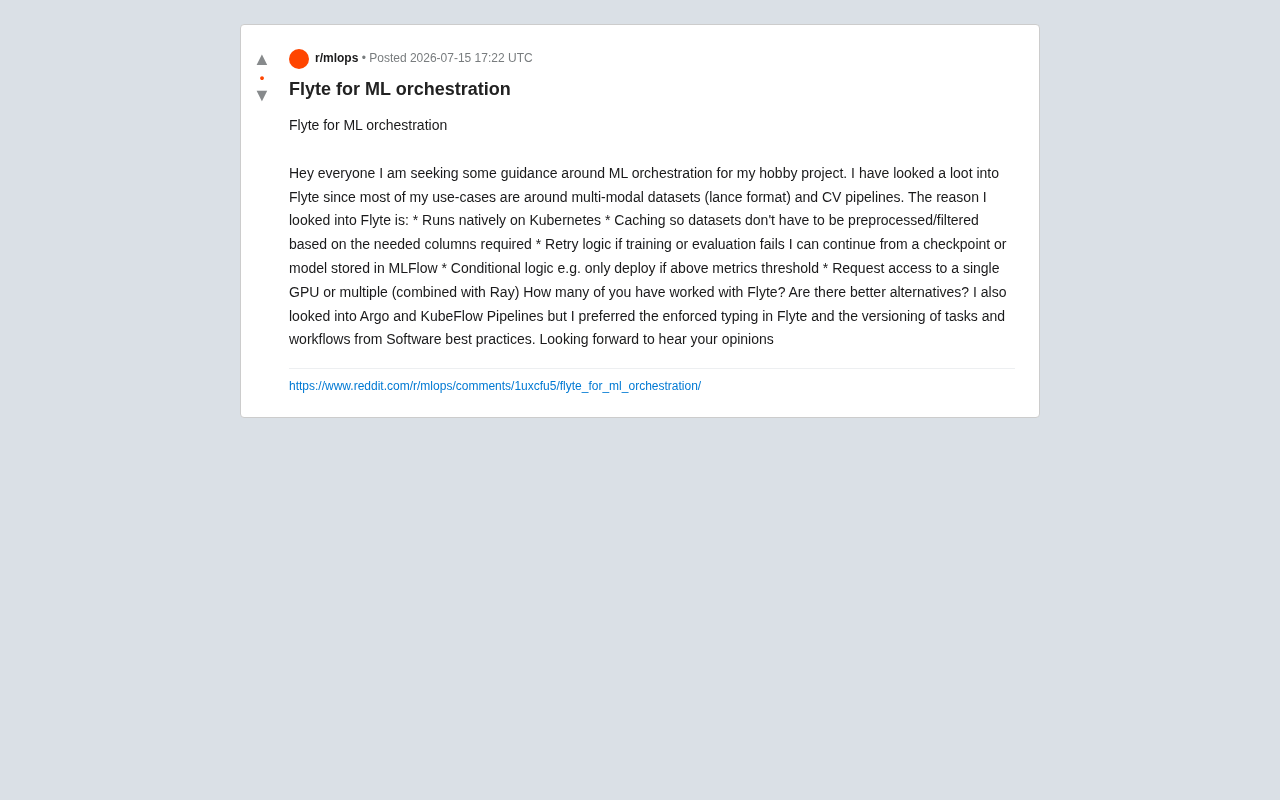
Flyte Deep Dive: A Practical Guide to Choosing Your ML Workflow Orchestration Tool
Deep dive into Flyte's core capabilities: cloud-native GPU scheduling, intelligent caching, checkpoint recovery, and conditional deployment — plus a full comparison with Argo and KubeFlow Pipelines.
Read more →

·2 min
GPT-5.6 Deep Dive: Tiered Models + Multi-Agent Architecture, LLMs Evolve into Workflow Engines
GPT-5.6 isn't just a capability upgrade — it's an architectural shift: tiered models, programmatic tool calling, and multi-agent collaboration turn LLMs into workflow engines for production systems.
Read more →
Production-Grade LangGraph Template: A…
·2 min
Production-Grade LangGraph Template: A Practical Guide to Engineering AI Agents for Production
A deep dive into production-grade LangGraph templates covering state management, observability, error handling, and containerized deployment to bridge the gap from demo to production.
Read more →

·3 min
ShunCode In-Depth Review: Local Agent Execution + Bridge Mode Turns ChatGPT into Your Programming Brain
ShunCode is a VS Code-based AI code editor that connects ChatGPT to a local Agent execution system via Bridge Mode, enabling full-loop code reading, editing, and testing with Diff approval and MCP support.
Read more →

·6 min
OpenAI Merges ChatGPT and Codex: The Super App for the AI Agent Era Is Here
OpenAI merges ChatGPT and Codex into a super app and releases three new GPT-5.6 models: Sol, Terra, and Luna. A deep dive into four hands-on workflows—Computer Use, Loops, and multi-threading—for the AI agent era.
Read more →

·4 min
Claude Code vs. Codex vs. Cursor: A Deep Comparison of Three AI Coding Tools
Claude Code, Codex, or Cursor? This in-depth comparison covers each tool's positioning, ideal users, and how to combine them for maximum productivity in your AI coding workflow.
Read more →
Tired of Algorithmic Feeds, He Built a…
·2 min
Tired of Algorithmic Feeds, He Built a Private Instagram with Vibe Coding
A developer uninstalled Instagram to escape social media "brain rot," then used AI-assisted programming (Vibe Coding) to build a private family photo-sharing tool. Exploring Vibe Coding, personal software, and digital wellbeing.
Read more →

·3 min
GPT-5.6 Hands-On: Building a Shooter Game and a Premium Website from a Single Prompt, Plus GPT-Live Voice Experience
Hands-on with GPT-5.6 and GPT-Live: build a playable shooter game from one prompt in 19 minutes, generate a premium animated website via multimodal understanding, and experience emotional two-way voice conversation. A full review of ChatGPT and Codex deeply integrated.
Read more →

·5 min
Complete Guide to the National Mathematical Modeling Contest: Modeling, Topic Selection, and Award-Winning Strategies in the AI Era
A comprehensive guide to preparing for the National Mathematical Modeling Contest: covering the essence of modeling, judging rules, topic selection, AI usage guidelines, and a four-day schedule to boost your chances of winning.
Read more →

·3 min
Enterprise AI Evaluation Tools: An In-Depth Comparison of Six Leading Platforms
An in-depth comparison of five AI evaluation tools—Arize, Braintrust, Confident AI, Langfuse, and LangSmith—across governance, framework lock-in, and evaluation vs. monitoring.
Read more →