#multi-GPU workstation
20 related articles

·2 min
FreeToken: How to Do the Hardware Math When Squeezing a 753B Model onto a Single GPU
UC Berkeley open-sources FreeToken inference system, enabling 753B parameter models on a single GPU via MoE sparsity. Analysis of its scheduling principles, hardware benchmarks, and key performance caveats.
Read more →

·3 min
Hidden Barriers to Machine Learning Research on Windows and How to Overcome Them
Analysis of Windows limitations for ML research, including open-source code compatibility issues, WSL2 constraints, and why native Linux is the de facto standard. Practical environment selection advice included.
Read more →

·3 min
Choosing a Laptop for AI Studies: MacBook vs NVIDIA Laptop — An In-Depth Comparison Guide
In-depth analysis for AI students choosing laptops: MacBook Air M5 with remote GPU vs NVIDIA laptop, comparing CUDA support, portability, battery life, and value.
Read more →

·2 min
The Hidden Perk of Local LLMs: No Need for a Heater in Winter
Local LLM GPUs generate heat rivaling space heaters. Explore the motivations, power realities, cooling challenges, and unique community culture of running AI at home.
Read more →

·3 min
Qwen3 27B Local Deployment Test: Frontier-Level Agent Capabilities on a Single RTX 3090
Hands-on testing of Qwen3 27B on a single RTX 3090, covering inference speed, Agent capabilities, multimodal vision, and tool calling, compared against DeepSeek V-Flash and other closed-source models.
Read more →

·3 min
Unsloth Desktop Released: An All-in-One Desktop App for Local Model Inference and Training
Unsloth Desktop is an open-source cross-platform app combining model inference, fine-tuning, and deployment. Supports Mac/Windows/Linux with 2x training speed, 70% VRAM savings, and zero telemetry.
Read more →

·3 min
NVIDIA Nemotron Open-Source MoE Model: A Large Language Model That Runs Locally on Your Laptop
NVIDIA launches the Nemotron open-source MoE model series with sparse activation, enabling efficient local deployment on laptops or DGX Spark. Learn about the MoE architecture and NVIDIA's tiered strategy.
Read more →

·2 min
Got a GPU Cluster but Don't Know What to Do? A Practical Guide to Choosing AI Projects
Facing GPU cluster resources as an AI beginner? This guide covers project ideas from AI safety to model evaluation to RAG optimization, helping students effectively leverage compute resources.
Read more →

·3 min
Unsloth Releases Quantized DeepSeek V4 Flash: Lossless Performance at 162GB
Unsloth releases UD dynamic quantized versions of DeepSeek V4 Flash 0731, offering six variants from 162GB lossless to 83GB extreme compression using MXFP4+BF16 mixed precision.
Read more →

·3 min
Feasibility Analysis: Deploying DeepSeek V4 Flash on Dual DGX Spark Systems
In-depth feasibility analysis of deploying DeepSeek V4 Flash on two NVIDIA DGX Spark units offline, examining memory bandwidth, MoE communication overhead, and quantization strategies.
Read more →
Apple M7 Ultra Leaked: Can 1.5TB Unifi…
·2 min
Apple M7 Ultra Leaked: Can 1.5TB Unified Memory Challenge NVIDIA Blackwell?
Apple's M7 Ultra chip rumored to feature 1.5TB unified memory targeting NVIDIA Blackwell-level AI performance. A deep dive into UMA advantages, what "matching Blackwell" really means, and Apple's AI strategy.
Read more →
·2 min
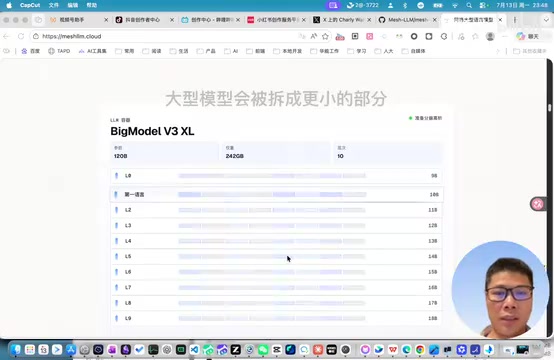
Mesh LLM: Pool Multiple Old Computers Into a Virtual Super GPU for Running Large Models
Mesh LLM is an open-source distributed inference framework that splits model layers across multiple devices, creating a virtual super GPU to run 100GB+ LLMs on consumer hardware.
Read more →

·4 min
Demystifying Unified Memory Architecture: How Mini PCs Run 70B Large Models
Why can a mini PC with unified memory run a 70B model while an RTX 4090 can't? A deep dive into the VRAM wall and unified memory architecture for smarter local AI hardware choices.
Read more →

·6 min
Unsloth Major Update: DeepSeek-V4 Support and a Deep Dive into NVFP4 Quantized Export
Unsloth v0.1.481-beta adds full DeepSeek-V4-Flash support, NVFP4/FP8/imatrix GGUF quantized export, 1.3x faster GRPO, 3-5x faster MoE training, and an OpenAI-compatible API service in Studio.
Read more →

·3 min
Unsloth Major Update: DiffusionGemma & Gemma 4 MTP Support, 2x Inference Speed Boost
Unsloth v0.1.464-beta adds DiffusionGemma, Gemma 4 MTP, and MiniMax-M3 support, delivering ~2x inference speed boost, new Hub, RAG Q&A, tensor parallelism, and full CUDA/ROCm/Windows coverage.
Read more →

·3 min
AMD Ryzen AI Halo Local AI Dev Kit Deep Dive: Is $4,000 Worth It?
AMD Ryzen AI Halo dev kit at $4,000 features 128GB unified memory and XDNA 2 NPU for local LLM inference. Deep dive into architecture, performance trade-offs, vs. Mac Studio, and software ecosystem challenges.
Read more →

·6 min
A 284B Model Running on a MacBook: The Real Breakthrough and Barriers of Local DeepSeek Inference
Redis creator runs 284B-parameter DeepSeek model on a MacBook Pro at 26 tokens/sec using a pure C engine, asymmetric quantization, and MoE architecture.
Read more →

·3 min
NVIDIA RTX PRO 4500 Accelerates Genomics and Protein Folding Workloads
Explore how the NVIDIA RTX PRO 4500 Blackwell workstation GPU accelerates genomic analysis and protein folding prediction, and its critical role in precision medicine and drug discovery.
Read more →
 Product Reviews
·5 min
Unsloth: The Open-Source Tool That Speeds Up Local LLM Fine-Tuning by 5x
Unsloth is an open-source LLM training tool with 63,000+ GitHub Stars. It supports local fine-tuning of Gemma 4, Qwen3, DeepSeek and more, with Web UI, VRAM optimization, and 2-5x training speedup on consumer GPUs.
Read more →
 Product Reviews
·5 min
Cube Studio: Tencent's Open-Source One-Stop AI Platform Covering Everything from Large Model Training to Inference
In-depth analysis of Cube Studio, Tencent Music's open-source cloud-native AI platform covering distributed training, DeepSeek fine-tuning, vLLM inference, VGPU management, and Huawei Ascend support.
Read more →