#o1 model
10963 related articles

·2 min
What It Means That Nemotron's 2-Bit Quantized 30B Model Sustained Tool Calling for 10 Minutes
NVIDIA Nemotron 3.5 Lightning sustained tool calls for 10+ minutes after extreme 2-bit quantization, revealing surprising robustness of low-bit models for Agent tasks and local deployment.
Read more →

·2 min
Unsloth Quantization Benchmarks: NVFP4 Delivers 1.5x Speedup, Dynamic GGUF Compresses Model Size by 83.5%
Unsloth's improved Dynamic algorithm delivers NVFP4 (1.5x speedup, 92-97% accuracy) and Dynamic GGUF (83.5% compression) for Qwen3.8-27B quantization.
Read more →

·2 min
1-Bit Quantization Breakthrough: Running a 27B Large Model in 8GB of Memory
Deep dive into how 1-bit quantization compresses a 27B-parameter Qwen3 model to run in 8GB memory while retaining 77% accuracy, and its impact on open-source AI.
Read more →

·2 min
Qwen3.8-27B Becomes the Most Popular Open-Source Model in History: A Dominant Lead Over DeepSeek-R1
Qwen3.8-27B becomes the most-used open-source model on Unsloth, far surpassing DeepSeek-R1 and Qwen3.6-35B-A3B. Deployable on consumer GPUs after quantization, it's now the top choice for developers.
Read more →

·2 min
On-Device Piano Continuation: A 125M Small Model Enables Local Real-Time AI Music Autocomplete
Explore how a 125M-parameter on-device AI piano continuation model achieves low-latency, offline music autocomplete locally. A deep dive into small models for vertical music generation and Edge AI.
Read more →

·3 min
AI Agent Lesson 1: How to Call a Large Language Model
AI Agent beginner tutorial: learn how to call LLM APIs from scratch, covering API-Key setup, request parameters, Messages organization, and response parsing.
Read more →
·3 min
GEN-1.5 Robot Foundation Model Released: One-Shot Learning Breakthrough Enables Robots to Master New Tasks from a Single Demonstration
Generalist AI releases robot foundation model GEN-1.5 with one-shot learning capability, enabling robots to master new tasks from a single demonstration. Deep dive into its technology and industry impact.
Read more →

·2 min
Grok 4.6 Tops AI Intelligence Index at 61 Points: Industry Competition Landscape and Developer Model Selection Guide
xAI's Grok 4.6 tops the Artificial Analysis Intelligence Index at 61 points. We analyze the industry signals, frontier model competition, and key factors for developer model selection.
Read more →

·2 min
Google's SL2T Model: Real-Time Sign Language-to-Text Technology Arrives on Pixel 11
Google launches SL2T sign language-to-text model supporting real-time ASL-to-English conversion, integrated with Gboard and Live Transcribe, deploying on-device on Pixel 11 for system-level accessibility.
Read more →
·3 min
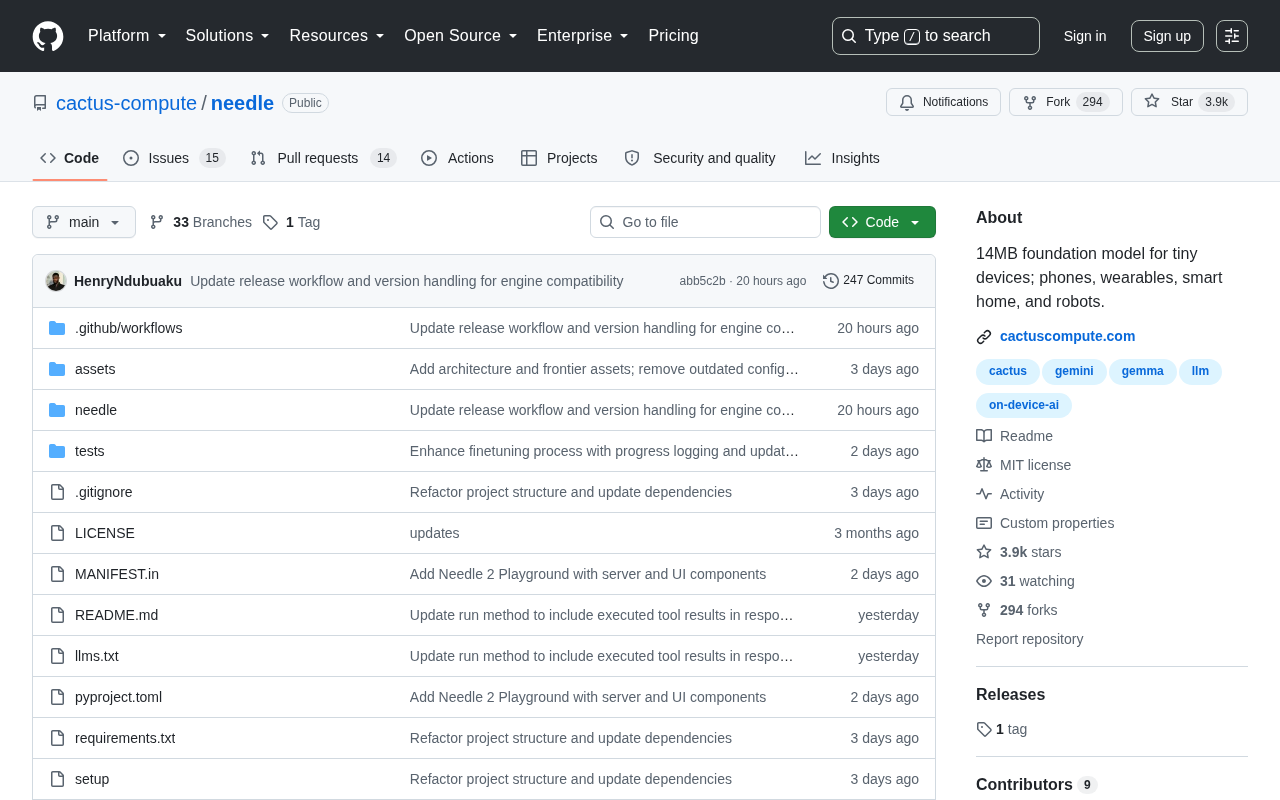
Needle: How a 14MB Foundation Model Is Unlocking Edge AI Deployment
Needle is a 14MB open-source foundation model from cactus-compute, designed for phones, wearables, smart home devices, and robots. Explore its edge AI potential.
Read more →

·3 min
GitHub Daily · August 12: Claude Code Ecosystem Explosion and Extreme Edge Model Compression
GitHub Trending Aug 12: Claude Code ecosystem explodes with diagram-design topping charts, needle compresses models to 14MB for edge AI, and Rust rises in AI infrastructure.
Read more →

·3 min
SAM3 + RTMPose Zero-Shot on 1950s Factory Footage: A Real-World Test of Foundation Model Generalization
A developer applied SAM3 and RTMPose to 1950s black-and-white factory footage with zero fine-tuning and got accurate results. We analyze the technical logic and implications.
Read more →

·3 min
How Open-Source Models Achieve Superior Retrieval Performance at 1% of GPT's Cost
Deep analysis of how open-source models match GPT-level retrieval performance at 1/100th the cost. Covers RAG cost optimization, embedding model fine-tuning, and deployment strategies.
Read more →

·2 min
10 Trillion Tokens in 3 Months: Open-Source Model Demand Is Exploding
Open-source LLMs processed 10 trillion tokens in under 3 months, hitting 300B daily. We break down what this milestone means and why open-source demand is accelerating.
Read more →

·3 min
Poolside Desktop Assistant 1.4.0 Update: Subagent Collaboration and Local Model Speed Boost
Poolside Desktop Assistant 1.4.0 adds native steering, task queuing, plan mode, and subagent collaboration, plus major local model inference speed improvements with deep Claude and Codex integration.
Read more →

·3 min
Maple-Preview: 20B Ternary MoE Model Achieves 120 tok/s On-Device Inference on iPhone
Maple-Preview achieves 120 tok/s inference of a 20B ternary MoE model on iPhone. We analyze ternary quantization, MoE sparse activation, and on-device inference challenges.
Read more →

·3 min
Next-Gen GPT Model Cracks 10 Open Math Problems for Just $2,000
OpenAI's next-gen model reportedly solves 10 long-standing open math problems for just $2,000 in token costs, evolving from knowledge carrier to knowledge producer.
Read more →

·2 min
OpenAI's Internal Model Astra Allegedly Solves 10 Math Problems — How Credible Is It?
OpenAI's internal model codenamed Astra reportedly solved 10 major open math problems. We examine the claim's credibility, AI math reasoning capabilities, and a rational evaluation framework.
Read more →

·3 min
Running the 1.56TB Kimi K3 Model on 8GB RAM with Pure C
A developer built a pure C99 inference engine that runs the 1.56TB Kimi K3 model on 8GB RAM using MoE sparsity and NVMe on-demand loading—no GPU, 176KB binary.
Read more →

·3 min
Cursor Enterprise Hidden Markup: Budget Models Actually Cost 10x More
Cursor Team and Enterprise users discover a flat $0.25/million token surcharge inflates budget model costs by 10x. Analysis of the hidden markup, its impact, and user strategies.
Read more →