#open-source LangSmith alternative
28 related articles

·2 min
Acrux Core: Open-Source LLM Observability Platform, a Self-Hosted Alternative to LangSmith
Acrux Core is an open-source LLM observability platform supporting self-hosted deployment with prompt management, dynamic tool binding, user feedback loops, and full-chain tracing—a free alternative to LangSmith and Langfuse.
Read more →

·3 min
Agent DevTools: A Local Debugger Designed Specifically for AI Agents
Agent DevTools is an open-source local debugger for AI Agents that lets you inspect prompts, memory, retrieval, and tool calls, with good vs. bad run comparison to quickly find root causes.
Read more →

·3 min
AI Agent Observability: A New Paradigm for Production Debugging and Hallucination Governance
Deep dive into AI Agent observability tools for production debugging and hallucination governance, covering full-chain tracing, semantic evaluation, and continuous improvement strategies.
Read more →

·2 min
AI Agent Debugging Tool: Inspect Execution Chains Like Browser DevTools
Agent DevTools is an open-source AI Agent debugging tool inspired by Browser DevTools, offering execution visualization, tool call tracing, and breakpoint analysis to help developers diagnose Agent failures.
Read more →

·3 min
TraceLLM: An Open-Source LLM Observability Platform Built on OpenTelemetry
TraceLLM is an open-source observability platform for production AI apps, built on OpenTelemetry, offering Prompt tracing, Token monitoring, latency analysis, and full distributed tracing.
Read more →

·3 min
Build RAG and AI Agent Projects at Zero Cost: A Practical Guide to Open-Source Tools
Build high-quality AI projects on a budget. Learn how to use Ollama, Groq, Chroma, and other free open-source tools to build RAG systems and multi-Agent workflows from scratch.
Read more →
·3 min
Build RAG and AI Agent Projects at Zero Cost: A Practical Guide to Open-Source Tools
Build high-quality AI projects on a budget. Learn how to use Ollama, Groq, Chroma, and other free open-source tools to build RAG systems and multi-Agent workflows from scratch.
Read more →

·3 min
Wattage: An AI Agent Token Cost Profiling and Regression Protection Tool
Deep dive into Wattage, an AI Agent token consumption profiling and cost regression protection tool, exploring its core features, industry context, and value for developers.
Read more →

·3 min
Cosmonapse: A Decentralized Multi-Agent Framework Built on an Event Bus
Cosmonapse is an open-source multi-agent framework that replaces central orchestrators with peer nodes, using typed signals and an event bus to fully decouple tool calls, memory, and HITL. Supports Python and TypeScript under Apache 2.0.
Read more →

·3 min
Getting Started with LangChain 1.3: Building Intelligent Agent Applications with Deep Agent
Learn LangChain 1.3 core concepts including LLM model abstraction, RAG retrieval-augmented generation, and Agent orchestration. Build a Deep Agent with planners, tools, and reflection modules.
Read more →

·3 min
Programmer to AI Engineer: You're Already 80% There — Here Are the 6 Skills You're Missing
Programmers transitioning to AI engineering aren't starting from scratch. Learn the 6 core skills — LLM APIs, RAG, prompt engineering, LLMOps — needed to make the leap.
Read more →

·6 min
AI's Second Half: The Decisive Battle Shifts from Models to Infrastructure
Model capabilities are converging, making inference cost and scalability the new focus of AI competition. A deep analysis of AI infrastructure's core layers.
Read more →

·4 min
AI Agent Development Deep Dive: Opportunities, Real Entry Barriers, and Learning Paths
A deep dive into AI Agent development: real architecture, entry barriers, and learning paths. From ReAct to multi-agent systems and LangChain — cut through the hype.
Read more →

·7 min
ManagedAgents.sh: A Deep Dive into the Model-Agnostic Open-Source Managed Agent Platform
ManagedAgents.sh is a model-agnostic managed agent platform from OpenComputer, supporting Claude, Pi, and Codex runtimes with Slack and GitHub integration.
Read more →

·7 min
Previewing the AI Engineer Summit: Industry Signals of AI Engineering Reaching Maturity
An exclusive look at the AI Engineer Summit dress rehearsals, decoding the paradigm shift from research to production. A deep dive into AI Engineer challenges, RAG, agent systems, and AI engineering as a distinct discipline.
Read more →

·7 min
The Agent Engineer Transition Roadmap: A Deep Dive into Three Core Skill Systems
Want to become an Agent engineer? This article systematically covers three core skill tracks—LLM fundamentals, LangChain architecture development, and enterprise deployment—to help you avoid detours.
Read more →

·7 min
6 Core Standards of a High-Value Agent Project That Impress Interviewers
Most Agent projects lack competitiveness in interviews due to missing business value and engineering depth. This article breaks down the 6 core standards of high-value Agent projects.
Read more →
·7 min
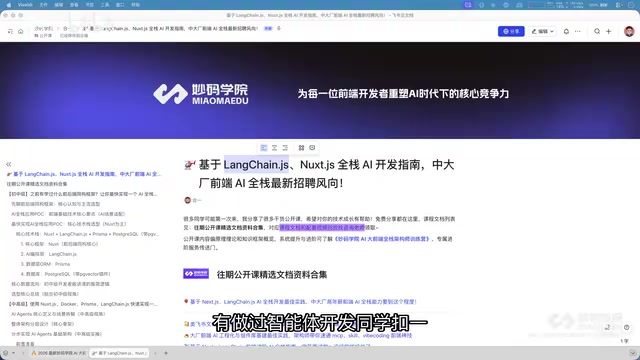
LangChain.js + Nuxt.js: An AI Full-Stack Advancement Path for Frontend Engineers
Frontend hiring now treats AI capabilities as a core assessment, covering RAG knowledge bases, AI Agent development, and LangChain.js engineering. Learn how LangChain.js + Nuxt.js helps frontend developers build memory- and retrieval-capable AI full-stack apps.
Read more →

·7 min
Electron + LangGraph in Practice: Building an AI Agent Visual Orchestration App from Scratch
A hands-on guide to building an enterprise-grade AI Agent workflow orchestration app with Electron Forge and LangGraph, covering local LLM deployment (Qwen3-0.6B), node-based visual canvas design, and full Function Calling integration.
Read more →

·3 min
Complete RAG System Development Guide: Data Preprocessing, Vector Retrieval, and Output Optimization in Practice
A complete guide to building RAG systems: covering data preprocessing, vector databases, embedding models, hybrid search, re-ranking, and advanced topics like Graph RAG and multimodal RAG.
Read more →