#programmer tools
944 related articles
 Tutorials
·3 min
Tongyi Lingma AI Automatically Deploys a Website to Alibaba Cloud in 5 Minutes: Zero-Code Website Building in Practice
Hands-on test of Tongyi Lingma AI zero-code website building: one sentence auto-generates HTML/CSS/JS and deploys to Alibaba Cloud in 5 minutes. Includes a math game demo and limitations analysis.
Read more →
 Tech Frontiers
·4 min
OpenAI's $3B Windsurf Acquisition: How AI Is Reshaping the Programming Landscape
OpenAI acquires AI coding tool Windsurf for $3B. We break down the three-layer strategic logic, the impact on programmer jobs, and the rise of AI product managers.
Read more →
 Tutorials
·4 min
Claude Code Tutorial: Complete Guide to Installation, Configuration & Model Selection for Chinese Users
Complete guide to Claude Code installation, configuration for Chinese users, comparing DeepSeek V4 Pro, Tongyi Qianwen & Sonnet proxy APIs for cost-effective AI coding.
Read more →
 Industry Insights
·4 min
OpenAI's $3 Billion Windsurf Acquisition: The Real Reason They Didn't Choose Cursor
Deep analysis of OpenAI's $3B Windsurf acquisition: why not Cursor? How Windsurf's enterprise DNA, process data, and user mindshare fill OpenAI's gaps, while Cursor's $9B valuation reshapes the AI coding landscape.
Read more →
 Tech Frontiers
·4 min
Cognition's Acquisition of Windsurf: The Capital Power Play Behind a Weekend Lightning Deal
Cognition acquires Windsurf's core assets at lightning speed, gaining $82M ARR and hundreds of thousands of DAU. A deep dive into the OpenAI, Google, and Anthropic power plays reshaping the AI coding tool market.
Read more →
 Product Reviews
·3 min
GPT-5.5 Hands-On Review: Image Generation at Just 3 Cents Per Image, Plus a Full Breakdown of Coding Capabilities and API Costs
Hands-on review of GPT-5.5 image generation and coding abilities. API image generation costs as low as 3 cents per image. Full breakdown of quality, capabilities, and cost comparisons.
Read more →
 Product Reviews
·3 min
Cursor In-Depth Review: Four Modes + Parallel Agents — Why It Remains the Best AI Coding Tool
In-depth comparison of Cursor vs Claude Code, Windsurf, Trae, and other AI coding tools across Agent modes, terminal tools, browser integration, parallel processing, and context management.
Read more →
 Expert Opinions
·3 min
The Tyranny of Software Is Ending: AI Lets Everyone Build Apps
Programming barriers once divided the world into those who build software and those who merely use it. AI coding tools and LLMs are breaking down that wall, enabling anyone to create apps through natural language.
Read more →
 Deep Dives
·4 min
The Four Stages of AI Agent Evolution: A Complete Guide from Copilot to Multi-Agent Collaboration
Deep dive into the four stages of AI Agent evolution: Chat, Copilot, Agent, and Agentic AI. Covers ReAct framework, Spring AI stack, and multi-Agent architecture design for 2025.
Read more →
 Deep Dives
·3 min
Claude Code Source Code Leak Revealed: Seven Core Mechanisms of the Harness Architecture Explained
Deep analysis of the Claude Code source code leak, revealing seven core mechanisms of its Harness architecture including context management, tool call orchestration, and state tracking for AI Agent developers.
Read more →
 Tutorials
·3 min
One Month Into My Internship Without Writing a Single Line of Code: A Practical Guide to AI Agent Coding
AI agent coding is now reality in 2025. Learn how to set up OpenCode with DeepSeek and let AI agents write your code through conversation, not copy-paste.
Read more →
 Tutorials
·4 min
A Practical Guide for Java Developers Transitioning to AI Agent Development: Technology Selection, Architecture Design & Resume Positioning
A systematic guide for Java developers entering AI Agent development, covering core concepts, Workflow vs. Agent architecture comparison, Spring AI Alibaba selection, and resume positioning strategies.
Read more →
 Deep Dives
·4 min
From AIGC to AI Agent: Core Strategies and Practical Guide for Multi-Agent Development in 2025
Deep analysis of AIGC vs AI Agent differences, covering multi-agent system architecture, task orchestration, hallucination control, with developer skill roadmap and career outlook.
Read more →
 Product Reviews
·3 min
How to Choose an AI Agent Framework in 2026? Pros and Cons of Four Leading Solutions
Compare four leading AI Agent frameworks in 2026: Coze, AutoGen, CrewAI, LangChain, and AutoGen Studio — covering coding requirements, private deployment, and commercialization.
Read more →
 Product Reviews
·4 min
AI Agent Framework Selection in 2025: Pros and Cons of Coze, AutoGPT, LangChain, and AutoGen
2025 comparison of four major AI Agent frameworks: Coze for beginners, AutoGPT/LangChain/MetaGPT for developers, Microsoft AutoGen for enterprise self-hosted deployment. A practical selection guide.
Read more →
 Tutorials
·3 min
Claude Code Getting Started Guide: Installation & Configuration Tutorial with Mainstream AI Coding Tool Comparison
Complete guide to Claude Code installation and configuration with usage notes for China, plus side-by-side comparison with Cursor, Copilot, and Trae to help developers choose the best AI coding assistant.
Read more →
 Expert Opinions
·3 min
Zig Language Bans AI Code Contributions: A Deep Debate on Open Source Principles
Zig founder Andrew Kelley rejects LLM-assisted PRs, introducing the concept of AI code's "digital smell." A deep analysis of the open source philosophy, code quality, and trust issues behind Zig's ban on AI contributions.
Read more →
 Expert Opinions
·2 min
In the Vibe Coding Era, Using RSS to Share and Discover Personal Apps
AI-assisted programming makes building tools as easy as blogging, but how are these personal apps discovered? Matt Webb proposes RSS for vibe-coded apps, and Simon Willison quickly validates the idea.
Read more →
 Expert Opinions
·3 min
In the Vibe Coding Era, Why We Need RSS to Share Personal Apps
AI programming makes building micro-apps as easy as blogging, but distribution is the new bottleneck. Matt Webb proposes RSS for sharing vibe-coded apps, and Simon Willison is already doing it.
Read more →
 Expert Opinions
·3 min
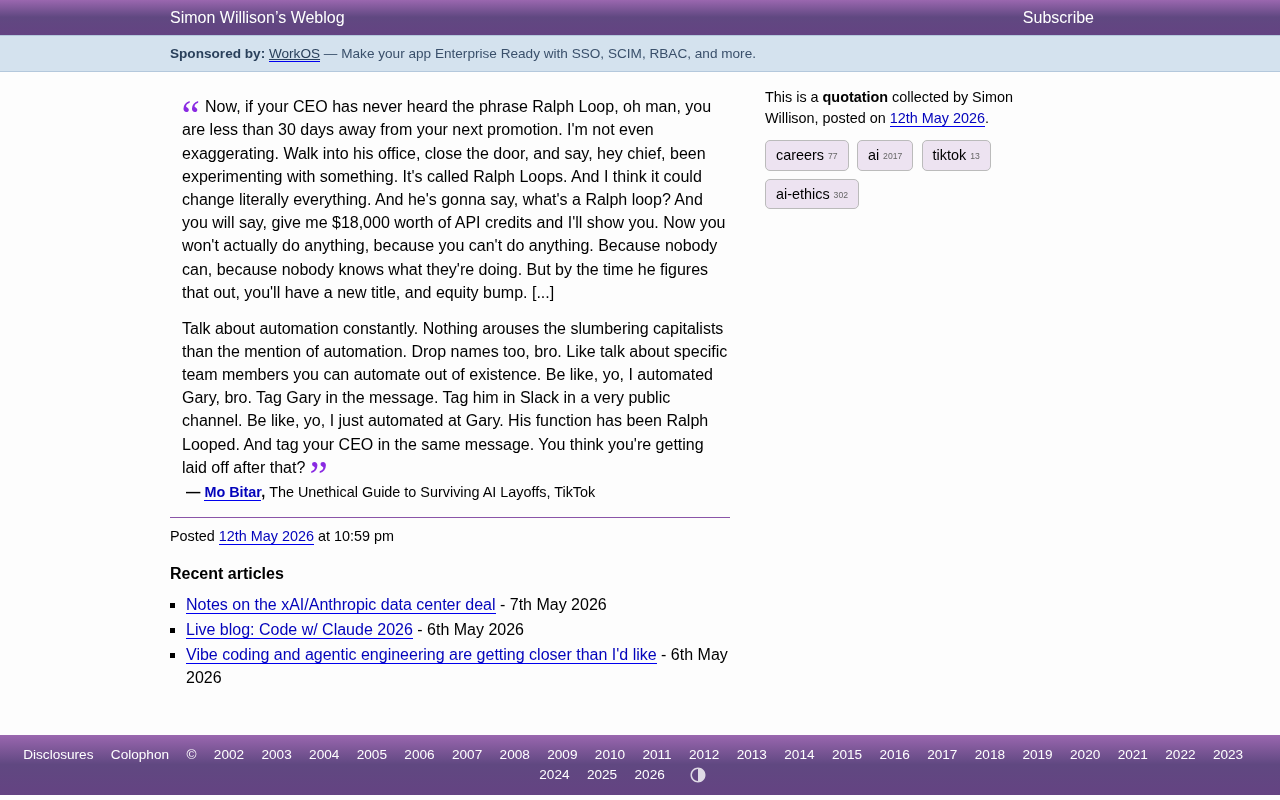
Surviving the AI Layoff Wave: The Workplace Hype Truths Exposed by a Satirical Video
Mo Bitar's satirical TikTok exposes AI workplace absurdities: fake jargon to secure budgets, automating colleagues for promotions. A deep dive into overestimated AI capabilities, fear-driven decisions, and the moral cost of tech hype.
Read more →