#self-evolution loop
54 related articles

·3 min
Loop Engineering: The New Paradigm for AI Self-Evolution
Loop Engineering by Anthropic is a new AI paradigm using four components—Mutator, Executor, Evaluator, Selector—to build self-iterating closed loops. Learn the architecture, use cases, and how to get started.
Read more →

·3 min
Prime Agent: An Open-Source Coding Agent That Can Improve Its Own Underlying Framework
Prime Agent is an open-source self-improving coding agent using Recursive Language Models and Continual Harness abstractions, achieving 95.5% on ARC-AGI-3.
Read more →

·4 min
The Self-Building Agentic IDE: The Next Evolutionary Direction for AI Programming Tools
Exploring the Agentic IDE concept: a self-building, self-iterating intelligent development environment. A deep analysis of how AI programming tools evolve from passive assistance to autonomous evolution.
Read more →

·2 min
Prime Agent: A Deep Dive into the RLM-Based Self-Evolving AI Agent
Deep analysis of Prime Agent's RLM architecture, exploring how self-improving AI agents achieve continuous evolution through runtime feedback loops.
Read more →

·2 min
OpenAI Open-Sources Codex Security CLI: An AI-Powered Code Security Scanning Tool
OpenAI quietly open-sources Codex Security CLI, supporting repo security scanning, vulnerability tracking, fix verification, and CI/CD integration — extending AI from code generation into security.
Read more →

·3 min
Fable-OS: A Self-Evolving Operating System That Writes Its Own Drivers
Fable-OS is an open-source self-evolving OS running on bare metal with natural language as its only interface. Its AI agent can autonomously write hardware drivers and evolve itself at runtime.
Read more →

·3 min
Symbio: Technical Analysis and Challenges of the AI Self Fine-Tuning Loop
In-depth analysis of Symbio's AI self fine-tuning loop mechanism, exploring the technical logic of self fine-tuning loops, personalization value, and challenges like catastrophic forgetting and model drift.
Read more →

·3 min
Cekura: A Deep Dive into the Automated Testing, Monitoring, and Self-Healing Closed-Loop Platform for Voice AI Agents
Deep analysis of how Cekura's five-step closed loop—scenario simulation, failure capture, root cause diagnosis, automatic prompt rewriting, and regression verification—solves voice AI agent quality assurance in production.
Read more →

·5 min
Robynn AI: Automated Website Repair and SEO Optimization Through Self-Learning Agents
Robynn AI is a self-learning website operations tool that uses intelligent auditing, natural language editing, and data-driven auto-rollback to solve post-launch decay issues like broken links and ranking drops.
Read more →

·3 min
Hermes Agent in Practice: A Self-Evolving AI Agent Framework
Hermes Agent is a mature AI Agent framework with built-in Claude Code and Codex coding capabilities, supporting 200+ models, multi-platform deployment, and WeChat integration. Its layered memory and self-evolution features enable low-Token automated task execution.
Read more →

·2 min
Hermes Agent: A Complete Beginner's Guide to the Self-Evolving Open-Source AI Agent
Hermes Agent is an open-source autonomous AI Agent with long-term memory and self-evolution. Learn its core innovations, how it compares to Open Cloud, and why it hit 121K GitHub stars.
Read more →

·3 min
Java AI Tech Stack Explained: Framework Selection & Learning Path Guide
A complete guide to Java AI development: Spring AI, LangChain4j, Spring AI Alibaba, and AgentScope4j — framework comparisons, selection tips, and a clear learning path.
Read more →
·6 min
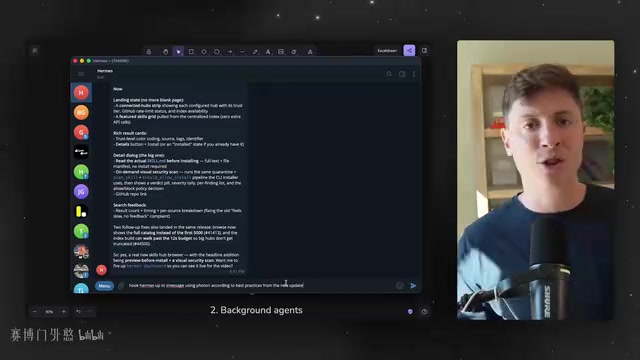
Hands-On With Hermes Agent's Eight Major Updates: A Complete Guide to AI Automation and Self-Evolution
The Hermes Agent gets a major upgrade with eight new features: native iMessage, parallel background sub-agents, Unreal Engine MCP support, a self-evolving Skill Hub, and more. A hands-on breakdown of the core changes and their real impact on personal AI automation workflows.
Read more →

·7 min
Grok 4.5 Launch: Coding AI Market Reshuffle, Anthropic Claims Half the Territory
Grok 4.5 launches at just $0.49 per task, 90% cheaper than rivals. Anthropic's Claude Code claims 50% of the AI coding market. SambaNova raises $1B. Read the latest AI market shifts.
Read more →

·5 min
6 Self-Hosted AI Agents Compared: Which One Is a Truly Self-Evolving Digital Employee?
An open-source AI Agent with 380K stars ranks only third? This comparison of 6 self-hosted AI Agents scores them on persistence, self-evolution, and data control—revealing why Generic Agent won with just 3,000 lines of code.
Read more →

·3 min
Getting Started with Claude Code: A Guide to Terminal AI Coding Tools
A deep dive into Claude Code: the difference between Terminal and Device Agents, enterprise selection advice, and how to use Claude Code with DeepSeek in China.
Read more →

·3 min
Hermes Agent Deep Dive: Anatomy of a Self-Evolving AI Agent Architecture
Deep dive into Hermes Agent's core architecture including the Skills system, GPA governance mechanism, and 47 built-in tools. Learn how Hermes self-evolves to get smarter with use.
Read more →

·3 min
Hermes Agent Practical Guide: An AI Agent That Gets Smarter the More You Use It
Deep dive into the Hermes Agent framework's core architecture, including the Skills system and steering engineering. Real-world tests show 60%+ task completion speed improvement. Complete guide covering local deployment, Feishu integration, and self-evolving learning loops.
Read more →

·3 min
Hermes Agent: How a Self-Evolving AI Framework Earned 120K Stars in Two Months
Deep dive into Hermes Agent, the open-source AI Agent framework with lower Token costs, persistent long-term memory, and self-learning evolution that earned 120K GitHub stars in two months.
Read more →

·2 min
Sakana AI Establishes Recursive Self-Improvement Lab, Replacing Brute-Force Compute with Creativity to Pioneer a New AI Paradigm
Sakana AI launches its Recursive Self-Improvement Lab, focusing on using AI to redesign AI development. From LLM² to AI Scientist, this Tokyo company proposes a sample-efficient path to AI self-evolution without brute-force compute.
Read more →