#AI Agent
1079 related articles
 Product Reviews
Trae 2.0 SOLO Mode In-Depth Review: Full Workflow from Natural Language to Website Deployment
In-depth review of ByteDance's Trae 2.0 SOLO mode: from natural language requirements to one-click website deployment. Covers memory, self-repair upgrades, and impact on Manus and Genspark.
 Tutorials
Building an AI Workstation: A Layered Tool Strategy and Physical Isolation Guide
A practical guide to building an AI workstation: physical isolation with vertical screens, pyramid tool layering (Doubao/Trae/Claude/GPT-4), and real Token cost breakdowns to maximize AI workflow efficiency on a budget.
 Tutorials
Conversation as Development: Rapidly Building an EHS Safety Management Platform with AI Agents
Learn how AI application generation Agents use natural language to rapidly build a complete EHS safety management platform with nine core modules, compressing development from months to hours.
 Tech Frontiers
Hugging Face Open-Source Agent Ecosystem Explained: From Local Deployment to AI-Automated Training
Deep dive into Hugging Face's open-source Agent ecosystem: open models matching closed-source performance, local deployment options, Skills for conversational model training, and MCP integration.
 Expert Opinions
Is CI/CD Dead? The Continuous Computation Architecture Revolution in the AI Agent Era
Traditional CI/CD pipelines are being shattered by AI Agents. This article analyzes the shift from PR-driven to intent-driven architecture, exploring Pre-Merge queues, stateful environments, and multiverse development as new continuous computation paradigms.
 Tutorials
AI Agent Learning Roadmap: A Complete Guide from LangChain to Enterprise Deployment
In-depth analysis of the popular GitHub project ai-agents-from-zero, covering LangChain, LangGraph, RAG, MCP and more, with a complete learning path from beginner to enterprise AI Agent development.
 Tutorials
Browser-Use WebUI Installation & Configuration Guide: AI Browser Automation in Practice
A detailed guide on installing Browser-Use WebUI, configuring Gemini and DeepSeek models, with four practical demos including form filling, content summarization, and e-commerce data scraping.
 Deep Dives
Microsoft Magentic-UI Explained: A Human-AI Collaborative Agent Operating System
Deep dive into Microsoft's open-source Magentic-UI: a human-AI collaborative Agent platform built on AutoGen. Explore its five core capabilities, system architecture, and Human-in-the-Loop design.
 Tutorials
DeepSeek R1 + BrowserUse: A Free Open-Source Browser Automation Setup Tutorial
Learn how to build a free browser automation solution with DeepSeek R1 and BrowserUse. Includes Ollama local deployment, WebUI setup, and real-world tests rivaling OpenAI Operator.
 Tutorials
Browser Use Deep Dive: A Practical Guide to Natural Language-Driven Browser Automation Agents
Deep dive into Browser Use browser automation agent: architecture, installation, CDP framework, and pytest integration. Learn how natural language-driven AI Agents replace repetitive browser tasks.
 Tutorials
Stagehand Tutorial: An AI Browser Automation Framework That Balances Control and Intelligence
Deep dive into Stagehand's four core capabilities: Act, Extract, Observe, and Agent. Learn to build browser automation that balances AI flexibility with code control using DeepSeek as a low-cost alternative to OpenAI.
 Product Reviews
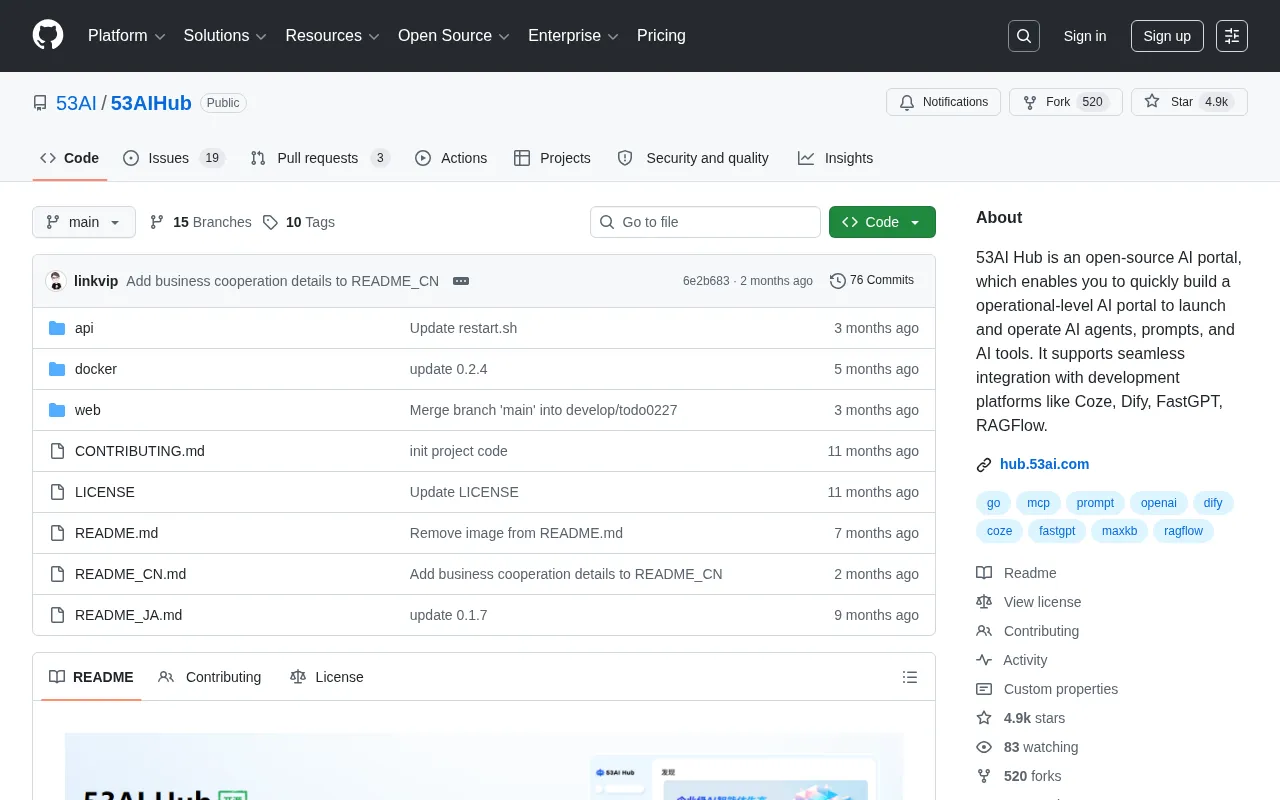
53AI Hub: Open-Source AI Portal Platform for Unified Management of Dify/Coze and Other AI Agent Applications
53AI Hub is an open-source AI portal platform supporting Dify, Coze, FastGPT integration, helping enterprises build operational-level AI app stores with Go-powered performance.
 Tutorials
Building a Generative Recommendation System with Go and AI Agents: Architecture Design and Practical Analysis
Deep dive into a Go-based generative recommendation system powered by LLMs, covering three-level semantic understanding, three-layer user memory, and five-dimensional feedback design.
 Tech Frontiers
Inside the SJSU Hackathon Winning Projects: A Practical Guide to Building High-Impact AI Agents
Deep analysis of SJSU hackathon-winning AI Agent projects covering architecture design, core elements, and UX optimization—a practical guide from prototype to product.
 Tutorials
Codex Desktop Pet in Practice: Building a Talking AI Sprite from Scratch
How to build a personalized AI desktop pet with OpenAI Codex and TTS voice cloning — covering character design, voice cloning, interaction development, and practical troubleshooting.
 Product Reviews
Cursor In-Depth Review: Four Modes + Parallel Agents — Why It Remains the Best AI Coding Tool
In-depth comparison of Cursor vs Claude Code, Windsurf, Trae, and other AI coding tools across Agent modes, terminal tools, browser integration, parallel processing, and context management.
 Tutorials
Practical Guide to Developing an AI Agent-Based Crop Pest and Disease Early Warning System
A detailed guide to developing an AI Agent-based crop pest and disease early warning system, covering image recognition, data visualization, and meteorological monitoring modules.
 Tutorials
Commercial AI Agent Development Guide: 7 Key Steps to Build from Scratch
A complete guide to building commercial AI Agents in 7 steps: requirements analysis, model selection, prompt engineering, Dify/Coze platform comparison, data storage, testing, and deployment.
 Deep Dives
The Four Stages of AI Agent Evolution: A Complete Guide from Copilot to Multi-Agent Collaboration
Deep dive into the four stages of AI Agent evolution: Chat, Copilot, Agent, and Agentic AI. Covers ReAct framework, Spring AI stack, and multi-Agent architecture design for 2025.
 Deep Dives
Claude Code Source Code Leak Revealed: Seven Core Mechanisms of the Harness Architecture Explained
Deep analysis of the Claude Code source code leak, revealing seven core mechanisms of its Harness architecture including context management, tool call orchestration, and state tracking for AI Agent developers.