#Agent Development Lifecycle
432 related articles

·3 min
Dify for Beginners: A Complete Guide to Building AI Applications
A beginner's guide to Dify covering Docker deployment, MySQL setup, model integration, five app types (Chatbot/Agent/Workflow), and publishing — build LLM apps fast.
Read more →

·3 min
Dify Getting Started: A Complete Zero-to-Production Guide for Building AI Applications
A complete guide to Dify — covering deployment, five core app types (chatbot, Agent, workflow, and more), LLM integration, and publishing for zero-experience developers.
Read more →

·3 min
Dify 1.8.0 Deployment Guide: Build AI Apps Without Writing Code
A complete guide to deploying Dify 1.8.0: Docker setup, environment config, five app types explained, and workflow-building tips for beginners.
Read more →

·3 min
Coze for Beginners: A Complete Guide to Getting Started with the AI App Development Platform
Coze by ByteDance is an all-in-one AI app development platform for non-coders. Build AI agents with drag-and-drop — no programming needed. Complete beginner's guide.
Read more →

·2 min
ROS2 Beginner's Guide: A Deep Dive into the Core Middleware for Robot Development
Learn ROS2 from scratch: understand how ROS differs from traditional OS, explore ROS1 vs ROS2 differences, and master version selection principles for robot development.
Read more →

·2 min
Daedalus: A Deep Dive into the Ollama-Based Local AI Engineering Runtime
Daedalus is an open-source local AI engineering runtime built on Ollama, covering architecture, debugging, and security. Zero token costs, full privacy, integrates with Claude Code and OpenCode.
Read more →

·2 min
Vibe Coding vs AI Engineering: A Practical Enterprise-Level Comparison Guide
A deep dive comparing Vibe Coding vs AI Engineering, with hands-on analysis of Claude Code and Codex, two real projects, and the role of Skills in enterprise AI development.
Read more →
Forward Deployed Engineer (FDE): The M…
·2 min
Forward Deployed Engineer (FDE): The Most In-Demand Role in the Age of AI Deployment
Forward Deployed Engineers (FDEs) are the hottest emerging role in AI. Learn what FDEs do, what skills they need, why companies like Palantir and OpenAI can't hire enough of them, and what this means for your career.
Read more →

·4 min
Cursor Designer: Why Software Must Retain Its Human Touch in the Age of AI Acceleration
Cursor designer Rio: AI compresses build loops dramatically, but risks flooding the world with mediocrity. From Glass UI principles to the migration of craft — why human agency, taste, and responsibility remain software's true core.
Read more →

·4 min
The Complete Guide to Claude Code Skills: Installation, Creation, and Management
A complete guide to Claude Code Skills: what they are, how they differ from Plugins, three installation methods, how to write SKILL.md, trigger mechanisms, and top resource recommendations.
Read more →

·3 min
LangGraph Production Template in Practice: A Complete Guide to Budget Control and Canary Routing
Deep dive into langgraph-agent-stack: per-run dollar budget control, canary traffic routing, Mock testing mode, and 800+ test cases to safely deploy AI Agents from demo to production.
Read more →

·4 min
WebMCP in Practice: A Complete Guide to Making Your Website AI Agent-Ready
A deep dive into the WebMCP proposal: how AI agents read websites, how to expose structured tools via imperative and declarative APIs, and how to audit agentic readiness with Lighthouse.
Read more →

·2 min
Kimi K3 Leads the Charge: Inside the AI Coding Agent Framework Transparency Race
Kimi K3 sets a new open-weight record at 2.8T params, GrokBuild pivots to local-first after a privacy crisis, Open Interpreter rewrites in Rust — a deep dive into five major AI coding agent developments and the shift toward harness transparency.
Read more →

·3 min
LangSmith Triple Release: Harness, Sandboxes, and Eval Complete the Agent Engineering Toolchain
LangChain launches Harness, Sandboxes, and Eval integrated into LangSmith, creating the first complete Agent engineering toolchain from development to acceptance testing.
Read more →

·5 min
AI Coding Getting Worse With Every Edit? Skills v1.1 Reveals the Real Cause and Solution
AI code getting messier with edits? The root cause isn't weak model capability but a lack of context and process. A deep dive into Matt Pocock's Skills v1.1: grilling, vertical-slice tickets, TDD, and WebFinder.
Read more →

·3 min
Building Real-Time 3D Digital Twin Wind Farms with Microsoft Fabric: AI Conversation + LIDAR Terrain + Telemetry Fusion
A wind farm digital twin built on Microsoft Fabric and Azure AI Foundry, fusing Finnish LIDAR terrain, real-time telemetry, and conversational AI for smart industrial operations.
Read more →
GitHub Copilot SDK Released: Embed AI …
·2 min
GitHub Copilot SDK Released: Embed AI Agent Capabilities Directly Into Your Applications
GitHub open-sources copilot-sdk, enabling developers to embed Copilot Agent capabilities into their own apps. Explore its strategic significance, core features, and enterprise adoption considerations.
Read more →

·2 min
Forge: Adding Reliability Guardrails to Local Model Tool Calling
Forge is an open-source Python middleware for local models (Ollama, llama.cpp, vLLM) that boosts tool-calling reliability via three-layer guardrails: validation, rescue parsing, and retry.
Read more →

·2 min
Why an 'AI First' Company Hit the Brakes on AI: The Dual Crisis of Cost and Capability
A Fortune 500 company went all-in on AI First, then retreated. Learn why legacy system failures, unpredictable code quality, and high API costs are forcing enterprises to rethink AI deployment.
Read more →
·3 min
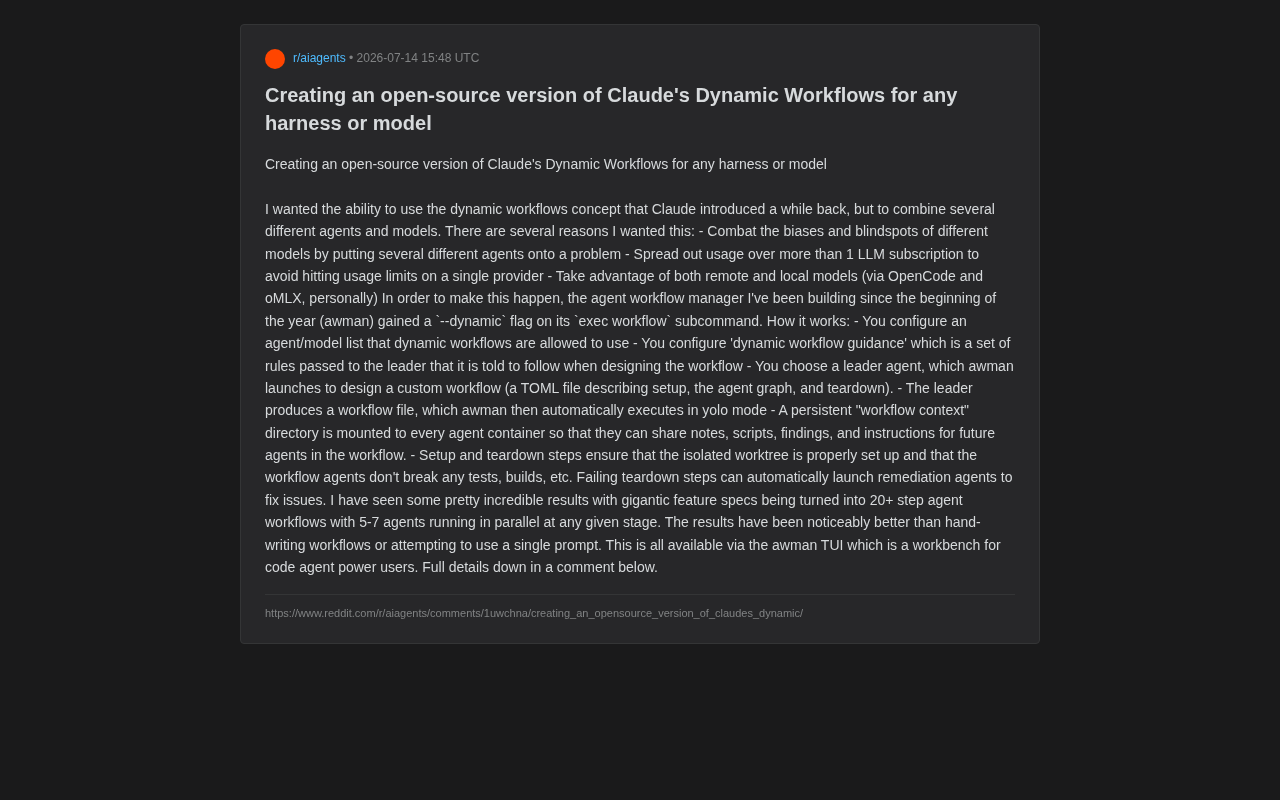
Open-Source Dynamic Workflows: How awman Enables Multi-Model Collaborative AI Programming
awman's --dynamic flag enables cross-framework dynamic workflows with multi-model collaboration. Explore its leader agent architecture, shared context design, and auto fault-tolerance mechanisms.
Read more →