#Agent automation
1620 related articles

·3 min
Building a GitHub Code Review Bot from Scratch: A Hands-On Guide to AI Agent Automation
A detailed guide on building a GitHub code review bot from scratch, covering cloud deployment, secure sandboxes, Vercel AI SDK, and multi-agent collaboration for automated development workflows.
Read more →

·3 min
Verification Browser for AI Agents: How 13ms Ultra-Fast Validation Solves the Trust Problem in Automation
Deep dive into the verification browser for AI agents: how 13ms verification windows and one-call checks solve hallucination problems in browser automation, enabling the leap from capability to trustworthiness.
Read more →

·3 min
How AI Agents Are Reshaping Enterprise Work: From Task Automation to Organizational Restructuring
Explore how AI agents are redefining enterprise work—from applied AI partnerships and multi-agent collaboration to structural workflow redesign and organizational transformation.
Read more →

·2 min
Multi-Agent Collaborative Paper Writing System: End-to-End Automation with FastAPI + Vue 3
An in-depth look at an intelligent paper writing platform built on FastAPI + Vue 3, combining LLM, RAG, and multi-Agent collaboration for full-process automation—an excellent case study for AI developers.
Read more →

·8 min
A Complete Guide to Agent Testing: Five Core Dimensions and Automation in Practice
In-depth analysis of the five core dimensions of AI Agent testing: command safety, tool-calling accuracy, task planning, output consistency, and error self-repair. Master automated testing and the transition path for test engineers.
Read more →

·8 min
The Complete Guide to Agent Testing: Five Core Dimensions and Automation in Practice
An in-depth analysis of the five core dimensions of AI Agent testing: command safety, tool-calling accuracy, task planning, output consistency, and error self-repair. Master automated testing methods and the transition path for test engineers.
Read more →
·2 min
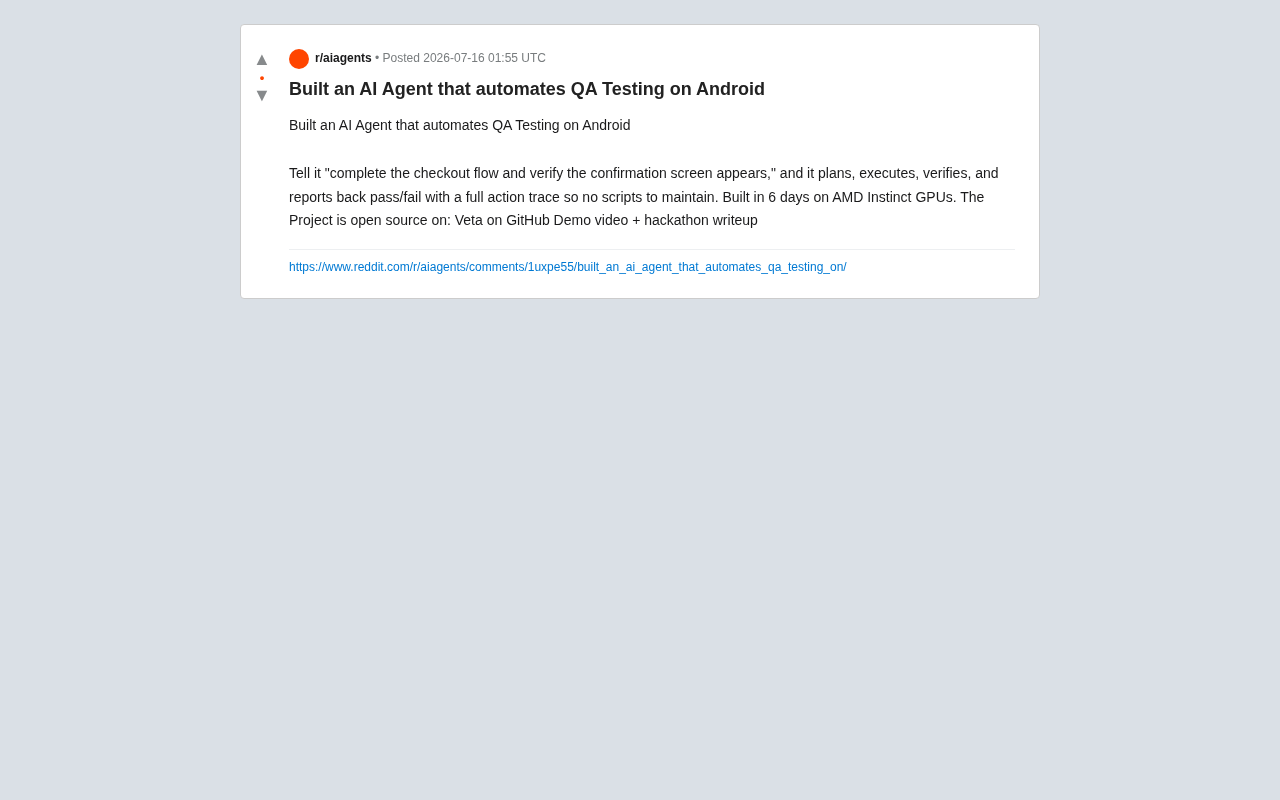
6-Day Open Source AI Agent: Natural Language-Driven Android Automation Testing
Veta is an open source AI testing agent: just describe your test goal in natural language and it autonomously plans, executes, verifies, and reports Android test results — no scripts needed.
Read more →

·3 min
AI Testing End-to-End in Practice: A Complete Guide from Test Case Generation to Agent Automation
A deep dive into AI testing workflows: API capture, test case generation, Agent orchestration, and automated execution. Learn the two core challenges — incomplete information and mandatory human review.
Read more →

·4 min
Agent Loop in Practice: A Guide to Building Self-Improving Automation with Guardrails
A deep dive into building verifiable, self-evolving Agent automation loops with Claude Code and Codex — covering Loop Contracts, four trigger types, three-phase execution architecture, and Evolve Loops.
Read more →

·3 min
The Complete Guide to OpenAI Codex: AI Agent Programming and Automation in Practice
A deep dive into OpenAI Codex: browser automation, Goal execution, plugins, Skills ecosystem, and coding power. Master 90% of Codex's features and transform your workflow.
Read more →

·2 min
A Deep Dive into Ansible: The Essential Guide to Agentless IT Automation
A comprehensive guide to Ansible, the open-source IT automation platform: core architecture, design philosophy, and use cases. Learn about agentless mode, YAML Playbook syntax, idempotency, and best practices for DevOps and Infrastructure as Code.
Read more →

·6 min
OraAgent Hands-On Review: End-to-End Automation of Foreign Trade Prospecting Emails — From Finding Customers to Sending Emails in One Click
A hands-on review of how OraAgent (AI assistant Aura) automates the entire foreign trade prospecting email workflow: auto-searching customers, prioritizing quality leads, batch-generating personalized emails, and one-click sending to cut acquisition costs.
Read more →
·6 min
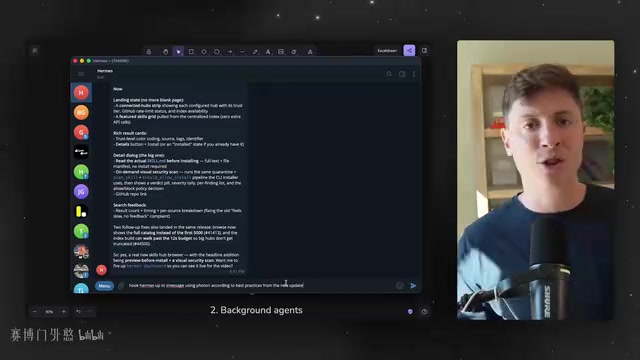
Hands-On With Hermes Agent's Eight Major Updates: A Complete Guide to AI Automation and Self-Evolution
The Hermes Agent gets a major upgrade with eight new features: native iMessage, parallel background sub-agents, Unreal Engine MCP support, a self-evolving Skill Hub, and more. A hands-on breakdown of the core changes and their real impact on personal AI automation workflows.
Read more →

·3 min
APA: A New Enterprise-Grade Automation Approach Merging Agents with RPA
APA (Agentic Process Automation) merges LLM agents into RPA, supporting natural language, operation manuals, and video recording to generate scripts—paired with financial-grade security and three-layer protection for enterprise automation.
Read more →

·4 min
Testing a Research Automation Agent: Zero-Shot Reproduction of a NeurIPS Paper End-to-End
Testing research automation agent Klaus Goh: full reproduction of IBM's TTM time series paper at NeurIPS—from search to zero-shot inference, 2700+ predictions in 10 seconds, MSE 0.363 beating TimesFM.
Read more →

·4 min
AI Agents Powering the Full Research Pipeline: A Practical Guide to Automation from Topic Selection to Publication
Learn how to use AI Agents to link the entire research pipeline—from literature management, data analysis, and paper writing to scientific illustration and dissemination—building a reusable research automation workflow with NotebookLM, N8N, and Ollama.
Read more →

·2 min
Meta Launches Muse Spark 1.1: Targeting Enterprise AI Coding and Agentic Automation
Meta launches Muse Spark 1.1, an AI coding assistant targeting enterprise agentic workloads, automated bug fixing, and large-scale code migration to compete with GitHub Copilot, Cursor, and Claude Code.
Read more →

·3 min
AI Agent Architecture Decoded: An Engineering Guide from Conversations to Automation
A deep dive into the four-layer engineering design of AI Agents: planning, memory, tool use, API cost optimization, MCP protocol integration, and Skill encapsulation.
Read more →

·2 min
No-Install Enterprise Agent: A New Approach to AI Workflow Automation and Core Capability Breakdown
A no-install AI Agent with hundreds of enterprise skills is emerging, enabling automatic multi-skill orchestration for complex workflows. Here's a deep breakdown of its three core advantages and key evaluation dimensions for enterprise adoption.
Read more →

·3 min
AI Agent vs. Automation Scripts: Goal-Driven vs. Fixed Workflows
AI Agents aren't advanced scripts. Scripts follow fixed instructions; Agents pursue goals, plan dynamically, call tools, and self-correct. A deep dive using Linux ops examples.
Read more →