#Browser Use AI
2155 related articles

·2 min
Ego Lite Review: AI Browser Automation That Won't Steal Your Mouse Focus
Ego Lite is a Chromium-based browser designed for AI collaboration. Through login state reuse and isolated Spaces, AI Agents autonomously handle web tasks, form filling, and data collection—ending the human-machine focus fight. Currently on macOS.
Read more →

·2 min
Ego Lite Review: AI Browser Automation That Won't Steal Your Mouse Focus
Ego Lite is a browser built for AI collaboration. Based on Chromium, it uses login state reuse and isolated Spaces so AI Agents can autonomously handle web operations, form filling, and data scraping—solving the human-machine focus conflict. macOS only.
Read more →

·2 min
Comet Browser Users Call for Claude Sonnet 5 Upgrade: A Deep Dive Into the AI Browser Dilemma
Perplexity's Comet browser faces user criticism over lagging model versions, stalled updates, and stability issues. A deep analysis of AI browser challenges.
Read more →

·5 min
Browser Use: A Deep Dive into the Event-Driven Browser AI Agent Framework
Browser Use is an open-source AI Agent framework that lets LLMs autonomously drive browser operations via natural language. This article breaks down its four-layer architecture, core Agent loop, CDP perception layer, dynamic Tools dispatch, and its Skills, Sandbox, and MCP extension capabilities.
Read more →

·1 min
Vercel v0 Launches Browser Use: AI Autonomously Opens Apps to Debug and Fix Bugs
Vercel v0 launches Browser Use: AI can now autonomously open apps, simulate user actions, evaluate designs, and proactively fix bugs — a key leap from code generator to full-stack dev partner.
Read more →
·1 min
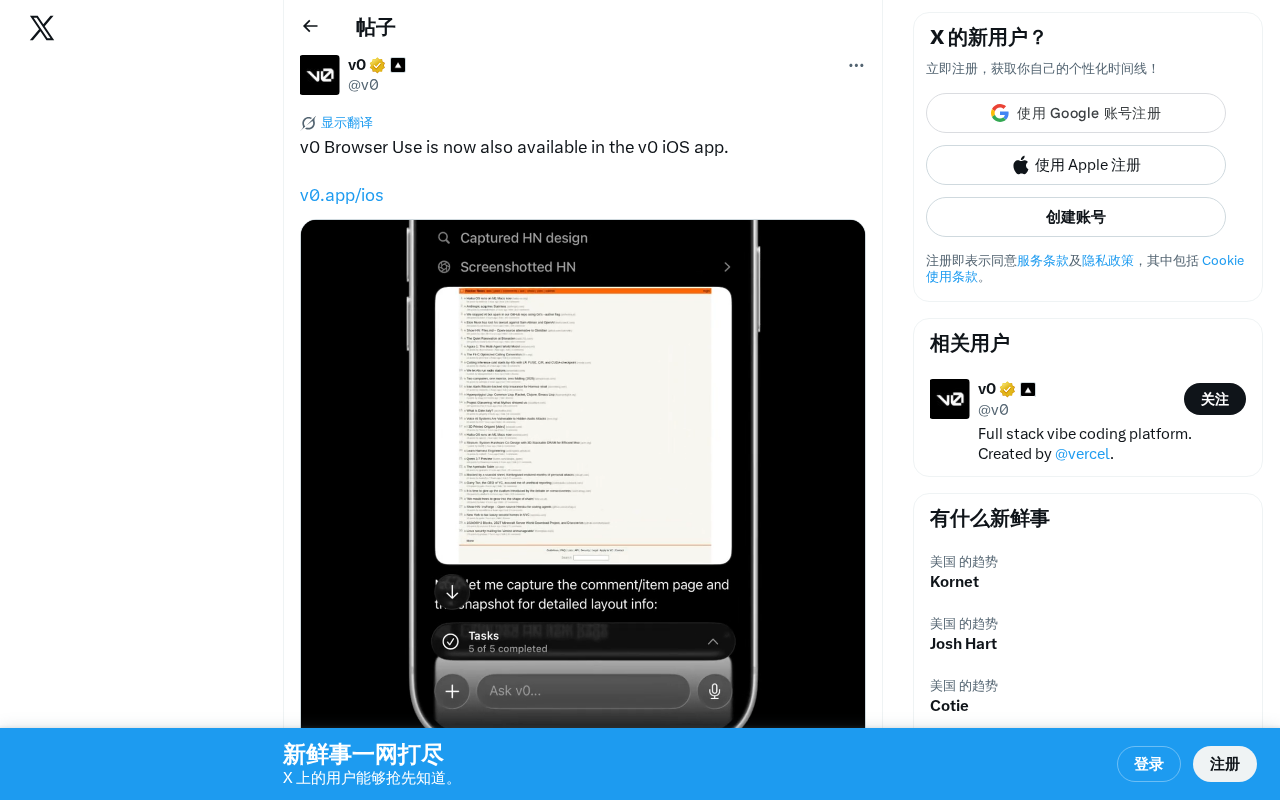
v0 Browser Use Feature Comes to iOS, Elevating the Mobile AI Coding Experience
Vercel's v0 brings Browser Use to iOS, enabling real-time code preview and touch interaction on iPhone and iPad. Explore what this means for mobile AI coding.
Read more →
 Tutorials
·4 min
Browser Use Tutorial: AI Browser Automation Agent Installation, Configuration & Practical Guide
Complete guide to Browser Use, the open-source AI browser automation agent: installation, Web UI usage, code integration, architecture, and token optimization tips for automating web tasks with natural language.
Read more →
 Tutorials
·4 min
Browser-Use WebUI Installation & Configuration Guide: AI Browser Automation in Practice
A detailed guide on installing Browser-Use WebUI, configuring Gemini and DeepSeek models, with four practical demos including form filling, content summarization, and e-commerce data scraping.
Read more →
 Deep Dives
·3 min
Auto-Use Open Source Project Explained: One AI Agent to Handle Your OS, Browser, and Code
Deep dive into the Auto-Use open source project—an end-to-end AI Computer Use Agent that unifies OS control, browser automation, and coding. Analysis of architecture, competitors, and industry trends.
Read more →
 Deep Dives
·2 min
Computer Agent: An Open-Source Rust AI Desktop Agent That Automatically Controls Mouse, Keyboard, and Browser
Computer Agent is an open-source AI desktop agent built in Rust that controls terminals, browsers, mice, and keyboards via natural language. Explore its features, architecture, and security.
Read more →
 Product Reviews
·3 min
Codex Browser Use Hands-On: How Powerful Is GPT 5.5's AI Browser Automation Really?
In-depth hands-on with OpenAI Codex's Browser Use and Computer Use features. See how GPT 5.5 enables browser automation, app testing, desktop control, and cross-device operation, with a full setup tutorial.
Read more →

·3 min
Five Giants Including OpenAI Join Forces: AI Agent Interoperability Standards Officially Unified
OpenAI and four competitors agree on unified AI agent standards, addressing interoperability challenges in tool calling and task orchestration. Analysis of implications for developers and enterprises.
Read more →

·2 min
Deno Deep Dive: A Secure JavaScript Runtime Powered by Rust
Deep dive into Deno runtime's core features: secure-by-default sandbox, native TypeScript, Rust+V8 architecture, built-in toolchain & Web standard APIs.
Read more →

·3 min
authentik: A Complete Guide to the Open-Source Self-Hosted Identity Authentication Platform
Explore authentik, an open-source identity authentication platform supporting SSO, OAuth2, SAML, and LDAP with self-hosted data sovereignty for enterprise identity management and Homelab setups.
Read more →

·3 min
Mozilla's First State of Open Source AI Report: Definitions, Ecosystem, and Future Directions
Mozilla Foundation releases its first State of Open Source AI Report, systematically examining open source AI definitions, the gap between open weights and true open source, ecosystem health, and policy implications.
Read more →

·3 min
Multiple States Join Forces to Pressure OpenAI: Demanding AI Agents Be Isolated in Sandboxes
Multiple U.S. states led by Iowa demand OpenAI isolate AI agents in sandbox environments, sparking debate over AI autonomy, safety guardrails, and liability in the emerging era of autonomous AI systems.
Read more →

·4 min
GPU Utilization Under 30%: Breaking Free from Reserved Resource Waste
Enterprise GPU clusters average under 30% utilization with massive reserved resource waste. This article analyzes root causes like zombie Notebooks and missing attribution, offering practical solutions including resource tagging, idle timeout reclamation, and elastic scheduling.
Read more →

·3 min
Wallfacer: A Terminal Session Manager Designed for Claude Code
Wallfacer is a terminal session manager designed for AI coding tools like Claude Code, solving multi-session parallel management challenges for developers.
Read more →

·3 min
Bonsai: A Deep Dive into Jane Street's Open-Source Functional UI Library for OCaml
Deep dive into Jane Street's open-source functional UI library Bonsai, exploring its OCaml-based incremental computation model, strongly-typed component architecture, and performance advantages for high-frequency data scenarios.
Read more →

·3 min
Migrating C/C++ Projects to Rust: A Practical Guide to Incremental Rewriting
A detailed guide on safely migrating C/C++ projects to Rust, covering incremental strategies, FFI interop, bindgen/cxx toolchain usage, and unsafe boundary management.
Read more →