#Codex controller
32 related articles

·2 min
OpenAI Codex Micro Review: A Deep Dive into the AI Coding Dedicated Hardware Controller
OpenAI and Work Louder launch the Codex Micro custom control panel with voice input, analog joystick, and programmable keys designed for AI-assisted coding workflows.
Read more →
·3 min
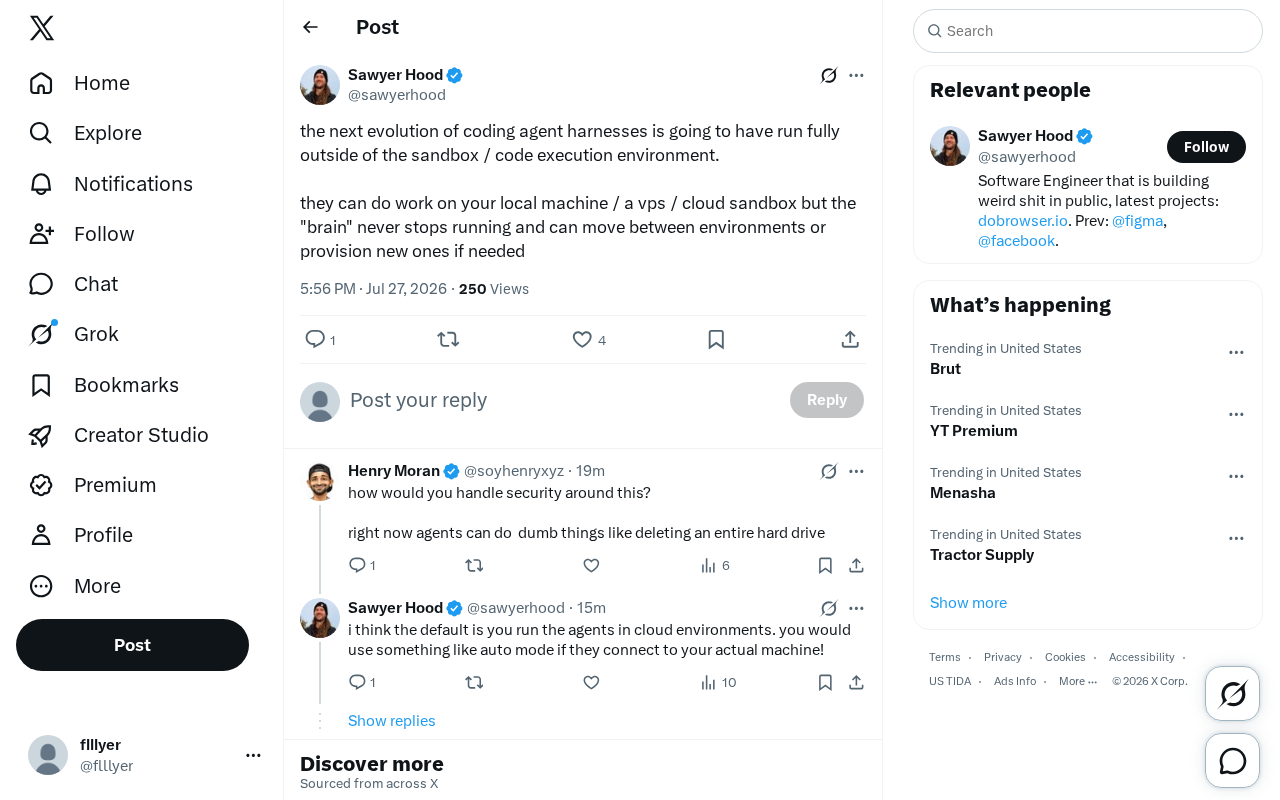
The Next Evolution of Coding Agents: Letting the Brain Break Free from the Sandbox
Exploring the key evolution in coding agent architecture: separating the reasoning core from code execution environments to decouple control and execution planes.
Read more →
·3 min
The Next Evolution of Coding Agents: Letting the Brain Escape the Sandbox
Exploring the next evolution in coding agent architecture: decoupling the reasoning core from code execution environments to separate control and execution planes.
Read more →

·4 min
7 Core Components for Designing Long-Running AI Agents
A deep dive into the 7 core components for building long-running AI Agents: Goal, Evaluator, Verifier, Loop, Orchestration, Observability, and Memory.
Read more →

·3 min
Pi Agent Review: A Minimalist Coding Agent That's Lightweight, Efficient, and Highly Customizable
Pi Agent hands-on review: ~1,200 token overhead, no built-in system prompts, supports Codex/Grok and more. Compared to Claude Code and OpenCode, Pi Agent wins with minimalist design and full customizability.
Read more →

·3 min
Multi-Agent Collaboration with Claude Code and Codex: A Guide to Architecture Design and State Management
A deep dive into Claude Code and Codex multi-Agent collaboration: architecture design, state-driven coordination, private/public zone division, and building efficient AI programming teams.
Read more →

·5 min
Browser Use: A Deep Dive into the Event-Driven Browser AI Agent Framework
Browser Use is an open-source AI Agent framework that lets LLMs autonomously drive browser operations via natural language. This article breaks down its four-layer architecture, core Agent loop, CDP perception layer, dynamic Tools dispatch, and its Skills, Sandbox, and MCP extension capabilities.
Read more →

·2 min
GPT-5.6 Released: How AI Agents Are Moving from the Screen into the Physical World
OpenAI releases the GPT-5.6 model family, focusing on real-world applications: from automating greenhouses and empowering small entrepreneurs, to Codex 5.6 helping a mathematician disprove a three-year problem. A deep dive into GPT-5.6's multi-agent architecture and end-to-end execution.
Read more →

·7 min
GitHub Copilot in Practice: The Capability Boundaries of AI Programming and the Irreplaceable Value of Humans
A developer's real case of building a dental clinic management system with GitHub Copilot and Azure SQL, revealing AI coding limits in cloud security config and how Human-in-the-Loop breaks through.
Read more →

·6 min
The Seven Core Components of Building Long-Running AI Agents
An in-depth look at the seven core components for building long-running AI agents: Goal, Evaluator, Verifier, Outer Loop, Orchestration, Observability, and Memory. Master this control system for reliable autonomous agents.
Read more →

·6 min
Alibaba Bans Claude Code: The Enterprise Security Red Line for AI Coding Tools
In-depth analysis of Alibaba's comprehensive internal ban on Claude Code: from the hidden-marker controversy and Anthropic's regional-restriction stance to five core questions of enterprise AI coding tool security admission.
Read more →

·7 min
Engineering Vibe Coding in Practice: Taming AI Programming with Superpowers and gstack
A deep dive into engineering Vibe Coding: using Superpowers for project-level decomposition and gstack for module layering and constraints to tame AI coding assistants like Codex and Claude Code.
Read more →

·4 min
Frontend to Full-Stack AI: A Complete NestJS + LangChain Roadmap
Pure frontend roles are shrinking fast. Learn how mastering NestJS and LangChain AI agent development can unlock a 20–30% salary boost on your full-stack AI transition path.
Read more →

·4 min
AI Weekly: Top Coding Model Returns, Google's New Flash Checkpoint, and the Video Generation Race
This week in AI: Anthropic's flagship coding model returns globally with new safety classifiers, Google tests a new Gemini Flash checkpoint, video generation heats up, and Figure AI robots enter BMW factories.
Read more →

·3 min
Vibe Coding in Practice: How Four Tools Work Together to Make AI Programming More Convergent and Controllable
Explore the four-layer AI programming architecture: SuperPrompt for project-level decomposition, Gstack for module-level code layering, and Cursor/Claude Code for execution. Master this workflow to make Vibe Coding truly engineering-grade.
Read more →

·3 min
OpenHands Agent Canvas: The Central Control Console for Managing All AI Agents
Deep dive into OpenHands Agent Canvas: not another AI coding assistant, but a unified control plane for managing Claude Code, Codex, and other AI Agents with automated workflows and self-hosted deployment.
Read more →

·2 min
Codex's Insane Logging Is Destroying Your SSD: 37TB Written in 21 Days
OpenAI Codex has a severe logging bug that wrote 37TB to a user's SSD in 21 days, potentially killing drives within a year. Learn the cause, risk, and fix.
Read more →

·3 min
Vibe Coding Practical Guide: Tool Selection, Development Workflow, and Lessons Learned
In-depth analysis of Vibe Coding methodology covering Claude Code, Cursor, and Codex tool strategies, full development workflow tips, and four key principles for avoiding pitfalls in complex systems.
Read more →

·3 min
Essential for Embedded Development: Three Must-Have MCP Servers
Three essential MCP servers for embedded development: Debugger MCP, VS Code MCP Server, and Zephyr Official MCP — solving AI coding pain points like missing syntax checking and documentation access.
Read more →

·3 min
TraeHarness Open-Sourced: 18 AI Agents Form a Virtual Development Team
TraeHarness is an open-source multi-agent framework with 18 specialized AI Agents simulating a real software team, covering requirements, architecture, development, testing, and deployment.
Read more →