#GPU throughput
426 related articles
 Tech Frontiers
·1 min
Google Anti-Gravity 2.0 Explained: The Multi-Agent Development Platform Replacing Gemini CLI
Google Anti-Gravity 2.0 officially replaces Gemini CLI with a desktop app, CLI terminal, and SDK. Powered by Gemini 3.5 Flash, it supports multi-Agent parallel collaboration and one-click Managed Agents deployment.
Read more →
 Product Reviews
·1 min
NVIDIA CompileIQ: Auto-Tuning Compiler Options to Squeeze Every Drop of GPU Kernel Performance
Deep dive into NVIDIA CompileIQ auto-tuning tool that intelligently searches compiler option combinations to find optimal build parameters for CUDA kernels.
Read more →
 Tutorials
·1 min
NVIDIA CUDA Tile: A Detailed Look at the New Tile-Based GPU Programming Paradigm
In-depth analysis of NVIDIA's new CUDA Tile programming model: how tile-based GPU kernel development integrates with C++, optimizes data locality, and accelerates Tensor Core computation for HPC, deep learning, and AI inference.
Read more →
 Product Reviews
·2 min
GLM 5.1 Flagship Model Tested at 400 TPS — From Sketch to Complete App in Two Minutes
Testing Zhipu's GLM 5.1 High Speed API: a full-power flagship model at 400 Token/s. From sketch restoration to generating a complete puzzle game, verifying speed and capability combined.
Read more →
 Tech Frontiers
·2 min
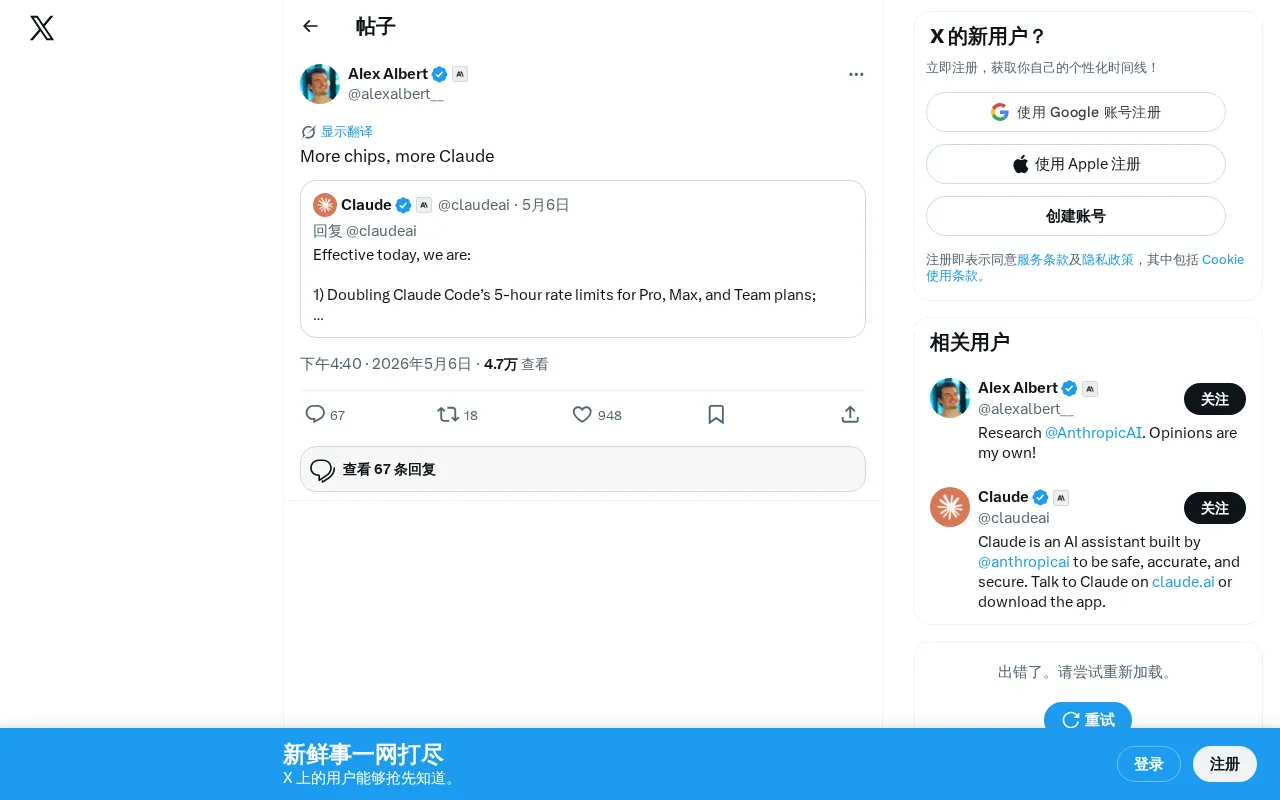
Anthropic's Compute Expansion Explained: How More Chips Make Claude Stronger and Faster
Anthropic announces a massive compute expansion with "More chips, more Claude." This article analyzes the impact on user experience, service capacity, response speed, and next-gen models.
Read more →
 Product Reviews
·2 min
New Features for Claude Managed Agents: Self-Hosted Sandboxes and MCP Tunnels Explained
Anthropic launches two enterprise features for Claude Managed Agents: self-hosted sandboxes with Cloudflare, Daytona, Modal, and Vercel, plus MCP Tunnels for secure private network connections.
Read more →
 Product Reviews
·2 min
Gemini 3.5 Flash vs Qwen3.6 Real-World Test: How Far Are Benchmark Scores from Actual Experience?
Hands-on testing of Gemini 3.5 Flash across UI generation, coding, and Agent capabilities vs Qwen3.6-27B, revealing the gap between benchmark scores and real-world performance.
Read more →
 Tutorials
·2 min
How to Tell If Your GPU Is Out of VRAM When Running Local LLMs: A Complete Guide to VRAM Monitoring
How to tell if your GPU is out of VRAM when running local LLMs. Learn the difference between dedicated and shared GPU memory, monitor VRAM overflow via Task Manager, and use quantization and context length control to avoid OOM.
Read more →
 Tech Frontiers
·1 min
Gemini 3.5 Flash Released: How Google Balances AI Model Speed and Capability
Google releases Gemini 3.5 Flash, optimizing the balance between speed and capability. Analysis of Flash series evolution, comparisons with GPT-4o mini, and practical value for developers.
Read more →
 Tutorials
·2 min
vLLM and SGLang Local Deployment Tutorial: A Practical Guide to 3-8x Performance Gains
Complete guide to deploying vLLM and SGLang locally. Compare performance vs LM Studio, deploy in 3 steps with Docker + AI assistant. Covers SGLang vs vLLM selection, 5090 VRAM optimization, and Cherry Studio integration.
Read more →
 Industry Insights
·2 min
Enterprise LLM Selection Guide: In-Depth Comparison of Llama 3.1, Qwen 2.5, and DeepSeek
How should enterprises choose open-source LLMs? This guide compares Llama 3.1, Qwen 2.5, DeepSeek, and Mistral across model capabilities, hardware requirements, and business scenarios.
Read more →
 Deep Dives
·2 min
How Fast Is 10 Tokens Per Second from an LLM? An Open-Source Tool for Visualizing Token Generation Speed
An open-source tool lets you visualize LLM token generation speeds from 5-800 TPS, helping developers make rational choices about model selection and inference optimization.
Read more →
 Deep Dives
·4 min
How Dangerous Are Windsurf Account-Switching Plugins? A Deep Dive into Technical Principles and Security Risks
Deep analysis of Windsurf seamless account-switching plugin's technical implementation, revealing risks of account bans, code theft, and legal liability. Four compliant alternatives for developers.
Read more →
 Deep Dives
·4 min
XANI: How GPU-Accelerated X-Ray Nanoscale Imaging Is Revolutionizing XFEL Data Analysis
Explore how the XANI project uses NVIDIA GPUs to accelerate XFEL data analysis, compressing nanoscale imaging from days to hours and advancing fusion materials and semiconductor research.
Read more →
 Tech Frontiers
·3 min
GPT Image 2 Generates APP Interfaces from Scratch — A Paradigm Revolution in AI Front-End Development
GPT Image 2 generates flawless text and photorealistic APP interfaces from scratch. Combined with Codex, AI front-end development enters a paradigm revolution. Coverage includes Amap's ABOT, LLM interpretability breakthroughs, and Huang's TPU rebuttal.
Read more →
 Tutorials
·2 min
NCCL Multi-GPU Communication Optimization in Practice: A Guide to Scaling HPC High-Performance Computing
Deep dive into NVIDIA NCCL multi-GPU communication library principles and optimization strategies, covering AllReduce, NVLink, and GPUDirect RDMA to help HPC and AI developers master scaling from single-node to massive clusters.
Read more →
 Tutorials
·2 min
GB200 NVL72 Block Scheduling in Practice: How Slurm Squeezes Every Bit of Rack-Level NVLink Performance
Deep dive into how Slurm block scheduling maximizes NVIDIA GB200 NVL72 rack-level NVLink performance through topology-aware allocation, reducing fragmentation and boosting GPU utilization by 15-25%.
Read more →
 Tutorials
·4 min
NCCL Inspector Explained: Real-Time GPU Cluster Communication Monitoring with Prometheus Integration
Deep dive into NVIDIA NCCL Inspector for real-time GPU cluster communication monitoring with Prometheus integration, covering straggler detection, alerting, and Grafana visualization for distributed training optimization.
Read more →
 Tutorials
·4 min
NVIDIA Model Optimizer Post-Training Quantization (PTQ) Practical Guide
A deep dive into NVIDIA Model Optimizer's PTQ workflow, covering INT8/INT4 quantization principles, calibration methods, RTX GPU optimization, and best practices for deploying quantized LLMs on consumer GPUs.
Read more →
 Deep Dives
·3 min
AI Model Deployment Pipeline Friction: How TensorRT Systematically Eliminates Inference Optimization Bottlenecks
Deep dive into pipeline friction in AI model deployment from training to production, covering TensorRT automated optimization, ONNX export, and Triton Inference Server best practices.
Read more →