#LangChain multi-agent
574 related articles

·5 min
Complete Breakdown of Core Competencies for AI Agent Engineers: From Demo to Production-Grade Systems
Deep breakdown of 4 core AI Agent engineer competencies: business decomposition, multi-Agent architecture, quantitative evaluation, and engineering delivery—bridging the gap from Demo to production.
Read more →

·5 min
The Complete Guide to AI Agent Development: A Four-Stage Progressive Roadmap
A systematic guide to AI Agent development across four stages: LLM fundamentals, ReAct paradigm, memory & tools, and multi-agent collaboration for developers.
Read more →
·3 min
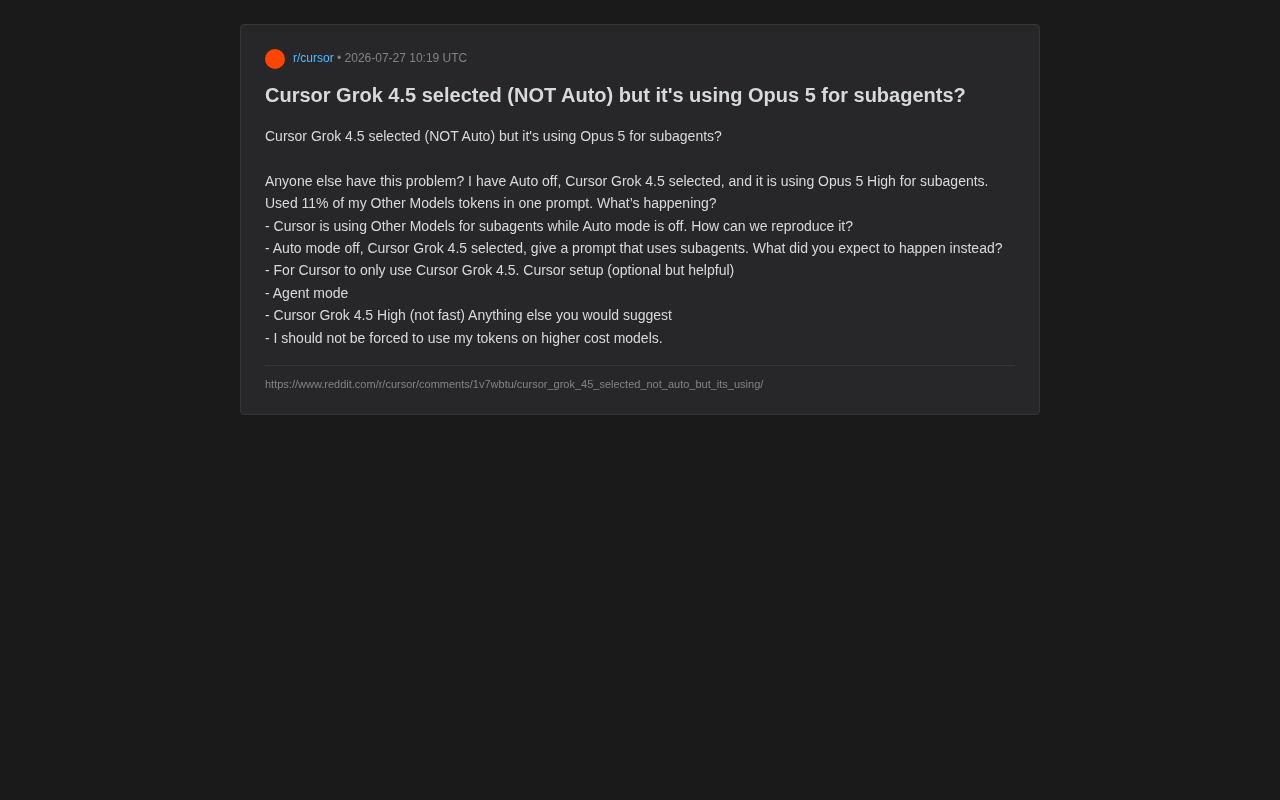
Cursor Selects Grok but Calls Opus: Subagent Model Substitution and Cost Control Issues Explained
Cursor users selecting Grok 4.5 find subagents secretly calling expensive Opus 5, consuming 11% quota per prompt. Analysis of model decoupling, cost transparency, and user strategies.
Read more →

·4 min
The More Complex the AI Agent, the More It Hallucinates? The Hidden Cost of Architectural Complexity
Why do AI Agents hallucinate more as they grow more complex? This article analyzes the causes from error accumulation, context noise, and model completion nature, with 5 practical production strategies.
Read more →

·3 min
Build RAG and AI Agent Projects at Zero Cost: A Practical Guide to Open-Source Tools
Build high-quality AI projects on a budget. Learn how to use Ollama, Groq, Chroma, and other free open-source tools to build RAG systems and multi-Agent workflows from scratch.
Read more →
·3 min
Build RAG and AI Agent Projects at Zero Cost: A Practical Guide to Open-Source Tools
Build high-quality AI projects on a budget. Learn how to use Ollama, Groq, Chroma, and other free open-source tools to build RAG systems and multi-Agent workflows from scratch.
Read more →

·4 min
GenAI Job Interview Gone Wrong: Interviewer Googles Gemini for Questions on the Spot — What's Broken in AI Hiring?
A fresh grad interviewing for a GenAI Trainer role faced prime number coding and activation function questions while the interviewer used Gemini to generate questions live — exposing AI hiring chaos.
Read more →
·3 min
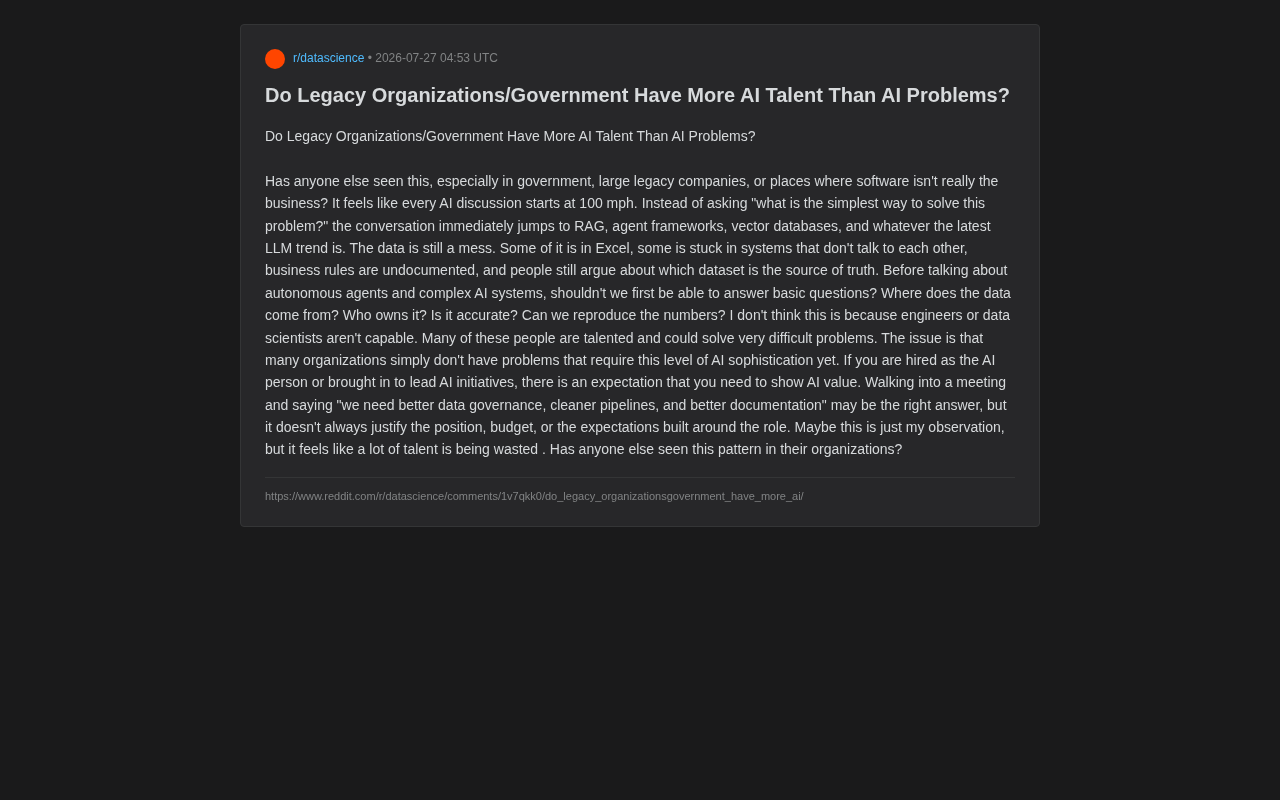
AI Talent Surplus with No Problems to Solve? The Structural Mismatch in Enterprise AI Adoption
Companies race to hire AI talent, but do traditional organizations have enough AI problems to solve? This article examines the structural mismatch in enterprise AI adoption and offers pragmatic strategy advice.
Read more →

·2 min
Deep Dive into Agent Skills Architecture: How to Extend AI Agent Capabilities
Agent Skills is a lightweight open-source format that extends AI agent capabilities with plug-and-play skill packages. This article dives deep into the Skills architecture, progressive disclosure, and how it differs from Multi-Agent design.
Read more →

·3 min
Getting Started with AI Agent Development: A Learning Path from Zero to Deployment
A systematic guide to the complete learning path for AI Agent development—covering prompt engineering, RAG knowledge bases, LangChain & LangGraph, fine-tuning, and multi-agent collaboration.
Read more →
·2 min
Getting Started with AI Agent Development: A Complete Guide from Zero to Real-World Projects
A beginner-friendly guide to AI Agent development, covering the full learning path from LLM basics, prompt engineering, and RAG to LangChain and multi-agent collaboration.
Read more →

·2 min
Getting Started with AI Agent Development: A Complete Guide from Zero to Deployment
A beginner-friendly guide to AI Agent development, covering the full learning path from LLM fundamentals, prompt engineering, and RAG to LangChain and multi-agent collaboration.
Read more →

·2 min
Deep Dive into Agent Skills Architecture: How to Extend AI Agent Capabilities
Agent Skills is a lightweight open-source format that extends AI agent capabilities via plug-and-play skill packages. Learn its architecture, progressive disclosure, and how it differs from Multi-Agent.
Read more →

·2 min
A Complete Guide to Learning AI Agents from Scratch: From Beginner to Practice
A complete guide to learning AI Agents: from large model fundamentals and core technologies to hands-on projects. Systematically outlines beginner methods and exposes crash-course marketing traps.
Read more →

·4 min
Spring AI 2.0: Five Key Updates Explained — Marching Toward the Age of AI Agents
Spring AI 2.0 brings five core updates: mandatory upgrade to Spring Boot 4, Tools parsing moving up, a built-in Agentic mechanism, MCP switching to Streamable HTTP, and an on-demand tool Advisor.
Read more →

·4 min
Spring AI 2.0 Explained: Five Key Updates Ushering in the Age of AI Agents
Spring AI 2.0 brings five core updates: mandatory Spring Boot 4 upgrade, Tools parsing moved up, built-in Agentic mechanism, MCP switch to Streamable HTTP, and on-demand tool-loading Advisor.
Read more →

·4 min
Spring AI 2.0: Five Key Updates Explained — Stepping into the Agent Era
Spring AI 2.0 brings five core updates: mandatory upgrade to Spring Boot 4, lifted Tools parsing, built-in Agentic mechanism, MCP switch to Streamable HTTP, and an on-demand tool-loading Advisor.
Read more →

·1 min
Becoming an AI Agent Engineer: A Detailed 4-Week Hands-On Learning Roadmap
Want to become an AI Agent engineer? This article breaks down a 4-week roadmap: from core agent architecture and ReAct, to multi-agent collaboration and real projects.
Read more →

·2 min
Multi-Agent Collaborative Paper Writing System: End-to-End Automation with FastAPI + Vue 3
An in-depth look at an intelligent paper writing platform built on FastAPI + Vue 3, combining LLM, RAG, and multi-Agent collaboration for full-process automation—an excellent case study for AI developers.
Read more →

·2 min
Deep Dive into the OpenClaw Multi-Agent Framework: From Dify Workflows to Autonomous AI Execution
An in-depth analysis of the OpenClaw multi-agent framework: its TypeScript single-process gateway design, inter-agent scheduling, advantages over Dify workflows, and the three evolutions of AI execution.
Read more →