#RoPE positional encoding
119 related articles

·4 min
Zhipu GLM-5.2 Released: China's First Open-Source Model to Cross the 'Primary Model' Threshold
Zhipu releases GLM-5.2 with 1M token context, matching GPT-5.x and Claude. Zcode 3.0 offers 3M free daily calls with one-click migration from Claude Code and Codex.
Read more →

·6 min
Jacobian-Lens in Practice: Manually Reshaping LLM Behavior with J-Space
After Anthropic released Jacobian-Lens, a developer reversed it from an interpretability tool into a behavior editor, manually tuning J-Space to reshape LLM outputs. An in-depth look at the tech, representation engineering, and AI safety risks.
Read more →

·5 min
Advanced Machine Learning Reading List: How to Choose the Right Book Among These 4 Classics?
Torn between Géron, Chollet, and Raschka? This article breaks down 4 classic ML books for self-learners aiming at finetuning and small language models (SLM), helping you find the best advanced path.
Read more →

·5 min
Krea 2 Turbo Style Reference LoRA: Define Your Generation Style with a Single Image
ostris releases the Krea 2 Turbo Style Reference LoRA, supporting single or multi-image style extraction for precise AI style transfer. Open-source, free, and locally deployable.
Read more →

·6 min
Alibaba Bans Claude Code: The Battle Over AI Coding Tool Security and Data Sovereignty
Alibaba bans Claude Code over security risks, sparking tech community debate. An in-depth analysis of data leakage risks with cloud AI coding tools and the rise of local AI deployment.
Read more →

·7 min
GPT-5.6 Full Model Lineup Hands-On Guide: A Deep Dive into API Relay Stations and Their Risks
The full GPT-5.6 model lineup is live. How can domestic developers access it at low cost via API relay stations? This article explains the principles, registration, token setup, client integration, and key risks.
Read more →

·4 min
Docx-CLI: An Open-Source Tool That Boosts AI Agent Word Document Efficiency by 50%
Docx-CLI is an open-source CLI tool for AI agents that strips redundant XML and enables precise editing, helping LLM agents save half the tokens and time on Word docs.
Read more →

·4 min
The Three Eras of AI Agents: The Capability Leap from Tool Calling to Autonomous Orchestration
An in-depth look at the three core eras of AI Agent development: reliable tool calling, coherent long-task execution, and autonomous orchestration with metacognition. Helps developers match tasks to model capabilities.
Read more →

·3 min
Zhipu GLM-5.2 Fully Released, AI Regulatory Storm Hits Simultaneously
Zhipu's GLM-5.2 is now fully available to Coding Plan users with long-context support and dual reasoning tiers. Meanwhile, Anthropic faces U.S. export controls and OpenAI is under multi-state investigation.
Read more →

·3 min
AI Art Prompt Deconstruction: Multi-Style Fusion Techniques Behind "The Last Ember"
A deep dive into the prompt logic behind AI artwork "The Last Ember" — covering Art Nouveau meets Egyptian mural fusion, Midjourney parameter settings, and structured prompt methodology.
Read more →

·5 min
Practical Guide to Deploying Invoice Analysis AI: Model Selection and Architecture Pitfalls
How can enterprises process 50+ invoice formats with AI? This article analyzes visual document understanding approaches—multimodal LLMs, OCR+LLM, and hybrid architecture—with key decision advice for non-technical AI leads.
Read more →

·7 min
50 AI Research Job Applications to FAANG, 0 Replies? Unpacking the Truth Behind the Job Search Struggle
An AI research engineer with 3 years of experience sent 50 applications to FAANG with zero replies. This article breaks down the hidden barriers of top-tech AI roles, the truth about LinkedIn ghost jobs, and the MLE vs. Research Engineer divide.
Read more →

·7 min
AI Coding in Practice: Generating a Minecraft Clone in 90 Minutes as LLMs Enter Project-Level Development
A major breakthrough in AI coding! Hands-on tests show new LLMs generating a Minecraft clone in 90 minutes and a TMNT game in 30 minutes, building 3D scenes, animation, and game logic in one shot.
Read more →

·5 min
Real-World Comparison of 6 Open-Source LLMs for On-Premise Deployment: A Selection Guide to Avoid Pitfalls
A hands-on comparison of 6 open-source LLMs (DeepSeek, Qwen3, Zhipu GLM, Kimi K2, MiniMax M3, Tencent Hunyuan 3) for on-premise deployment—covering hardware cost, inference efficiency, and deployment difficulty.
Read more →

·4 min
DeepSeek Coder Deep Dive: How This Open-Source Code LLM Outperforms GPT-4
A deep dive into DeepSeek Coder V1 to V2: MoE architecture, 128K context, 90.2% HumanEval pass rate, and how it became the first open-source model to beat GPT-4 Turbo.
Read more →
·6 min
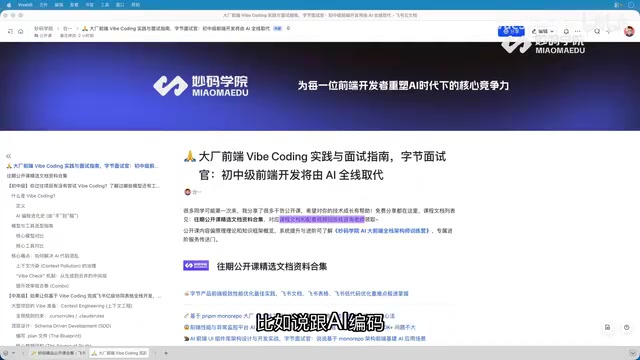
Vibe Coding in Practice at Big Tech: How Frontend Engineers Can Avoid Being Replaced in the AI Era
A big-tech interviewer reveals: junior/mid frontend dev is being replaced by AI. This article breaks down 3 core Vibe Coding interview questions to help you master key skills for the AI-assisted coding era.
Read more →

·5 min
From Prompts to Harness Engineering: The Evolution of AI Agent Development Paradigms
Why has AI engineering methodology evolved from prompts to context engineering and now Harness engineering? This article examines three paradigms, key bottlenecks, and the Agent = Model + Harness formula.
Read more →

·6 min
DINOv2 vs SigLIP: Why the Huge Gap in k-NN Classification? A Guide to Avoiding Vision Encoder Selection Pitfalls
Experiments show DINOv2 Giant scores just 41% on k-NN classification, while SigLIP2 reaches 92%. This article dives into the embedding-space differences between contrastive and self-supervised learning to guide vision encoder selection.
Read more →

·4 min
Grok vs GPT vs Claude: Which AI is the Best Coding Assistant?
Grok 4.5, GPT-5.5, and Claude go head-to-head on the same coding tasks. A deep comparison of code quality, UI design, and engineering standards to help you choose the right AI coding assistant.
Read more →

·6 min
Grok 4.5 Deep Dive: Coding on Par with Top Models, at a Fraction of the Cost
A senior developer's 24-hour deep test of Grok 4.5: a 1.5T-param MoE model at $2/M input tokens, with coding benchmarks rivaling GPT-5.5. Real performance, token efficiency, and limits explained.
Read more →