#Windsurf
592 related articles
 Product Reviews
·3 min
Haiku 4.5 vs GPT-5 Mini vs GLM-4.6: Real-World Benchmark of Budget Coding Models
In-depth comparison of Claude Haiku 4.5, GPT-5 Mini, and GLM-4.6 across speed, cost, code quality, concurrency safety, and tool calling to help developers choose the right budget AI coding model.
Read more →
 Tech Frontiers
·2 min
Claude Haiku 4.5 Released: Double the Speed at One-Third the Price, Setting a New Cost-Efficiency Benchmark for AI Coding
Anthropic releases Claude Haiku 4.5, a distilled version of Sonnet 4.5 with near-flagship coding performance, double the speed, and one-third the cost. Scores 73.3 on SWE-Bench, ideal for developers seeking cost-efficiency.
Read more →
 Tutorials
·3 min
51.8K Stars! Claude Code Best Practices: A Complete Guide from Getting Started to Agent Engineering
Deep dive into the 51.8K Star Claude Code best practices project on GitHub, covering Prompt Engineering, efficient Web Coding, multi-Agent collaboration, and more.
Read more →
 Tutorials
·4 min
Vibe Coding Practical Guide: SDD Methodology Explained with 4 Enterprise-Level AI Programming Projects
Deep dive into SDD specification-driven development methodology with 4 enterprise-level Vibe Coding projects including Chat BI and multimodal knowledge bases, covering Cursor, Claude Code, and Prompt Engineering.
Read more →
 Tutorials
·3 min
Jules MCP Server: Using the MCP Protocol to Let Claude Orchestrate Google Jules for Autonomous Coding
Jules MCP Server is an open-source project providing a production-grade MCP server for Google Jules API, enabling Claude and Cursor to orchestrate autonomous coding via multi-Agent collaboration.
Read more →
 Tech Frontiers
·3 min
OpenAI Codex Comes to ChatGPT Mobile: The AI Coding Tool War Heats Up
OpenAI brings Codex to the ChatGPT mobile app, competing directly with Claude Code. Explore Codex mobile features, developer impact, and the 2025 AI coding tool landscape.
Read more →
 Deep Dives
·4 min
Claude Code Auto Mode Fully Explained: Classifier Mechanism, Fault Tolerance Design & Security Protection
Deep dive into Claude Code Auto Mode: how the independent Classifier reviews AI operations, three-level graceful degradation prevents system deadlocks, SubAgent triple review with Prompt Injection protection, plus setup and plan requirements.
Read more →
 Deep Dives
·3 min
MCP Protocol Explained in 3 Minutes: The USB-C Standard for AI
A clear breakdown of MCP (Model Context Protocol): its core concepts, three standard primitives, real-world use cases, and ecosystem status. Learn how Anthropic's open-source unified tool integration standard is changing AI development.
Read more →
 Tech Frontiers
·3 min
Microsoft Revokes Claude Code Licenses: Inside the Strategic Battle Over AI Coding Tools
Microsoft revokes internal Claude Code licenses despite widespread praise, prioritizing GitHub Copilot's competitive position in the intensifying AI coding tools market battle.
Read more →
 Product Reviews
·3 min
Cursor In-Depth Review: Four Modes + Parallel Agents — Why It Remains the Best AI Coding Tool
In-depth comparison of Cursor vs Claude Code, Windsurf, Trae, and other AI coding tools across Agent modes, terminal tools, browser integration, parallel processing, and context management.
Read more →
 Deep Dives
·4 min
Harness Engineering Explained: The Third-Generation Development Paradigm for Taming AI Agents
Deep dive into Harness Engineering: the third-gen AI development paradigm. Learn its three-layer architecture for effectively harnessing AI Agents to complete complex development tasks.
Read more →
 Tech Frontiers
·2 min
GitHub Copilot Cloud Agents Now Support Fully Configured Development Environments
GitHub Copilot Cloud Agents now support fully configured dev environments with repo cloning, dependency installation, and toolchain credentials—evolving AI from code completion to autonomous development.
Read more →
 Tech Frontiers
·3 min
GitLab's Major Restructuring: Layoffs, Flattening, and a Bold Bet on the AI Agent Era
GitLab announces Act 2 restructuring: cutting 30% of operating countries, removing three management layers, splitting R&D into 60 autonomous teams. A deep dive into GitLab's Jevons Paradox bet on the AI agent era.
Read more →
 Tutorials
·2 min
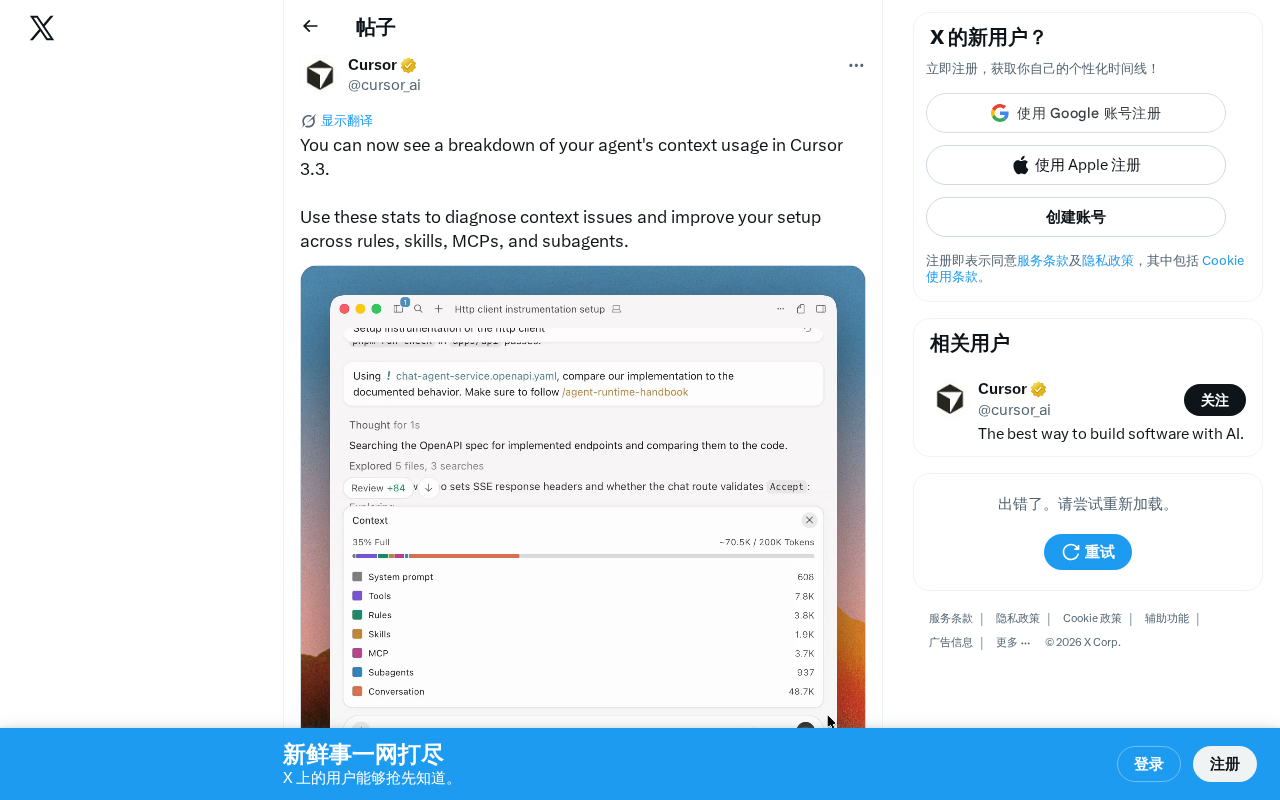
Cursor 3.3 Context Usage Analysis: A Complete Guide to Understanding and Optimization
Cursor 3.3 adds Agent context usage analysis, helping developers visualize Rules, MCP, Skills context consumption. Learn how to optimize AI programming efficiency.
Read more →
 Tech Frontiers
·3 min
Cursor 3 PR Review Feature Explained: Complete Code Review Workflow Within Your Editor
Cursor 3 introduces native PR review with in-editor diffs, comments, commits, and review status. Learn about file tree navigation, changes picker, and AI-assisted code review potential.
Read more →
 Tech Frontiers
·3 min
Cursor's Parent Company Anysphere Uses Composer to Train Next-Gen AI: How Bootstrapped Iteration Is Changing Code Generation
Anysphere uses previous-gen Composer to build RL training environments for next-gen Cursor AI. Explore how bootstrapped AI training reshapes code generation and the competitive landscape.
Read more →
 Expert Opinions
·3 min
Zig Language Bans AI Code Contributions: A Deep Debate on Open Source Principles
Zig founder Andrew Kelley rejects LLM-assisted PRs, introducing the concept of AI code's "digital smell." A deep analysis of the open source philosophy, code quality, and trust issues behind Zig's ban on AI contributions.
Read more →
 Product Reviews
·3 min
Entire CLI: An Open-Source Tool That Automatically Records AI Programming Sessions via Git
Entire CLI is an open-source CLI tool that auto-captures AI coding sessions from Cursor, Copilot, and Claude Code via Git hooks, linking them to commits for full traceability and compliance.
Read more →
 Expert Opinions
·4 min
In the Vibe Coding Era, Why Do We Need RSS for Distributing Personal Apps?
Vibe Coding makes building apps as easy as writing blog posts, but personal tools lack good distribution channels. This article explores using RSS as a lightweight app distribution protocol.
Read more →
 Expert Opinions
·2 min
The Vibe Coding Era: Why We Need RSS to Share Personal Micro-Apps
Vibe coding makes AI programming as simple as blogging, driving an explosion of personal micro-apps. Matt Webb proposes RSS for sharing micro-apps, and Simon Willison has already implemented it.
Read more →