#augmented intelligence
528 related articles

·4 min
The Rise and Fall of AI Agent Civilizations: What Multi-Agent Simulations Reveal
Explore how multi-agent simulations let AI agents autonomously build civilizations. From Stanford's AI Town to civilization-scale simulations, discover memory mechanisms, emergent behavior, and implications for social science and AI safety.
Read more →

·2 min
GitHub Daily · August 31: Local AI Servers and Training LLMs from Scratch
GitHub Trending Aug 31: minimind trains a 64M-param LLM in 2 hours; ODS turns any PC into a local AI server; plus OSINT tools and game enhancers.
Read more →

·1 min
Wiki-Style Memory: A New Paradigm for AI Agent Long-Term Memory
Explore how wiki-style memory solves AI Agent long-term memory challenges. Compare RAG and summary compression, and learn how structured, editable, cross-referenceable memory architecture drives Agent autonomy.
Read more →

·1 min
PageIndex: A Document Q&A Engine Where Every AI Answer Is Traceable and Verifiable
PageIndex is a document Q&A tool that lets you import entire document collections, with every AI answer featuring clickable citations that jump to highlighted source lines for instant verification.
Read more →

·3 min
The Great AI Rebalancing Era: How Value Distribution Is Being Reshaped
How AI is triggering a Great Rebalancing of labor, capital, and skills — analyzing which capabilities will rise or fall as cognitive work is democratized.
Read more →

·3 min
NVIDIA Co-Signs Open Letter: Why Open Models Matter
NVIDIA co-signs an open letter backing open models, highlighting their value for safety, innovation diffusion, and AI sovereignty. A deep dive into NVIDIA's strategic motivations and the coexistence of open and closed AI models.
Read more →

·3 min
DeepMind Partners with Fenris Creations: Tackling AI's Continual Learning Challenge Through Living Game Universes
DeepMind partners with Fenris Creations to use living persistent game universes to tackle four frontier AI challenges: continual learning, deep memory, long-horizon planning, and multi-agent dynamics.
Read more →

·3 min
Oasis Smart Workspace: A New Paradigm for Human-AI Agent Collaboration
Deep analysis of Oasis smart workspace and how its agent aggregation, knowledge compounding, and adaptive evolution redefine human-AI collaboration.
Read more →

·2 min
Cluing Hosted Agents: Turning AI Agents into Shareable Team Collaboration Assets
Cluing launches Hosted Agents with cross-device continuity, evolving skills, team collaboration, and API/MCP connectivity, upgrading AI agents from personal tools to organizational infrastructure.
Read more →

·3 min
The Boundaries of AI: Why Personal Memory and Human Creativity Cannot Be Replaced
AI's knowledge comes from public data, but vast personal memories remain undigitized. Explore why private experience fuels irreplaceable creativity and the right model for human-AI collaboration.
Read more →

·3 min
Apple EgoDex: Turning Vision Pro into a Dexterous Manipulation Data Factory
Apple's EgoDex uses Vision Pro's ARKit hand tracking to collect 338K dexterous manipulation episodes across 194 tasks, offering a new low-cost data collection paradigm for robot imitation learning.
Read more →

·4 min
AI Agent Learning Roadmap: A Four-Stage Guide from Zero to Production
A complete AI Agent learning roadmap covering four stages—foundations, core frameworks, hands-on projects, and advanced mastery—to help beginners build production-ready agents in six months.
Read more →

·4 min
Why Scaling LLMs Can't Achieve True Agentic Autonomy
Explore why scaling LLMs alone can't produce true agentic autonomy, and how three-tier embodied AI, efference copies, and offline sleep cycles offer a path beyond Scaling Laws toward AGI.
Read more →

·3 min
Cursor Launches Origin Code Hosting Platform: AI Editor Evolves Into a Full-Cycle Development Platform
Cursor launches its self-developed code hosting platform Origin, evolving from an AI editor to a full-cycle development platform. Analysis of its competition with GitHub, data security, and developer ecosystem impact.
Read more →

·3 min
After Being Laid Off by AI, a Programmer Open-Sourced an AI CEO: Who Should the Automation Axe Really Fall On?
A CEO used AI as a reason to fire developers. They responded by open-sourcing an AI CEO, exposing the power bias in automation narratives and who really should be replaced.
Read more →

·3 min
LLM Blind Spots: Simple Tasks They Still Can't Get Right
An in-depth analysis of LLM failures on simple tasks like counting, math, and spatial reasoning, explaining why tokenization and probabilistic prediction create inherent limitations.
Read more →

·3 min
What Is an FDE? The Most Underrated High-Paying Career of the AI Era
FDE (Forward Deployed Engineer) is an emerging high-paying AI-era role that doesn't require deep coding skills. Learn what FDEs do, core skills needed, salary expectations, and how to break in.
Read more →
·3 min
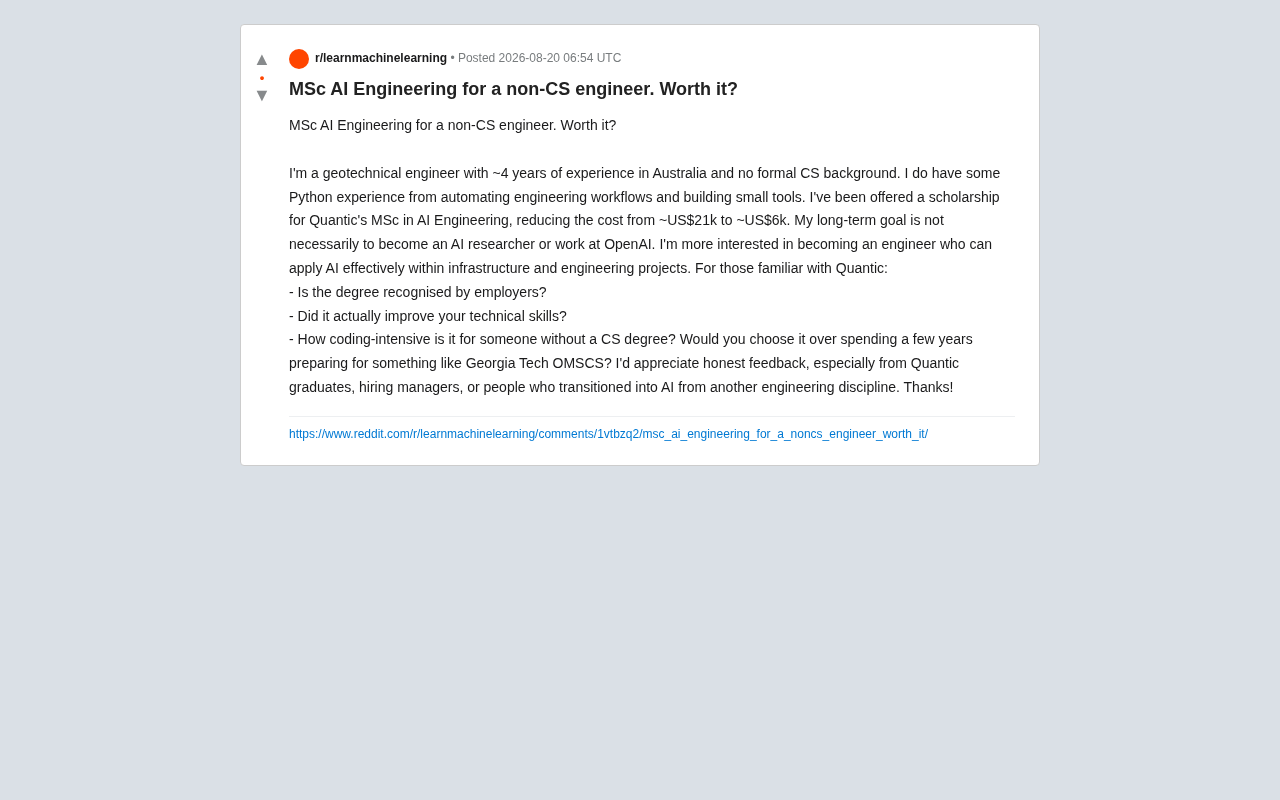
Is an AI Master's Worth It for Non-CS Engineers? Quantic vs OMSCS Deep Comparison
Should non-CS engineers pursue an AI master's? Deep comparison of Quantic AI Engineering vs Georgia Tech OMSCS, analyzing degree recognition, programming barriers, and ROI for traditional engineers transitioning to AI.
Read more →

·1 min
FLOPs Are Intelligence, Parameters Are Knowledge: Understanding the Essence of AI Large Models in One Sentence
Exploring the insight that FLOPs represent intelligence (computational reasoning) while parameters represent knowledge (memory storage) in AI large language models.
Read more →

·4 min
Top 10 Hottest AI Skills in the Programming World: From Methodologies to Workflows Fully Explained
In-depth review of the 10 hottest AI Skills in programming, covering Super Powers, MCP Builder, Composio and more—how Skills enable structured workflows, automated testing, and external connections.
Read more →