#chain-of-thought leakage
52 related articles

·5 min
LLM Reasoning Chains Stolen: Deep Dive into Architecture-Level Vulnerabilities Across Three Major AI Providers
Deep analysis of a security paper revealing architecture-level vulnerabilities in Anthropic, OpenAI, and Google's encrypted reasoning chains, covering decryption jailbreak attacks, distillation theft, privacy leaks, and Agent prompt injection.
Read more →

·3 min
AT&T's AI Sales Agent: Google Reveals an Enterprise-Grade Deployment Blueprint
Google and AT&T reveal a production AI sales Agent system using persistent memory for cross-channel continuity, achieving line-level hyper-personalization on ADK+Gemini architecture.
Read more →

·2 min
Clara AI SDR Deep Dive: How an AI Sales Rep Converts Website Visitors in Real Time
Deep dive into how Clara AI SDR uses AI Agents to proactively engage website visitors in real time, qualifying leads, demoing products, handling objections, and booking meetings to convert inbound traffic into qualified pipeline.
Read more →

·3 min
Qwen 3.8 Max In-Depth Analysis: Performance, Benchmarks, and Open-Source Ecosystem Comprehensive Evaluation
In-depth analysis of Alibaba's Qwen 3.8 Max flagship model, covering benchmark performance, math reasoning & code generation evaluation, open-source community feedback, and developer deployment guide.
Read more →

·3 min
From ML to AI Engineer: A Pragmatic Transition Learning Roadmap
A detailed guide on the core differences between ML and AI engineers, with a complete learning roadmap covering engineering fundamentals, LLM app development, and production deployment including RAG systems and agent development.
Read more →

·2 min
Reasoning Chain Theft Attacks on Closed-Source LLMs: Security Risks of API Side Channels
Are hidden reasoning chains in closed-source LLMs truly secure? Research shows attackers can reconstruct full thought chains via API side-channel signals, threatening trade secrets and IP.
Read more →

·2 min
The deep_think Tool Accidentally Leaks Hidden Reasoning Chains from Large Language Models: The Fragility of Chain-of-Thought Security Boundaries
Researchers found that providing a deep_think tool to OpenAI and Anthropic models causes unexpected leakage of hidden reasoning chains, exposing the fragility of CoT security boundaries.
Read more →

·2 min
Why Is DeepMind Falling Behind on Math Benchmarks? The Clash Between Specialized Systems and General-Purpose Models
DeepMind has top math AI systems like AlphaGeometry and AlphaProof but trails OpenAI on general math benchmarks. We analyze the specialized vs. general-purpose model divide and what benchmarks miss.
Read more →

·3 min
Is AI Reasoning Real or Fake? Right Answers, Wrong Reasons
AI aces reasoning tests but may reason incorrectly. This article analyzes fake reasoning behind correct answers in LLMs, covering data contamination, memory effects, and methods like process supervision and counterfactual testing.
Read more →

·3 min
LLMOps Tool Selection Guide: An In-Depth Comparison of Tracing, Evaluation, and Governance Capabilities
In-depth analysis of LLMOps tool selection, comparing Langfuse, LangSmith, Helicone, and Orq.ai across tracing, evaluation, and governance capabilities with practical recommendations.
Read more →
·3 min
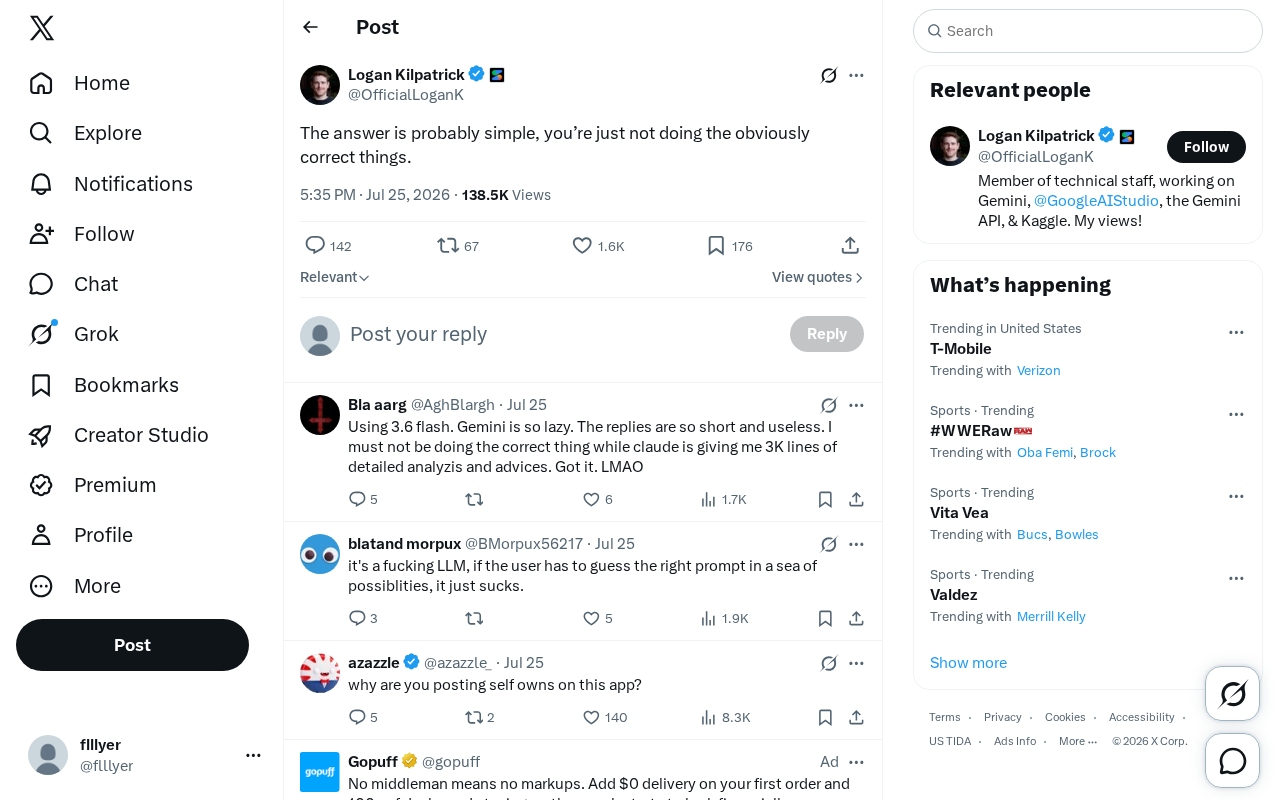
AI Not Performing Well? Start by Getting These Simple but Often Overlooked Things Right
When your AI system underperforms, the problem is often not the model or algorithm — it's basic work like data cleaning, prompt writing, and evaluation that hasn't been done right.
Read more →
·3 min
AI Not Working Well? Start by Getting These Simple but Often Overlooked Things Right
When AI systems underperform, the problem often isn't the model or algorithm — it's that basics like data cleaning, prompt writing, and evaluation aren't done right. Learn the simple fixes that matter most.
Read more →

·4 min
Gemini API in Practice: Building AI Agents with Files
Google's official hands-on: how to go from idea to production fast with AI Studio and build AI Agents using the now-GA Interactions API. The core idea—Agents are just combinations of files.
Read more →

·2 min
GPT-5.6 Codex Three-Model Showdown: Sol/Terra/Luna Tested on Classic Candy Logic Puzzle
We tested GPT-5.6 Codex models Sol, Terra, and Luna on a classic candy logic puzzle. Sol scored near-perfect across HIGH and XH modes; Terra and Luna nearly failed. Here's what it means for developers.
Read more →

·3 min
GPT-5.6 Proves 50-Year Graph Theory Conjecture in Under an Hour — A Milestone for AI Mathematical Reasoning
GPT-5.6 Soul Ultra proves the 50-year-old Cycle Double Cover Conjecture in under an hour. Plus: BCI clinical breakthrough, Apple vs. OpenAI, xAI privacy concerns, and EU dark pattern rules.
Read more →
Reverse-Engineering Web Apps: A New Ap…
·3 min
Reverse-Engineering Web Apps: A New Approach to Breaking Through the API Barrier for AI Agents
Explore a new approach to AI Agent tool integration: reverse-engineering web apps to turn API-less pages into callable Agent tools, with analysis of MCP synergy and challenges.
Read more →

·7 min
Building AI Agents in Rust: The GAIA Benchmark Reveals the Capability Ceiling of Large Models
A Rust-based AI Agent evaluation framework uses the GAIA benchmark to compare GPT, Claude, DeepSeek and other models with no tools. Results show pure LLMs cap at ~25% accuracy, revealing why tool use is decisive for Agents.
Read more →

·5 min
Alibaba Bans Claude Code: Invisible Fingerprints and the AI Tool Trust Crisis
Alibaba has banned Claude Code as high-risk software. Reverse engineering revealed a covert environment-identification mechanism hiding user fingerprints in punctuation via prompt steganography. A deep dive into the incident and AI tool trust.
Read more →

·5 min
Getting Started with LangChain: LLM Invocation, Agent Practice, and Environment Setup Guide
Starting from the three limitations of LLMs, this guide systematically explains LangChain's core positioning, environment setup, API key prep, model init, and the message system. Learn init_chat_model and AIMessage/HumanMessage/SystemMessage.
Read more →

·7 min
Codex Direct Connection Configuration Guide for China: Complete GPT Agent Setup Tutorial
Complete guide for configuring OpenAI Codex Agent in China, covering installation, API key setup, permission modes, reasoning intensity, and security considerations for third-party relay services.
Read more →