#loop stacking
132 related articles
 Product Reviews
·4 min
OpenHuman Deep Dive: A Context-First Open-Source Personal AI Agent
Deep dive into OpenHuman open-source AI Agent: context-first architecture, Rust+React hybrid, Memory Tree system, Token Juice compression, and multi-model routing.
Read more →
 Industry Insights
·4 min
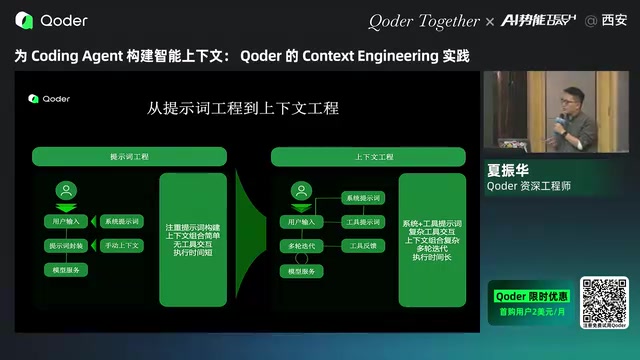
Qoder's Context Engineering in Practice: Four-Layer Retrieval Engine and Memory System Architecture
Deep analysis of Qoder's (Tongyi Lingma international edition) context engineering architecture, including its four-layer retrieval engine, memory engine, context caching, and core product design.
Read more →
 Tutorials
·2 min
Harness Engineering Deep Dive: Multi-Level Memory and Multi-Agent Collaborative Development in Practice
Deep dive into Harness Engineering: deconstructing Claude Code's multi-level memory, defense-in-depth, Hermes Agent autonomous evolution, and multi-Agent collaboration for industrial-grade AI development.
Read more →
 Tech Frontiers
·3 min
Generic Agent: A Self-Evolving AI Agent Built with Just 3,000 Lines of Code
Generic Agent builds a self-evolving AI agent with just 3,000 lines of code, 9 atomic tools, and a five-layer memory architecture — using only one-sixth the tokens of competitors.
Read more →
 Product Reviews
·3 min
AIStarter and PanelAI Architecture Upgrade Explained: The Evolution of an All-in-One AI Toolbox
Deep dive into AIStarter and PanelAI architecture upgrades covering project market, model management, AI assistant features, and pricing strategy for this all-in-one AI toolbox.
Read more →
 Tutorials
·3 min
Universal AI Prompts for Mathematical Modeling: A Zero-to-Hero Four-Stage Practical Guide
A detailed guide to the four-stage universal AI prompt system for mathematical modeling, covering problem analysis, innovative model construction, data processing, and model solving for competitions.
Read more →
 Tutorials
·3 min
PyTorch Beginner Tutorial: A Complete Guide to Tensor Operations and Neural Network Construction
A detailed PyTorch beginner guide covering tensor operations, dynamic computational graphs, GPU acceleration, and building your first neural network with nn.Module, with learning path recommendations and code examples.
Read more →
 Tech Frontiers
·2 min
Google I/O 2025 Gemini Updates Roundup: Model Upgrades, Multimodal Interaction, and AI Agent Deep Dive
A comprehensive breakdown of Gemini updates at Google I/O 2025: next-gen model upgrades, multimodal interaction, AI Agent capabilities, and competitive analysis against ChatGPT and Copilot.
Read more →
 Product Reviews
·2 min
CodeGraph Real-World Test: Can a Code Graph Indexing Tool Actually Save Tokens? The Results Were Surprising
Real-world test of CodeGraph (20k Stars), a code graph indexing tool that replaces AI file-by-file scanning with local semantic graphs. Unity project comparison reveals higher costs but significantly better code quality.
Read more →
 Tutorials
·1 min
Godot Enemy AI Tutorial: Building a Patrol and Chase System from Scratch
Build a Zelda-style enemy AI system in Godot with AI tools. Covers patrol mechanics, Area2D detection, collision layers, and chase state switching with full prompts.
Read more →
 Product Reviews
·2 min
GLM 5.1 Flagship Model Tested at 400 TPS — From Sketch to Complete App in Two Minutes
Testing Zhipu's GLM 5.1 High Speed API: a full-power flagship model at 400 Token/s. From sketch restoration to generating a complete puzzle game, verifying speed and capability combined.
Read more →
 Industry Insights
·1 min
AI Agent Token Consumption Out of Control: Budget Crises and Response Strategies from 15 Enterprises
AI Agent token consumption is growing exponentially beyond enterprise budgets. Based on 15 real cases, this article analyzes cost overrun causes and provides strategies including model tiering, semantic caching, and token governance.
Read more →
 Tech Frontiers
·2 min
Google Gemini 3.5 Launch: Frontier Intelligence Meets Action in the AI Agent Era
Google I/O 2025 unveils the Gemini 3.5 series, combining frontier intelligence with action capabilities. Deep analysis of its AI Agent breakthroughs, Google's ecosystem advantages, and competitive implications.
Read more →
 Product Reviews
·2 min
User Profile Milestones Feature Explained: Beta Testing Opening Soon
The new User Profile Milestones feature is developed and deployed, with Beta testing opening soon. Learn how gamification mechanics boost user retention and engagement.
Read more →
 Product Reviews
·2 min
Gemini 2.5 Pro Hands-On Review: How Good Is Its Frontend UI Generation?
Hands-on testing of Gemini 2.5 Pro's real performance in frontend UI generation, code writing, and task planning—from blog DevOps to immersive 3D starfield pages on the AntiGravity platform.
Read more →
 Deep Dives
·2 min
How Replit Evaluates AI Coding Agents: A Deep Dive into ByteBench Benchmark and Continuous Optimization Framework
Deep dive into Replit's dual-pillar AI Agent evaluation framework, including open-source ByteBench benchmark, Telescope semantic clustering tool, and A/B test-driven continuous iteration methodology.
Read more →
 Tutorials
·2 min
Solo Developer Building a WoW-Style RPG with AI + Unity: Skills, Pets & Commerce Systems in Action
Solo dev uses Doubao AI with Unity and Playmaker to build a WoW-style RPG. Skills (AoE/DOT), pet combat, and commerce systems already working—showcasing how AI enables one person to build an MMO.
Read more →
 Product Reviews
·3 min
Major Codex Update: A Zero-Barrier AI Coding and Automation Agent Tool
Deep dive into OpenAI Codex's latest updates: Markdown rendering, inline comments, scheduled tasks, background Computer Use and more. A beginner-friendly AI coding and automation Agent tool.
Read more →
 Product Reviews
·1 min
Claude Code G-code Generation in Practice: 3 Projects That Break Through 3D Printing Slicer Limitations
Use Claude Code to generate G-code directly, bypassing slicer limitations to achieve sine wave textures, scale vases, and creative 3D prints with Blender automation.
Read more →
 Product Reviews
·3 min
Cursor + Windsurf Two-in-One Real-World Test: Is Stacking Free Quotas Actually Worth It?
Real-world test of a Cursor + Windsurf two-in-one tool: one-click switching, free quota stacking, VPN-free access. Detailed analysis of benefits, suitable users, and security risks.
Read more →