#multi-agent RL
1310 related articles
 Tutorials
·3 min
51.8K Stars! Claude Code Best Practices: A Complete Guide from Getting Started to Agent Engineering
Deep dive into the 51.8K Star Claude Code best practices project on GitHub, covering Prompt Engineering, efficient Web Coding, multi-Agent collaboration, and more.
Read more →
 Tutorials
·4 min
Vibe Coding Practical Guide: SDD Methodology Explained with 4 Enterprise-Level AI Programming Projects
Deep dive into SDD specification-driven development methodology with 4 enterprise-level Vibe Coding projects including Chat BI and multimodal knowledge bases, covering Cursor, Claude Code, and Prompt Engineering.
Read more →
 Tutorials
·3 min
Building an AI Workstation: A Layered Tool Strategy and Physical Isolation Guide
A practical guide to building an AI workstation: physical isolation with vertical screens, pyramid tool layering (Doubao/Trae/Claude/GPT-4), and real Token cost breakdowns to maximize AI workflow efficiency on a budget.
Read more →
 Expert Opinions
·4 min
Is CI/CD Dead? The Continuous Computation Architecture Revolution in the AI Agent Era
Traditional CI/CD pipelines are being shattered by AI Agents. This article analyzes the shift from PR-driven to intent-driven architecture, exploring Pre-Merge queues, stateful environments, and multiverse development as new continuous computation paradigms.
Read more →
 Product Reviews
·3 min
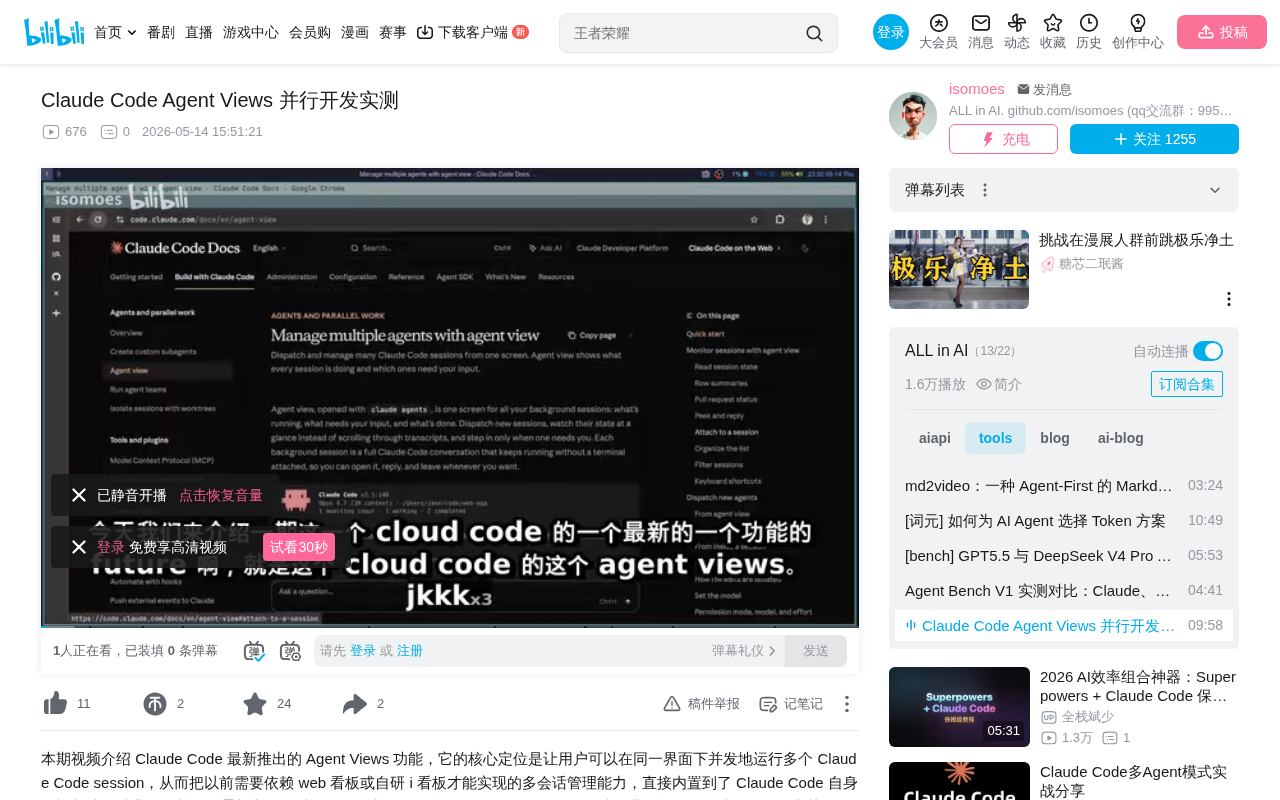
Claude Code Agent Views Hands-On: Parallel Development Experience & Pitfall Guide
Hands-on review of Claude Code Agent Views parallel development: cross-project parallel, Git Worktree multi-branch workflows, Space compact mode, plus key caveats on rate limits and Worktree merging.
Read more →
 Tutorials
·3 min
Jules MCP Server: Using the MCP Protocol to Let Claude Orchestrate Google Jules for Autonomous Coding
Jules MCP Server is an open-source project providing a production-grade MCP server for Google Jules API, enabling Claude and Cursor to orchestrate autonomous coding via multi-Agent collaboration.
Read more →
 Tutorials
·4 min
Claude Code Installation Guide: From Zero Setup to Multi-Agent Collaboration in Practice
Complete Claude Code installation guide covering environment setup, one-command install, troubleshooting, cost-saving alternatives, and multi-Agent collaboration tips for beginners.
Read more →
 Tutorials
·4 min
Complete Guide to Agent Observability: Tracing, Evaluation, and Red Teaming in Practice
Deep dive into Microsoft Foundry's Agent observability solution covering multi-Agent tracing, AI quality evaluation, Red Teaming security testing, and automated prompt optimization to bridge the gap between expected and actual Agent behavior.
Read more →
 Deep Dives
·3 min
MCP Protocol Explained in 3 Minutes: The USB-C Standard for AI
A clear breakdown of MCP (Model Context Protocol): its core concepts, three standard primitives, real-world use cases, and ecosystem status. Learn how Anthropic's open-source unified tool integration standard is changing AI development.
Read more →
 Tutorials
·4 min
Browser Use Tutorial: AI Browser Automation Agent Installation, Configuration & Practical Guide
Complete guide to Browser Use, the open-source AI browser automation agent: installation, Web UI usage, code integration, architecture, and token optimization tips for automating web tasks with natural language.
Read more →
 Tutorials
·3 min
AI Agent Learning Roadmap: A Complete Guide from LangChain to Enterprise Deployment
In-depth analysis of the popular GitHub project ai-agents-from-zero, covering LangChain, LangGraph, RAG, MCP and more, with a complete learning path from beginner to enterprise AI Agent development.
Read more →
 Deep Dives
·3 min
Microsoft Magentic-UI Explained: A Human-AI Collaborative Agent Operating System
Deep dive into Microsoft's open-source Magentic-UI: a human-AI collaborative Agent platform built on AutoGen. Explore its five core capabilities, system architecture, and Human-in-the-Loop design.
Read more →
 Product Reviews
·3 min
Dify-Chat: An Open-Source AI Application Management Platform Built on Dify API
Dify-Chat is an open-source platform built on the Dify API supporting Chatflow, Workflow, deep thinking visualization, chart rendering, and more to help developers quickly deploy AI application interfaces.
Read more →
 Product Reviews
·3 min
Aix-DB Open-Source Framework: A Multi-Agent Approach to Natural Language Database Querying
Deep dive into Aix-DB: an open-source multi-agent framework using LangChain/LangGraph and MCP protocol for natural language to SQL, data analysis, and visualization.
Read more →
 Tutorials
·4 min
Building a Generative Recommendation System with Go and AI Agents: Architecture Design and Practical Analysis
Deep dive into a Go-based generative recommendation system powered by LLMs, covering three-level semantic understanding, three-layer user memory, and five-dimensional feedback design.
Read more →
 Tech Frontiers
·3 min
Inside the SJSU Hackathon Winning Projects: A Practical Guide to Building High-Impact AI Agents
Deep analysis of SJSU hackathon-winning AI Agent projects covering architecture design, core elements, and UX optimization—a practical guide from prototype to product.
Read more →
 Product Reviews
·3 min
Cursor In-Depth Review: Four Modes + Parallel Agents — Why It Remains the Best AI Coding Tool
In-depth comparison of Cursor vs Claude Code, Windsurf, Trae, and other AI coding tools across Agent modes, terminal tools, browser integration, parallel processing, and context management.
Read more →
 Tutorials
·3 min
Commercial AI Agent Development Guide: 7 Key Steps to Build from Scratch
A complete guide to building commercial AI Agents in 7 steps: requirements analysis, model selection, prompt engineering, Dify/Coze platform comparison, data storage, testing, and deployment.
Read more →
 Deep Dives
·4 min
The Four Stages of AI Agent Evolution: A Complete Guide from Copilot to Multi-Agent Collaboration
Deep dive into the four stages of AI Agent evolution: Chat, Copilot, Agent, and Agentic AI. Covers ReAct framework, Spring AI stack, and multi-Agent architecture design for 2025.
Read more →
 Deep Dives
·3 min
Claude Code Source Code Leak Revealed: Seven Core Mechanisms of the Harness Architecture Explained
Deep analysis of the Claude Code source code leak, revealing seven core mechanisms of its Harness architecture including context management, tool call orchestration, and state tracking for AI Agent developers.
Read more →