#protocol translation proxy
38 related articles

·4 min
Foundry VTT Public Access Guide: The Right Way to Securely Expose Self-Hosted Services
Learn how to securely expose Foundry VTT to the public internet. Compare port forwarding, Cloudflare Tunnel, and reverse proxy solutions with practical advice on network isolation and layered defense.
Read more →

·6 min
Hands-On with Panel AI On-Premises Deployment: One-Click Enterprise Adoption and Unified Compute Cluster Scheduling
In-depth review of Panel AI v1.1.1: second-level installation, no-public-IP networking, batch compute cluster management. Learn how enterprise AI on-premises deployment barriers are dramatically lowered.
Read more →

·3 min
Free Claude Opus 4.6 Access: Complete Guide to Connecting Antigravity via CLIProxyAPI
Use CLIProxyAPI to connect Antigravity's free models to Claude Code, Cline, and more. Access Claude Opus 4.6 Thinking and Gemini 3 Pro at zero cost. Full setup guide included.
Read more →

·2 min
Claude Code with Open-Source Models: Why Cache Misses Happen and How to Fix Them
Why Claude Code cache misses occur with DeepSeek and MiniMax, how Prompt Cache and KV Cache work, and practical solutions including API proxy layers and stable prefix strategies to cut AI coding costs.
Read more →
·5 min
Practical AI Cost Optimization: A Deep Dive into Intelligent Routing and Context Compaction
AI bills keep soaring? This article breaks down two core cost-reduction strategies: intelligent routing via an LLM Gateway, and context compaction to cut Token usage—no major refactoring needed.
Read more →

·7 min
Unity Custom MCP Tool Development Guide: Enabling AI Agents to Precisely Control the Editor
Learn how to develop custom tools based on the Unity MCP Relay Server, enabling AI agents like Cursor to directly control the Unity editor. Covers setup, tool building, parameter validation, and MCP Pro comparison.
Read more →

·5 min
Connecting DeepSeek V4 in VSCode: Complete Claude Code Plugin Setup Tutorial
Shrinking GitHub Copilot student benefits? Learn to install the Claude Code plugin in VSCode and connect the DeepSeek V4 API via CCSwitch—powerful Agent capabilities at 25% price, no IDE switch needed.
Read more →

·6 min
Databricks Agent Framework in Practice: A Guide to ChatAgent Wrapping and Production Deployment
A deep dive into Databricks Agent Framework (Mosaic AI): unify LangGraph/OpenAI agents via ChatAgent, log & evaluate with MLflow, version with Unity Catalog, and deploy Model Serving Endpoints for production AI agents.
Read more →

·7 min
From Vibe Coding to Engineered AI Programming: A Practical Guide to Enterprise Development
AI coding tools are changing development, but Vibe Coding hides risks in code quality and maintenance. This article explores Engineered AI Programming, compares Codex and Claude Code, and reveals real enterprise development paths.
Read more →

·7 min
HuggingFace Open-Sources ml-intern: An AI Engineer That Reads Papers and Trains Models Autonomously
Hugging Face's open-source ml-intern autonomously reads papers, writes training scripts, and finetunes LLMs, deeply integrating the HF ecosystem and smolagents. Explore its features and impact on ML careers.
Read more →
·7 min
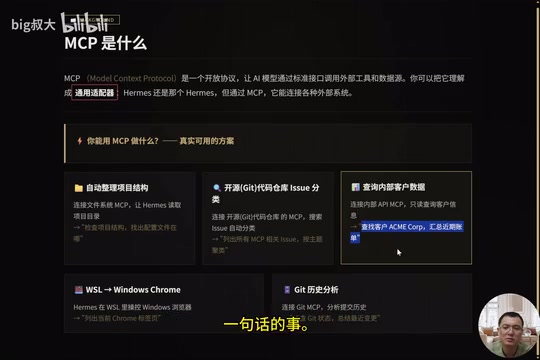
Connecting Hermes Agent to MCP: One Protocol to Unify All External Systems
Learn how to extend Hermes Agent's external system capabilities via MCP (Model Context Protocol): setup, whitelist permissions, WSL-to-Chrome bridging, and multi-server orchestration for AI Agent developers.
Read more →

·6 min
Claude Code Chinese Guide: A Complete Path from Zero to an Efficient Workflow
A systematic Claude Code learning guide built for Chinese developers, covering ten core modules including Slash Commands, Memory, MCP, and Hooks, with a three-tier path to build an AI coding workflow in 11–13 hours.
Read more →

·7 min
Otari: A Comprehensive Look at the Open-Source LLM Control Plane Tool
An in-depth analysis of the open-source LLM control plane tool Otari—covering unified multi-model access, cost observability, and security compliance governance to help teams build manageable, production-grade AI infrastructure.
Read more →

·3 min
AI Agent Architecture Decoded: An Engineering Guide from Conversations to Automation
A deep dive into the four-layer engineering design of AI Agents: planning, memory, tool use, API cost optimization, MCP protocol integration, and Skill encapsulation.
Read more →

·4 min
Using Codex in China with Zero Barriers: A Complete DeepSeek Alternative Tutorial
No ChatGPT Plus? No problem. Learn how to use Codex in China via Codex++ and DeepSeek API in 5 simple steps — starting for as little as ¥10.
Read more →

·6 min
Dify Self-Hosted Deployment in Practice: Building an Enterprise-Grade AI Application Platform from Scratch
A complete guide to self-hosting Dify, the open-source AI platform: environment setup, Docker Compose deployment, LLM integration, and app building. Runs on just 2 cores and 4GB RAM.
Read more →
Developer's TTS API Selection Guide: O…
·3 min
Developer's TTS API Selection Guide: OpenAI vs. ElevenLabs vs. Grok vs. Cartesia
Deep comparison of TTS APIs: OpenAI, ElevenLabs, xAI Grok, and Cartesia — covering audio quality, latency, pricing, voice cloning policies, and AI Gateway architecture to help developers find the right fit.
Read more →

·4 min
Dify Beginner's Guide: Interface Overview & Complete Docker Self-Hosted Deployment Guide
Complete guide to Dify's four core modules (Explore, Studio, Knowledge Base, Tools) with step-by-step Docker self-hosted deployment instructions for building production-grade AI apps.
Read more →

·2 min
API Aggregation Proxy Platforms: Call All Major AI Models Through a Single Interface
Explore API aggregation proxy platforms that let you call GPT, Claude, DALL·E and more through one unified interface. Includes GPT-Image-2 testing at just $0.006 per call.
Read more →

·4 min
7-Step Framework for Deploying Commercial AI Agents: From Requirements to Production
A detailed 7-step guide to building commercial AI Agents, covering requirements, platform selection (Coze/Dify/FastGPT), prompt engineering, databases, UI, testing, and deployment.
Read more →