#ChatGPT Codex review
320 related articles

·3 min
AI Project Memory Systems: Building a Continuously Accumulating Context Architecture in Four Stages
As models get stronger, why does the experience feel worse? The root cause is missing context. This article breaks down four stages—project descriptions, progressive disclosure, intra-memory, and three guardrails—to build a sustainable AI project memory system.
Read more →

·2 min
Claude Desktop's Record Skill: Demonstrate Once, and AI Handles the Repetitive Work Automatically
Claude Desktop's new Record Skill: no prompt writing needed—just record a demo once, and AI learns and reuses the entire workflow. Two real-world cases explained.
Read more →

·2 min
Codex Hands-On Tutorial: Generating MG Animation with an AI Agent in One Sentence
Get started with the Codex AI Agent from scratch: project creation, plugin config (Computer Use/Remotion), Plan Mode vs Goal Mode, and a hands-on demo of generating an MG animation in one sentence.
Read more →

·2 min
Codex Hands-On Tutorial: Generate MG Animation with an AI Agent in One Sentence
Get started with Codex AI Agent from scratch: project creation, plugin setup (Computer Use/Remotion), Plan Mode vs Goal Mode, and a hands-on demo of generating MG animation in one sentence.
Read more →

·1 min
Getting Started with Claude Code: Comparing AI Coding Tools and Choosing the Right One
An in-depth look at Claude Code's key strengths: full-project context reading and automatic debugging. Compare Cursor, Trae, Codex, and more to find your ideal AI coding assistant.
Read more →

·3 min
The AI Coding Landscape: Model Tiers, Tool Camps, and a Deep Dive into MCP/Skills/CLI
A systematic map of today's AI coding landscape: the evolution from ChatGPT to Claude Code, LLM capability tiers, tool camps like Cursor/Copilot, and the three key weapons of the Agent era — MCP, Skills, and CLI.
Read more →

·4 min
OpenAI Merges Codex and ChatGPT: Deep Dive into Three New Models + Agent Workflows
OpenAI merges Codex and ChatGPT into a unified platform while launching three new models: SOUL, TERRA, and LUNA. Deep dive into Computer Use, loop workflows, multi-threading, and the Agent Native strategy.
Read more →

·3 min
OpenAI Releases GPT-5.6 and ChatGPT Work: The Era of Autonomous AI Has Arrived
OpenAI launches GPT-5.6 (Sol, Terra, Luna), ChatGPT Work, a new desktop app, and Sites hosting. AI evolves from a Q&A tool into an autonomous work partner for finance, file management, and more.
Read more →

·4 min
Building an AI-Automated Topic Selection System: A Practical Guide to the Three-Dimension Method
Learn how Bilibili creator JK built an AI-automated topic selection system using Codex and Feishu — covering the three-dimension method: practice, trending topics, and benchmarking.
Read more →
ChatGPT Work Deep Dive: The Cloud-Loca…
·3 min
ChatGPT Work Deep Dive: The Cloud-Local Split and What It Means for Users
ChatGPT Work runs in the cloud on web/mobile but accesses local files on desktop — and they don't sync. A deep dive into the split design, UX tradeoffs, and broader AI agent challenges.
Read more →

·7 min
The Complete Guide to LLM Application Engineer Interviews: Six High-Frequency Agent Topics
A focused guide to core LLM application engineer interview topics, covering agent architecture, Multi-Agent, Langfuse evaluation, security, and RAG optimization.
Read more →

·7 min
The Complete Guide to LLM Application Engineer Interviews: Six High-Frequency Topics in the Agent Domain
A focused guide to the core interview topics for LLM application engineers, covering agent architecture, Multi-Agent, Langfuse evaluation & tracing, security, and RAG optimization.
Read more →

·7 min
Alibaba Open-Sources 2.4T Qwen Model as Chinese AI Sweeps the Global Competitive Landscape
Alibaba open-sources a 2.4 trillion parameter Qwen model and launches the Qwen Token Plan. Chinese models surge, Kimi K3 tops global rankings, and China's AI is reshaping the global competitive landscape.
Read more →

·7 min
Harness Engineering: Why a Powerful Model Isn't Enough — Here's What Really Matters
A data-deletion disaster reveals the biggest AI Agent risk: the problem isn't the model, it's Harness design. Learn context management, process standards, and permission isolation.
Read more →

·2 min
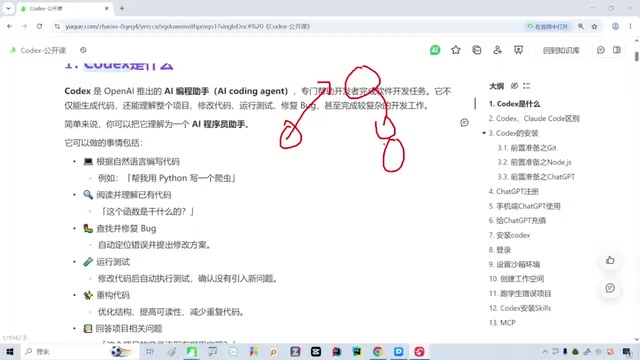
Getting Started with ChatGPT Codex: Key Differences Between an AI Coding Agent and ChatGPT
Codex is OpenAI's AI coding agent that autonomously reads code, fixes bugs, and runs tests — far beyond ChatGPT's code generation. Learn the key differences.
Read more →

·4 min
Vibe Coding vs. AI-Assisted Engineering: An In-Depth Look at Enterprise-Level Development
Can AI coding tools let non-developers replace programmers? This deep dive examines Vibe Coding's real limits, compares Claude Code vs. Codex, and reveals the methodology behind enterprise-grade AI-assisted software engineering.
Read more →

·6 min
The Complete Codex Guide: From Beginner to Pro with the All-in-One AI Assistant
OpenAI Codex is more than a coding tool—it's an AI agent that writes code, makes slides, and operates browsers. This guide covers its four versions, permission modes, plugins, automation, and six best practices.
Read more →

·6 min
GPT-5.6 Hands-On Deep Dive: Three-Tier Models + Ultra Multi-Agent, Codex Fully Evolved
OpenAI launches GPT-5.6 with three tiered models—Sol, Terra, and Luna—Ultra multi-agent parallel collaboration, Codex integrated into ChatGPT desktop, and an upgraded Computer Use.
Read more →

·5 min
The Complete Claude Code Guide: Installation, Core Features, and Advanced Workflows
An in-depth guide to Anthropic's Claude Code agentic coding tool, covering installation, pricing plans, model selection, token management, CLAUDE.md global memory, MCP integration, Subagents, and more.
Read more →
·2 min
Codex Joins ChatGPT: A Beginner's Guide to AI Coding Agents
OpenAI integrates Codex into ChatGPT. Learn what AI coding agents can do, how Codex compares to Claude Code and Cursor, and how to get started today.
Read more →