#LangChain alternative Java
29 related articles

·4 min
Beyond Vibe Coding: A Complete Guide to Enterprise-Grade AI Engineering
Hit the Vibe Coding ceiling? This guide covers the three-stage AI coding progression path, Claude Code vs. Codex, SuperPower SDD, and how to go from vibe coding to enterprise-grade AI engineering.
Read more →

·7 min
Dify Local Deployment in Practice: A Complete Guide with BT Panel + Docker
A step-by-step guide to locally deploying the open-source Dify AI platform using the BT Panel on a VMware virtual machine—covering Ubuntu setup, Docker config, and image pull troubleshooting.
Read more →

·7 min
Dify Local Deployment Guide: Full Walkthrough with BT Panel + Docker
A step-by-step guide to locally deploying the Dify open-source AI platform using BT Panel on a VMware virtual machine, covering Ubuntu setup, Docker config, and image pull troubleshooting—beginner-friendly.
Read more →

·5 min
Java Backend Interview Sprint: A Systematic Methodology From Rote Q&A to Scenario Questions
How can you prepare efficiently for a Java backend interview? This article breaks down the core methodology of "process-driven interview engineering," covering resume optimization, understanding principles, scenario analysis frameworks, and production troubleshooting.
Read more →

·5 min
Getting Started with LangChain: LLM Invocation, Agent Practice, and Environment Setup Guide
Starting from the three limitations of LLMs, this guide systematically explains LangChain's core positioning, environment setup, API key prep, model init, and the message system. Learn init_chat_model and AIMessage/HumanMessage/SystemMessage.
Read more →

·6 min
GPT-5.6 Now Widely Available: The Era of Three-Tier Models and Multi-Agent Orchestration Arrives
OpenAI releases GPT-5.6 (SOUL/TERRA/LUNA), with Ultra mode running four agents in parallel; Meta launches Muse Spark 1.1 with million-token context; ChatGPT desktop unifies Chat, Work, and Codex.
Read more →

·4 min
Tencent Open-Sources Agent Memory: A Fully Local AI Long-Term Memory Solution with Zero External Dependencies
Tencent Cloud open-sources TencentDB Agent Memory — a fully local AI Agent memory system with a 4-tier progressive pipeline, zero external API dependencies, and 8,100+ GitHub Stars. Ideal for finance, healthcare, and privacy-sensitive use cases.
Read more →

·5 min
Why Did Ollama Rise So Fast? Decoding the Success of a Local LLM Tool
How did Ollama grow from a niche open-source project into developers' default choice for running local LLMs? This article breaks down its rise across product design, technical strategy, and ecosystem building.
Read more →

·4 min
AI Coding Security: A CLI Tool Designed to Block Vulnerable Dependencies for Agents
AI coding assistants (Copilot/Cursor/Claude Code) frequently introduce vulnerable dependencies and hallucinate package names. This post analyzes an Agent-native CLI security tool and the shift-left security philosophy for AI-era supply chains.
Read more →

·7 min
Getting Started with Dify: A Complete Guide from Local Deployment to Building Enterprise-Grade AI Applications
A detailed guide to Dify, the open-source LLM app development platform, covering its core features and full local deployment via VMware + Ubuntu + aaPanel + Docker. Supports 100+ models like DeepSeek and ChatGPT to build enterprise AI apps fast.
Read more →

·3 min
Getting Started with Codex: A Deep Dive Comparison of AI Coding Agents vs. Claude Code
A deep dive into AI coding agents like Codex and Claude Code — real-world comparisons, MCP protocol explained, and how these tools are transforming programming for developers and beginners alike.
Read more →
·7 min
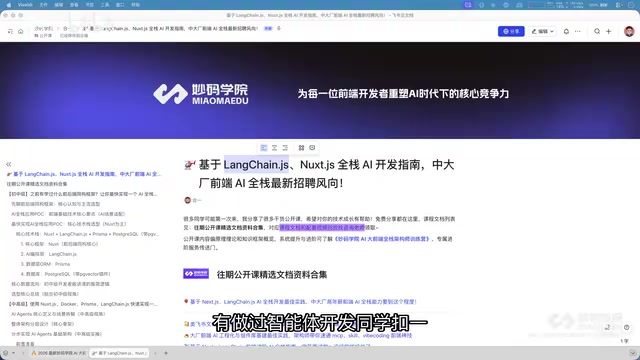
LangChain.js + Nuxt.js: An AI Full-Stack Advancement Path for Frontend Engineers
Frontend hiring now treats AI capabilities as a core assessment, covering RAG knowledge bases, AI Agent development, and LangChain.js engineering. Learn how LangChain.js + Nuxt.js helps frontend developers build memory- and retrieval-capable AI full-stack apps.
Read more →

·7 min
Electron + LangGraph in Practice: Building an AI Agent Visual Orchestration App from Scratch
A hands-on guide to building an enterprise-grade AI Agent workflow orchestration app with Electron Forge and LangGraph, covering local LLM deployment (Qwen3-0.6B), node-based visual canvas design, and full Function Calling integration.
Read more →

·7 min
Learning Python from Scratch: A Complete Guide to the Three-Stage Learning Path
Want to learn Python from scratch but don't know where to begin? This article breaks down three stages—basic syntax, advanced mastery, and hands-on practice—with real projects in crawling, automation, and data analysis to help you build programming thinking.
Read more →

·4 min
Frontend to Full-Stack AI: A Complete NestJS + LangChain Roadmap
Pure frontend roles are shrinking fast. Learn how mastering NestJS and LangChain AI agent development can unlock a 20–30% salary boost on your full-stack AI transition path.
Read more →

·2 min
AIVenture: Master Agent Development and Vibe Coding Through a Dungeon Game
AIVenture is an open-source retro dungeon game by Google that teaches Vibe Coding, agentic workflows, and tool calling through playable levels. Built with Angular, Phaser.js, and Gemma.
Read more →

·3 min
Claude Account Banned? A Complete Test of Chinese Domestic Agent Alternatives
Claude bans disrupting your workflow? We tested GLM-5.2 + WorkBuddy across dev, office, and research tasks. Here's whether domestic AI can truly replace Claude.
Read more →

·3 min
The Ultimate Ollama Guide: A Complete Walkthrough for Running AI Models Locally
Complete Ollama guide: install and run open-source LLMs like DeepSeek, Llama, and Qwen locally on Windows/Mac/Linux. Free, private, and beginner-friendly.
Read more →

·2 min
Spring AI vs LangChain4j: A Comprehensive Comparison of Java AI Frameworks
In-depth comparison of Spring AI and LangChain4j covering ecosystem integration, features, usability, RAG, Tools, MCP, and Agents to help Java developers choose the right AI framework.
Read more →

·4 min
Spring AI vs LangChain4j: How to Choose a Java AI Framework
In-depth comparison of Spring AI and LangChain4j — two major Java AI frameworks — covering core features, completeness, ecosystem support, and usability to help Java developers make the right choice.
Read more →