#LangGraph deployment
346 related articles

·2 min
AI Agents 101: The Core Difference Between LLMs and Agents, and How They're Built
What is an AI agent? How does it differ from a large language model? Learn the core concepts, the Agent formula (LLM + Workflow + Knowledge Base), and how to choose between Dify, LangChain, and LlamaIndex.
Read more →

·3 min
Agent Infinite Loop Engineering Guide: Detection, Breaking, and Root Cause Analysis
How to handle Agent infinite loops? This guide covers three-layer loop detection, four strategy-switching techniques, root cause analysis, and multi-layer fallbacks for building stable, production-grade Agent systems.
Read more →

·3 min
Enterprise AI Deployment: The Core Decision Between Ontology and Agent Architecture
A systematic guide to enterprise Ontology: its core value, tools like OntoFlow and FIBO, when to build one, and how to deploy business-domain-level AI Agents.
Read more →

·3 min
Java AI Tech Stack Explained: Framework Selection & Learning Path Guide
A complete guide to Java AI development: Spring AI, LangChain4j, Spring AI Alibaba, and AgentScope4j — framework comparisons, selection tips, and a clear learning path.
Read more →

·3 min
LangGraph Production Template in Practice: A Complete Guide to Budget Control and Canary Routing
Deep dive into langgraph-agent-stack: per-run dollar budget control, canary traffic routing, Mock testing mode, and 800+ test cases to safely deploy AI Agents from demo to production.
Read more →

·3 min
Java Developers Pivoting to AI: Why RAG Knowledge Bases Are the Best Entry Point
Traditional Java roles are shrinking while AI demand surges. Learn the three paths into AI for developers, and why RAG knowledge bases are the highest-ROI entry point for Java engineers.
Read more →

·3 min
Coze Expert Agent: A Complete 5-Step Guide to Building an AI Collaborative Team
Learn how to build a reusable AI work team in 5 steps using Coze Expert Agents — create agents, set up projects, invite members, and assign tasks efficiently.
Read more →

·3 min
DeepAgents in Practice: A Complete Guide to Building a HarmonyOS Automated Testing Agent
A deep dive into DeepAgents' core mechanisms, with a hands-on guide to building a HarmonyOS automated testing Agent — covering create_deep_agent, LangChain comparison, and long-chain task planning.
Read more →

·3 min
AI Second Brain Tech Stack: Building a Proactive Intelligent Assistant for ADHD Users
How to build a true AI second brain for ADHD users: LangGraph, n8n, RAG, vector databases, and layered architecture for a proactive personal assistant.
Read more →

·3 min
Java Developers Transitioning to AI: A Practical Guide to Building RAG Knowledge Bases
How can Java developers break into AI? This guide covers the AI application engineer career path, RAG knowledge base fundamentals, vector database retrieval, and enterprise-grade RAG challenges.
Read more →

·2 min
AI Agent Development Roadmap: A Four-Stage Guide from Zero to Production
A four-stage AI Agent development roadmap: from core theory and ReAct paradigm to multi-agent collaboration and production deployment. Covers DeepSeek, Coze, Dify, and more.
Read more →

·3 min
Coze Deep Dive: Multi-Agent Collaboration Platform Architecture and Usage Guide
Deep dive into Coze's three core capabilities: multi-person multi-AI collaboration, customizable agents, and cross-platform project management. Covers credits, Dify comparison, and a practical learning path.
Read more →

·3 min
LangChain V1.3 in Practice: Mastering AI Engineering Mindset — From Tool User to Tool Master
Why do AI results vary so dramatically? LangChain V1.3 reveals the answer: engineering mindset. Covers LangGraph, Deep Agent, RAG, Time Travel, and more.
Read more →

·3 min
AI Agent 4-Week Learning Roadmap: A Complete Guide from Zero to Independent Development
A structured 4-week AI Agent learning roadmap: Week 1 covers LLMs & Prompt engineering, Week 2 ReAct paradigms, Week 3 RAG memory systems, Week 4 multi-agent architectures.
Read more →

·3 min
Four Paths for Frontend Engineers to Level Up in AI: From RAG to Vertical Agents
How can frontend engineers transition into AI development? This guide covers four agent development directions: RAG, workflow agents, vertical agents, and general-purpose agents — with framework picks like LangChain.js.
Read more →

·2 min
AI Agent Development for Beginners: A Three-Phase Learning Roadmap
A structured zero-to-one roadmap for AI Agent development: Phase 1 covers Python & LLM basics, Phase 2 tackles five core Agent capabilities and LangChain/LangGraph, Phase 3 delivers hands-on RAG projects.
Read more →

·3 min
Waku Agent Deep Dive: The Four Core Pillars of a Local-First AI Assistant
A deep dive into Waku Agent's four pillars: Loop Engineering, three-tier Memory system, Eval assessment, and the Harness scaffold. Full walkthrough of a local-first AI assistant from task execution to memory consolidation.
Read more →

·3 min
From RAG to Agent: A Complete Architecture Guide for AI-Native Systems
A comprehensive guide to modern AI-native system architecture: LLM reasoning, three RAG paradigms (vector/knowledge graph/BM25), Agents, MCP tool calling, AI gateways, and observability for enterprise AI.
Read more →
Production-Grade LangGraph Template: A…
·2 min
Production-Grade LangGraph Template: A Practical Guide to Engineering AI Agents for Production
A deep dive into production-grade LangGraph templates covering state management, observability, error handling, and containerized deployment to bridge the gap from demo to production.
Read more →
·2 min
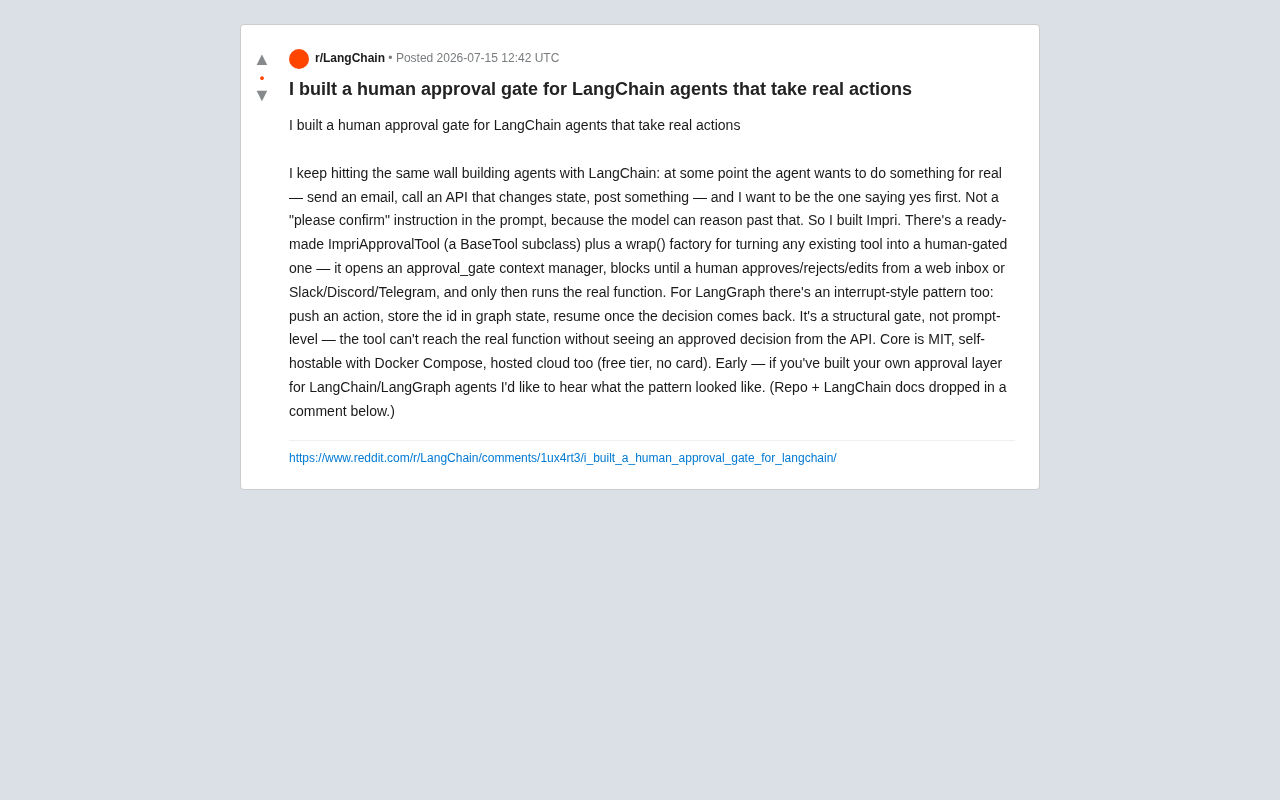
Impri: A Structural Human Approval Gateway for AI Agents
A deep dive into Impri — a structural human approval gateway for LangChain/LangGraph agents, exploring why prompt-level constraints fail and how code-layer gates enable reliable human-in-the-loop AI.
Read more →